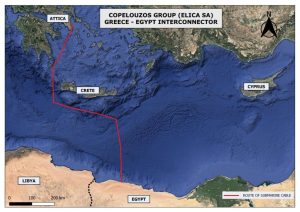
A new chapter is opening in the long-troubled Greece–Cyprus–Israel electricity interconnection project — known as the Great Sea Interconnector. The statements made on November 12 by Greek Prime Minister Kyriakos Mitsotakis and Cypriot President Nikos Christodoulides have reignited debate about the cable’s future, setting the stage for what could be a decisive turning point.
According to information from the energy ministers of both countries — Stavros Papastavrou of Cyprus and George Papathanasiou of Greece — following their meeting in Brussels with European Energy Commissioner Kadri Simson, two distinct scenarios are emerging for the project’s future.
Scenario One: Investor Entry and U.S.–Israel Momentum
As Mitsotakis and Christodoulides confirmed, the technical and financial data behind the project will be updated under the supervision of the Independent Power Transmission Operator (ADMIE), Greece’s grid operator. The goal: to attract new investors. The Cypriot energy minister noted that an external consultant will be appointed to revise the project’s techno-economic study.
This review comes in the wake of the P-TEC Energy Conference held in Athens on November 6–7, where U.S. influence shaped the discussions around energy cooperation in the Eastern Mediterranean. One key development was the revival of the “3+1” alliance — an energy partnership between Greece, Cyprus, Israel, and the United States.
Sources indicate that investment funds from the U.S. and Israel are eager to enter the project. The recent stabilization of the situation in Israel is said to have rekindled the Netanyahu government’s interest, while French investors are also reportedly exploring involvement.
If this scenario holds true, U.S. and Israeli participation could also address the security guarantees Cyprus has been seeking for the project’s implementation — a critical factor given the region’s geopolitical sensitivities.
Moreover, insiders say the project would proceed as a unified whole, rather than in separate stages. That means both the Greece–Cyprus and Cyprus–Israel segments would be built simultaneously. Some sources even suggest that to avoid friction with Turkey, work might start with the Israel–Cyprus section first.
Scenario Two: Project on Ice
The second, less optimistic scenario envisions the Great Sea Interconnector being frozen indefinitely.
The decision to update the project’s technical and economic parameters, while essential, will likely delay progress until the new studies are complete. Those who view this scenario as more probable argue that few investors would commit to a project burdened with so many uncertainties and financial risks.
If that proves true, the project — which has already tested the Athens–Nicosia relationship — could effectively be shelved, consigning it to the “Greek calends”, a phrase meaning indefinitely postponed. The diplomatic tension it stirred between the two capitals would fade, but at a cost.
Such an outcome would raise serious questions about the reliability of both Greece and Cyprus in the eyes of international investors. It could also push Nexans, the French company contracted to manufacture parts of the cable, to demand compensation from ADMIE, given that the Greece–Cyprus segment has already been constructed.
A Project Between Geopolitics and Economics
The Great Sea Interconnector was conceived as a strategic energy bridge linking the Eastern Mediterranean to the European grid, enhancing regional stability and energy independence. Yet, as geopolitical currents shift and financial pressures mount, its fate remains uncertain — suspended between renewed ambition and looming paralysis.
Whether the project becomes a symbol of regional cooperation or another missed opportunity will depend on decisions made in the coming months — and on who ultimately chooses to invest in connecting the power lines of three nations and two continents.