Greece is unwavering in its commitment to exercise its sovereign rights in hydrocarbon development, Environment and Energy Minister Stavros Papastavrou stated in a televised interview as he announced the upcoming visit of U.S. Secretary of Energy Chris Wright to Athens this November.
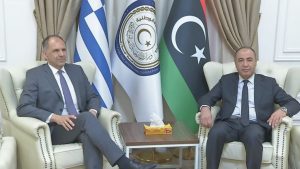
Speaking to Open TV and addressing the recent diplomatic note from Libya that disputes the maritime boundary with Greece, Papastavrou emphasized that such declarations do not affect the ongoing hydrocarbon licensing procedures being conducted by the Greek government.
“Such notes are invalid and we reject them outright, as they stem from baseless agreements,” the minister said. He also pointed out a striking contradiction in Libya’s stance, noting that although the administration of Field Marshal Khalifa Haftar challenges Greek maritime blocks, the official website of Libya’s National Oil Corporation still presents an international tender that respects the median line with Greece.
Strengthening Strategic Alliances
“In a constantly shifting geopolitical landscape, Greece defends its sovereign rights not only in theory but through concrete action,” Papastavrou stressed. He highlighted Greece’s strategic position as a member of the European Union, NATO, and currently as a non-permanent member of the UN Security Council.
With a strong reform-oriented government, solid deterrent capabilities, and robust economic growth, the country offers both opportunity and investment security, the minister stressed.
He also underscored the geopolitical significance of the upcoming visit by U.S. Energy Secretary Chris Wright, scheduled for November 6–7, which he said reinforces Greece’s role as a reliable energy and security partner.
On Migration and Libya’s Role
When asked about increased migration arrivals from Libya, Papastavrou was unequivocal: “Let’s be clear—Greece is a state governed by the rule of law. Of course, we uphold international law and global standards. But that doesn’t mean we don’t have the obligation to protect our national security, public order, and social cohesion.”
He criticized the European Union’s handling of the issue, saying: “To be honest, Europe has taken a rather introspective stance. The European Commission tried to engage, but it failed.”
He concluded with a pointed message for Libya’s eastern authorities: “Now it’s up to them—Mr. Haftar and his team must decide whether they want to align with Europe and international legitimacy, or move further away. That’s their choice.”