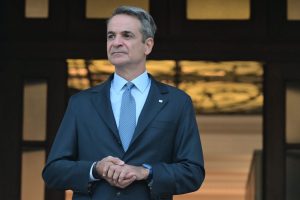
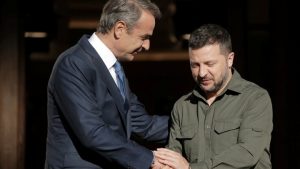
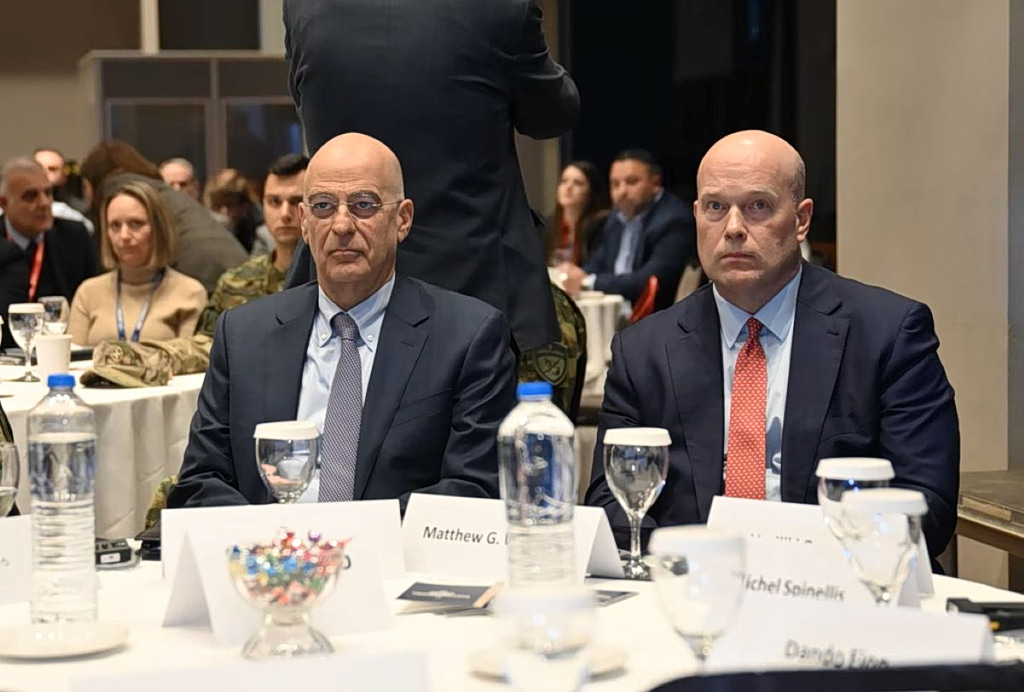
The Greek Parliament convened Thursday morning for a debate on foreign policy that quickly turned into a political showdown. Prime Minister Kyriakos Mitsotakis called for unity on national issues but delivered a speech focused on his government’s achievements, while accusing the opposition of posturing and theatrics. His remarks, which showed little introspection, provoked sharp criticism from his rivals.
Mitsotakis opened by describing Greece as “standing tall and confident,” a reliable partner in both the European Union and NATO and “a pillar of security” in a volatile region. He argued that his administration had consistently defended national interests while promoting peace and international law during what he called a period of global instability.
The prime minister spoke of a world under strain, with 61 armed conflicts currently raging across the globe, renewed power competition between the United States and China, and growing challenges such as climate change and migration. In that context, he said, Greece’s steady diplomacy, stable economy, and strong defense posture had made it a credible regional actor.
He highlighted a €28 billion (about $30 billion) modernization program for the armed forces, including Rafale and F-35 fighter jets and new French-built frigates. “We ensure stability through readiness,” he said, noting that Greece’s deterrence capability was stronger than ever and increasingly supported by its domestic defense industry.
Mitsotakis also underlined Greece’s role as an emerging energy hub for southeastern Europe. He said the country had transformed from an importer meeting only its own gas needs to a key regional supplier, with 17 billion cubic meters of natural gas now flowing annually through Greek infrastructure. The result, he said, was greater energy security for the Balkans and the wider region.
Cyprus and Greek-Turkish Relations
Addressing long-standing regional issues, Mitsotakis reaffirmed that Greece “will never recognize occupations or faits accomplis,” referring to Turkey’s ongoing military presence in northern Cyprus. “Stability in the Eastern Mediterranean cannot be restored without a just and viable solution to the Cyprus issue,” he said.
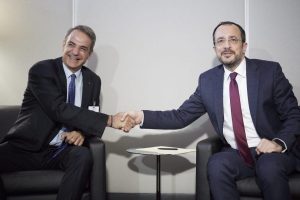
He praised what he called a “relationship of mutual trust and honesty” with Cypriot President Nikos Christodoulides and dismissed speculation about tensions over the planned Greece–Cyprus–Israel electricity interconnection cable. “Those suggesting problems or rivalries are mistaken,” he said, stressing that Athens and Nicosia remain aligned on the project’s long-term importance for regional energy security.
On Turkey, Mitsotakis struck a tone of cautious firmness. “I would urge calm among those self-styled patriots who claim to be ready for war from the safety of their couches,” he said, adding that national policy “cannot be conducted through slogans or bravado.”
He defended his decision to begin a “structured dialogue” with Ankara, coordinated directly by the two foreign ministers — Greece’s Giorgos Gerapetritis and Turkey’s Hakan Fidan — rather than through traditional exploratory talks. The effort aimed to find a framework for addressing what Athens recognizes as the sole bilateral dispute: the delimitation of maritime zones.
Optimism about the talks, which peaked in mid-2023 when relations between the two neighbors appeared to improve, has since faded. During Fidan’s visit to Athens in November 2024, both ministers publicly acknowledged that no common ground had been found, effectively freezing the dialogue. Mitsotakis did not address the setback but questioned whether anyone truly wished to return to a period of heightened tension with Turkey.
Opposition Criticism
PASOK leader Nikos Androulakis accused the prime minister of delivering “a self-congratulatory speech divorced from reality.” He said Mitsotakis’s remarks presented an idealized image of Greek diplomacy while ignoring its shortcomings.
Androulakis mocked the prime minister’s appearance at the recent Gaza peace conference in Egypt, describing the event as “a still life” and claiming European leaders, including Mitsotakis, had served merely as “decor” for former U.S. President Donald Trump’s carefully staged summit. “The world is changing rapidly, yet Europe seems content to play a supporting role,” he said.
He also criticized what he called “one-sided alignment with Netanyahu’s government” during the Gaza conflict, urging Athens to support recognition of a Palestinian state, in line with a 2015 parliamentary resolution. “There is a difference between a strategic partnership with the people of Israel and embracing ethnic cleansing,” he said.
Sokratis Famellos, leader of the left-wing SYRIZA party, accused the government of pursuing “communication, not substance” in foreign policy. He contrasted the current approach with that of the previous SYRIZA administration, which, he said, had pursued “an active, multidimensional, and assertive foreign policy” during the eurozone crisis, multiple wars, and the refugee emergency. “Back then, Greece had an international footprint,” he said.
Famellos argued that Greece was now “on the sidelines, not at the center of developments,” citing what he called its diplomatic absence from discussions on Libya, Syria, the Western Balkans, and the Middle East. He accused Mitsotakis of making Greece “a predictable client of the United States” and criticized the cancellation of a planned meeting with Turkish President Recep Tayyip Erdogan at the United Nations, calling it “a fiasco.”
On Gaza, Famellos called for the “immediate recognition of the State of Palestine” and condemned the government’s “one-sided support for Netanyahu.” He said it was “a disgrace” that Greece had not joined other nations in acknowledging “the genocide of the Palestinian people.”
While the debate continued late into the day, Mitsotakis’s appeal for unity appeared to fall flat. The session revealed once again the deep political divisions over how Greece should manage its alliances, assert its sovereignty, and navigate a region where diplomacy, energy, and security are increasingly intertwined.