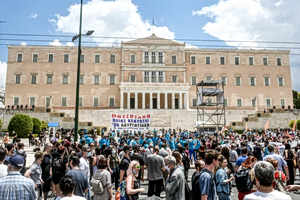
For the first time in many years—at least 15, by most estimates—mayors across Greece have decided to act as one. On December 16, the very day Parliament votes on the state budget for 2026, city halls and municipal services across the country are shutting down in a coordinated protest against what local leaders describe as the financial “strangulation” of local communities.
The move, decided by the Central Union of Greek Municipalities (KEDE), cuts across party lines and ideological divisions. From Athens and Thessaloniki to Piraeus, Patras and dozens of smaller cities, elected mayors are closing municipal buildings and gathering outside the Greek Parliament at noon, demanding administrative and financial autonomy for local government within a genuinely decentralized state.
On Wednesday, December 17, KEDE will also hold an extraordinary general assembly at a central Athens hotel, with the leadership of the Ministry of Interior present, to debate the new Local Government Code that has been sent to mayors for consultation.
“Municipalities are at breaking point”
The symbolic shutdown, says Piraeus Mayor Giannis Moralis, is not a publicity stunt. “It is a clear warning from local government, which has reached its limits,” he stresses.
“Municipalities across the country are in the red,” Moralis says. “We cannot balance our budgets. Our operating costs are not covered. At the same time, resources are being cut while new responsibilities are constantly added—without any financial support. This reality leaves no room for spin.”
Despite the government’s narrative of growth, fiscal surpluses and positive economic indicators, Moralis argues that local authorities continue to face economic suffocation. Chronic staff shortages in critical services, delays in hiring and persistent underfunding, he says, directly undermine municipal operations and, ultimately, citizens’ quality of life.
“I am not optimistic that this symbolic closure will bring immediate, tangible results,” he admits. “The government knows our demands well. They are shared by all mayors, regardless of political affiliation. They are specific, documented and have been raised for years. But there has been no real political will to meet them.”
Yet, he adds, inaction is not an option. “When the state shifts responsibilities without resources, choices become dangerously limited. In Piraeus, after nine consecutive years of reductions, it is now certain that we will be forced to raise municipal fees—not by choice, but out of necessity.”
While acknowledging that the new Local Government Code addresses some issues and that targeted funding streams exist for specific projects, Moralis insists that an immediate change in overall funding policy is essential. “Local government has been deprived of billions of euros over many years. What is needed is a bold reform that ensures genuine administrative and financial autonomy—something that exists in every advanced European country.”
“We are not asking for privileges”
“If nothing changes,” Moralis warns, “the cost will inevitably be passed on to citizens, and municipal services will fall below the standards we ourselves want to provide. That is profoundly unfair.”
Local government, he concludes, is not asking for special treatment. “We are asking for the basics: the ability to deliver projects for our communities, to support social cohesion, to manage daily life and to serve citizens with dignity and effectiveness.”
Athens mayor: “This is a fight for dignity”
Athens Mayor Haris Doukas frames the shutdown in even starker terms. “This is not a protest. It is a fight for dignity,” he says.
According to Doukas, the new Local Government Code is not a reform but a form of institutional undermining. “It effectively weakens democratic representation, abolishes the second round of municipal elections, legitimizes backroom deals and leads to easily controlled municipal administrations,” he argues. He also raises alarms over the introduction of electronic voting without sufficient transparency safeguards.
At the same time, Doukas says, the government continues to withhold legally established funds, transfer responsibilities without financing and push mayors toward raising local taxes. “In other words, citizens are asked to pay for government failures. This policy does not support cities—it weakens them and leaves them exposed to crises.”
“This mobilization is only the beginning,” Doukas warns. “We will not step back as long as the voices of local communities are ignored.”
“Without strong municipalities, there is no strong state”
Gregory Konstantellos, mayor of Vari–Voula–Vouliagmeni and first vice president of KEDE, emphasizes that the decision was collective, democratic and fully institutional. It was taken at KEDE’s recent congress, approved by its board and adopted by municipal councils nationwide.
“The reason is simple,” he says. “Once again, the state budget does not meet the real needs of municipalities or the responsibilities the state itself assigns to us. Funding remains below legally mandated levels, while austerity-era caps on municipal resources are still in place.”
He also points to serious concerns over the new Local Government Code. “When critical resources and powers are left to future ministerial decisions, local government remains dependent—not truly autonomous.”
City halls are closing for one day, Konstantellos stresses, not to inconvenience citizens, but to highlight a problem that affects them directly. “An underfunded and institutionally weak local government cannot provide reliable services, plan for the future or invest in infrastructure, prevention and social cohesion.”
“This mobilization sends a clear message,” he concludes. “Without strong municipalities, there can be no strong state.”
Widespread participation across Greece
Most municipalities have announced their participation. In Piraeus, administrative and financial services will be closed from 6:00 a.m. to 6:00 p.m., with essential staff on duty. Daycare centers will remain open, and elected officials will attend the protest outside Parliament.
In Athens, municipal services are suspended, with only emergency and civil protection operations running. Thessaloniki has announced a similar shutdown, with its mayor leading a delegation to Athens.
In Patras, demonstrations are planned both outside City Hall and at a nearby farmers’ road blockade. The municipality notes that state funding to local authorities has fallen by 60% since 2009 and demands the return of legally mandated resources and the removal of austerity-era funding caps.