The geopolitical chessboard in the Eastern Mediterranean feels like shifting sand, with Ankara keeping up a revisionist strategy that constantly tests Athens’ patience. Analyses from defense institutes and military sources agree that a military confrontation, while unwanted, remains a scenario worth considering.
Through three distinct scenarios, analysts map out how a single spark could ignite armed conflict, with a new, unpredictable factor now added to the mix: the “green” and energy standoff in the Aegean archipelago.
Set against ecology and energy
The first and most immediate scenario involves a contained, local crisis over ecology and energy. Turkey’s recent creation of “National Marine Parks” in the northeastern Aegean, in response to similar Greek environmental projects, has turned international waters into a stage for hybrid pressure tactics.
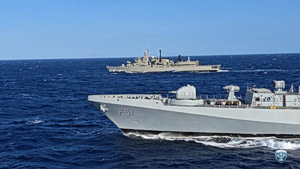
In this scenario, the trigger comes from the movement of a Greek research vessel or a cable-laying ship connecting offshore wind farms. Ankara, applying its “Blue Homeland” doctrine, intervenes with warships, claiming Athens is violating its continental shelf or zone of responsibility.
If the Greek side refuses to back down and sends naval reinforcements for protection, the situation escalates instantly. Turkey’s goal isn’t to seize territory, but to create a de facto fact on the ground that would force Greece into comprehensive negotiations over joint management of the Aegean.
Conflict spreading across multiple fronts
If a “typical” hot incident, whether from an accident or at the marine parks, isn’t defused within the first 72 hours through international diplomacy, the risk of it spreading into full-scale war becomes real.
This second scenario envisions the country’s entire defense posture being tested on multiple fronts at once.
The conflict spreads from Evros to Kastellorizo. In the Aegean, operations include large-scale air strikes, naval battles, and the use of long-range missile systems against key military infrastructure.
At the same time, amphibious operations target Greek islands. On the Evros front, the confrontation becomes a classic but bloody war of attrition involving heavy artillery, tanks, and drone swarms. In such an all-out conflict, what matters most isn’t just weapons systems, but the endurance of personnel, the adequacy of ammunition stockpiles, and Greek society’s psychological resilience under attack.
Turkish provocations in Cyprus draw in Greece
The third scenario shifts the focus outside Greek-Turkish borders, casting Cyprus as the region’s flashpoint. A new crisis on the island, triggered by Turkish provocations in the buffer zone or unilateral moves in Cyprus’s exclusive economic zone, sets things off.
A Turkish aggressive act in Nicosia forces Athens to activate its Joint Defense Space doctrine, since inaction would mean Cyprus’s total geopolitical subjugation. Greece’s military response in support of the National Guard automatically pulls the tension back to the Aegean and Evros. This is the most complex scenario, since Cyprus’s geographic distance makes direct support difficult, while the involvement of third countries and the United Nations complicates diplomatic handling. A similar scenario now also exists following any Israeli strike on the occupied part of Cyprus.
Whether it’s an “ecological” provocation at a wind farm or a full-blown conflagration, deterrent military strength and diplomatic readiness are the only safeguard. Understanding these scenarios lets Athens avoid being caught off guard, turning vigilance into a guarantee of peace.
“We’ll send frigates and F-16s wherever needed…”
Greece’s political leadership is projecting calm, diplomatic confidence, and full operational readiness, sending a clear message to Ankara that Greek strategy isn’t dictated by Turkish reactions. As tension in the Eastern Mediterranean and the Aegean brings the neighboring country’s familiar provocations back into focus, Prime Minister Kyriakos Mitsotakis and Foreign Minister Giorgos Gerapetritis laid out precisely both the “red lines” and the framework for bilateral dialogue.
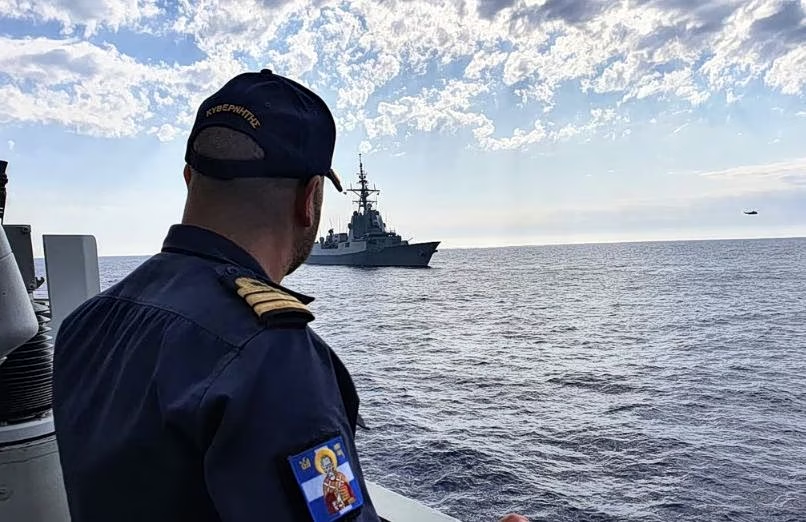
Gerapetritis stressed diplomatic strategy, again signaling readiness. He said Greece would answer provocations, and would answer from a position of strength, speaking on Open TV. Asked whether the country could face another incident like the one over the Kasos cable connecting Greece to Cyprus, he said Greece has shown it can send frigates and F-16s wherever needed, adding that if necessary, both the frigate and the upgraded F-16s would indeed be deployed.
He added that easing tensions with Turkey was never an end in itself, but a means of building a functional relationship between the two countries. Greece will keep talking with Turkey, he said, since dialogue with every neighbor is a duty, but calm waters in no way mean any retreat from Greece’s core national positions.
A dual strategy toward Ankara
Gerapetritis’s reference to a dual strategy of talking while also calling out Turkey’s actions reflects the realist character of Greek foreign policy, according to government sources. Keeping communication channels open is seen by the Greek side as the most effective tool for defusing crises and avoiding an accidental but dangerous incident in the field. At the same time, Athens makes clear that dialogue doesn’t mean tolerance. Every Turkish violation or provocation will keep being flagged and reported internationally, exposing Ankara to international bodies and to Greece’s allies.
“We’re not discussing anything beyond the continental shelf and the EEZ”
The Prime Minister set out the same position a bit later yesterday, in his remarks to the Cabinet. He said reactions from the east that follow Greece’s own actions don’t affect its planning, that areas of Greek sovereignty derive from international law, and that Greece is ready to defend them at any time. He added that Greece wants good neighborly relations with Turkey, but isn’t discussing anything beyond delimiting the continental shelf and the EEZ in the Aegean and the Eastern Mediterranean.
According to the same sources, the Greek government is sending a clear message to the international community that Greece remains a reliable partner and a pillar of stability in the region, operating strictly within the rule of law, while making clear to Turkey that its wish for peaceful coexistence and dialogue should never be read as weakness.
Greek shield after new Iranian threats against Bulgaria
Athens is on standby to once again provide anti-missile and air defense protection to Bulgaria. The move was judged necessary after new threats from Tehran against Sofia, adding to concerns over regional stability. The Defense Ministry says it’s ready to respond quickly to any formal request from the neighboring country, repeating a successful operation carried out a few months ago.
The operational plan calls for strategically moving Patriot systems to northern Greece, along with support from Greek F-16 fighter jets. The main goal is to shield Bulgarian airspace and secure its critical infrastructure, while the deployment also protects the strategic facilities at Alexandroupoli, a key transport and energy hub.