 Μake us preferred on Google
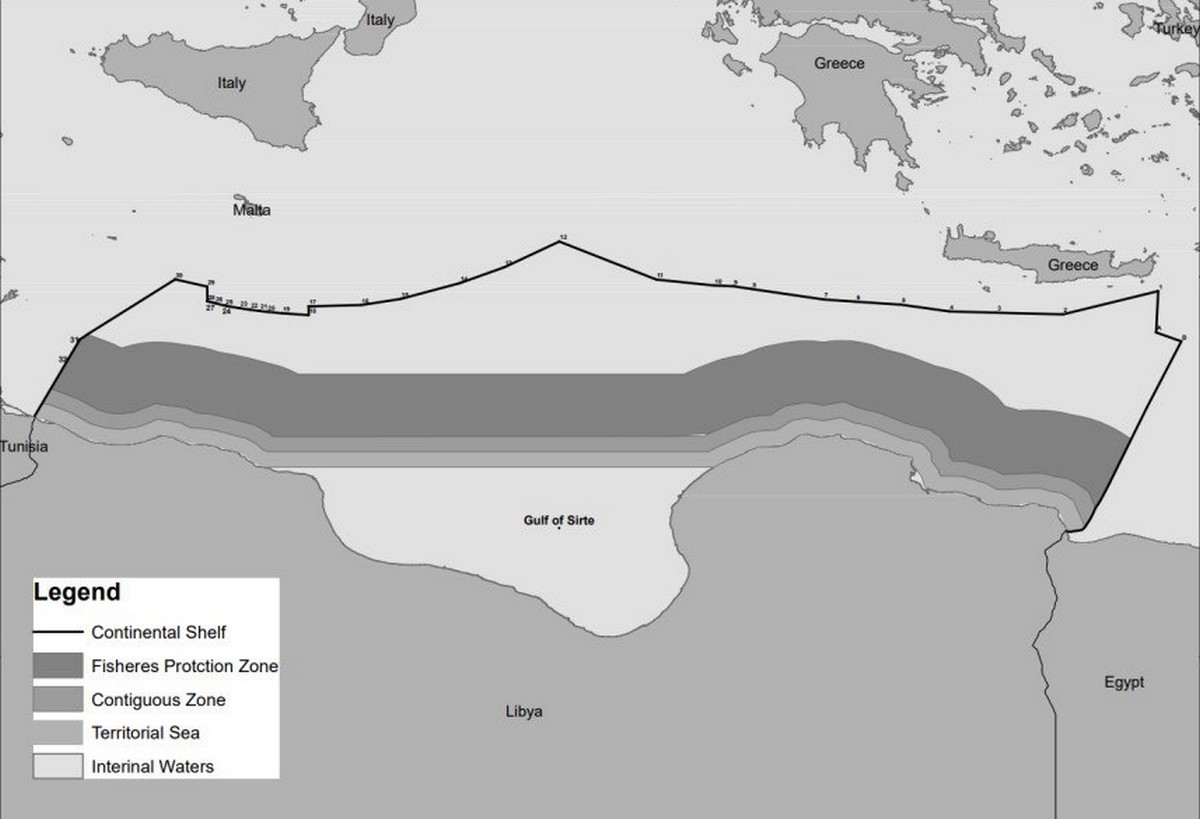
 Libya has officially submitted its claim on the outer limits of its continental shelf in the Mediterranean to the UN. The declaration, made via a note verbale on May 27, 2025, was circulated as an official document of the 79th UN General Assembly under the agenda “Oceans and the Law of the Sea.”
In the annex to the note, which includes a detailed map and a table of coordinates, Libya lays out its maritime claims and raises objections to recent activities by Greece and Egypt in the Eastern and Central Mediterranean.
Reference to the Turkey-Libya Maritime Accord
At the heart of Libya’s submission is its reaffirmation of the maritime delimitation agreement signed with Turkey on November 27, 2019 — known as the Turkey-Libya Memorandum of Understanding. The document, Libya notes, was “duly registered with the UN Secretariat pursuant to Article 102 of the UN Charter on December 11, 2019” and represents a “fair solution reached in accordance with international law.”
The Libyan government asserts that “neither Greece nor Egypt has sovereign rights” in the maritime zones established between Libya and Turkey under this accord.
Strong Opposition to Greece-Egypt Agreement
Tripoli firmly rejects the 2020 Greece-Egypt EEZ agreement as “null and void” and contrary to international law, particularly UNCLOS and the principle of equity. Libya accuses Greece of unilaterally issuing hydrocarbon exploration licenses south of Crete in April 2024, in areas it claims fall within Libyan maritime jurisdiction. It also condemns continued Greek drilling since November 2022 as violating its sovereign rights.
Libya also denounces Greece’s April 2025 Maritime Spatial Plan, claiming it encroaches on its continental shelf and asserting it holds sovereign rights under international law. Libya maintains the plan has no legal effect against it.
Protest Over Ionian Sea Declaration
In addition to disputes in the Eastern Mediterranean, Libya also objected to Greece’s April 17, 2025, declaration of an EEZ in the Ionian Sea. Libya contends that the southern boundary of this EEZ “is not equidistant between the main coasts of Libya and Greece” and that it “infringes on Libya’s continental shelf,” in violation of fundamental principles of the law of the sea.
Tripoli accuses both Athens and Cairo of “illegal and maximalist maritime claims” and demands a suspension of all exploration and drilling activities in the contested zones until maritime boundaries can be resolved through negotiation and legally binding agreements.
Coordinates and Legal Precedents
The Libyan submission details the delineation of its continental shelf from Points B and A in the east (defined in the 2019 Turkey-Libya MoU), to maritime boundaries with Italy (including Sicily), Malta, and Tunisia. These claims are said to be based on decisions by the International Court of Justice (ICJ) from 1982 and 1985.
Athens Responds: Libya’s Note “Produces No Legal Effect”
Greek diplomatic sources dismissed the Libyan démarche, asserting it “produces no legal effect.” Officials in Athens emphasized that Libya’s positions have been stated before and have already been “appropriately answered” by both Greece and Egypt.
“The international legal order is not shaped by unilateral verbal notes or the wishful thinking of third parties,” Greek sources said. “Such positions do not indicate readiness for the resumption of negotiations on the delimitation of the continental shelf and Exclusive Economic Zone in accordance with the international Law of the Sea.”
Greece, the statement added, “will continue to adhere to international law and maintain strong regional alliances that enhance its diplomatic clout.”