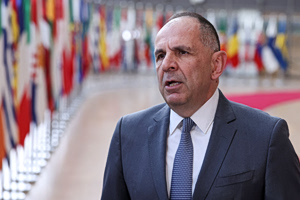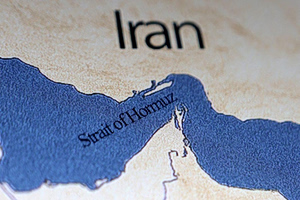
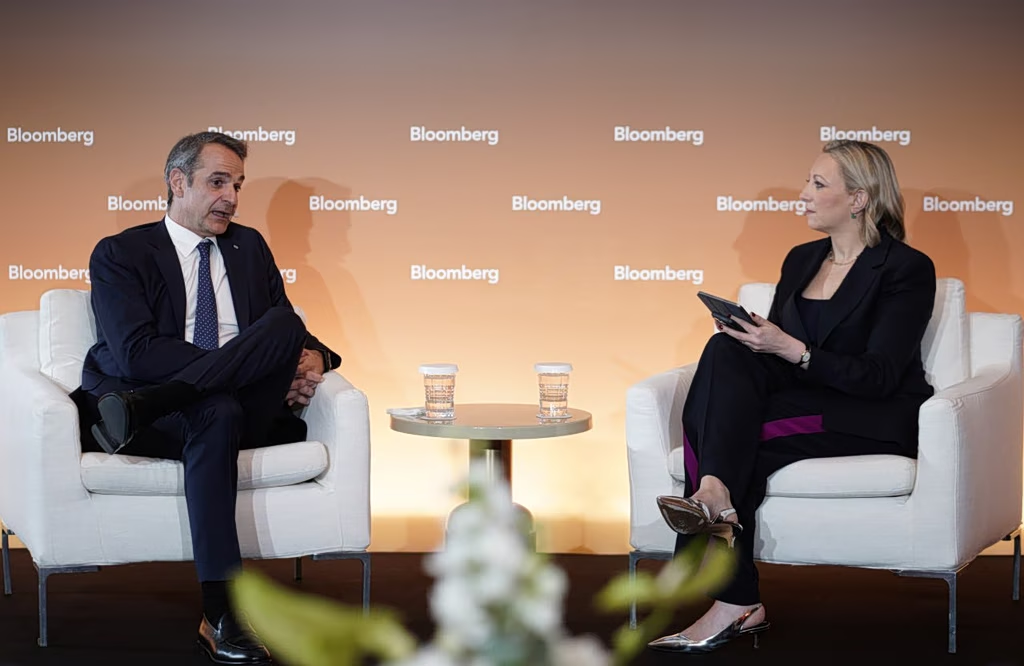
Greece will not participate in any military operations near the Strait of Hormuz, Kyriakos Mitsotakis said Tuesday, while speaking at the “Greek Energy: The New Era” conference organized by Bloomberg. The Greek prime minister struck a firm tone, signaling both Athens’ stance and what he described as limited appetite across Europe for deeper military involvement.
“The simple answer is no,” Mitsotakis said during a discussion with journalist Francine Lacqua. “Greece is not going to participate in any operation around the theater of current operations.”
He added that any such move would require a collective European decision — something he considers unlikely at this stage.
“Unless there is a European-endorsed mission, Greece will not participate on its own,” he said. “And I think the likelihood of such a mission right now is very low.”
His remarks come as President Trump increasingly mounts pressure on allies to help secure shipping routes through the Strait of Hormuz, a vital artery for global energy supplies.
Focus on Regional Defense, Not Expansion
Mitsotakis emphasized that Greece’s security focus remains firmly on its immediate region, particularly the Eastern Mediterranean. “We were the first to respond to a call for assistance from our Cypriot brothers,” he said, noting that Greece deployed two frigates and four F-16 fighter jets to support Cyprus.
He also referenced the EU’s “Aspides” naval mission — a defensive operation launched in 2024 to protect commercial shipping in the Red Sea and surrounding waters following attacks on international vessels — stressing that it has a strictly limited geographic scope and will not extend to the Strait of Hormuz.
However, Mitsotakis noted that the mission has received limited European backing beyond Greece and Italy, reinforcing his view that broader military engagement in the region is unlikely.
Europe Urged to Prepare for Prolonged Crisis
While ruling out military involvement, Mitsotakis warned that Europe must be ready for the economic and energy consequences of a potentially prolonged conflict. “No one can predict how long this war will last,” he said. “It will be very different if it lasts a few weeks versus several months.”
He called on European leaders to draw lessons from the 2022 energy crisis following Russia’s invasion of Ukraine, particularly in identifying which policy measures proved effective. “Europe needs a toolbox of short- and long-term measures ready to deploy,” Mitsotakis said, stressing the need to support households and businesses facing rising energy costs.
The prime minister also highlighted the importance of faster decision-making at the European level. He recalled that it took eight months for the European Union to agree on a cap on natural gas prices during the previous crisis. “We cannot wait that long this time,” he said, calling for quicker, more targeted, and temporary interventions.
Greece, he added, would support a reduction in fuel taxes if agreed at the European level and if it does not burden national finances. Otherwise, the government will prioritize targeted support for vulnerable households, leveraging available fiscal space.
Rethinking Europe’s Energy Strategy
Looking ahead to an upcoming EU summit, Mitsotakis said the key challenge will be aligning immediate crisis-response measures with long-term structural reforms aimed at boosting industrial competitiveness.
He specifically called for a reassessment of the EU’s Emissions Trading System (ETS), arguing that its current design risks driving energy prices too high, particularly for energy-intensive industries. “Having both expensive energy and an expensive ETS at this stage is irrational,” he said. While not advocating for its suspension, Mitsotakis called for a recalibration to avoid placing excessive costs on sectors such as shipping and cement production.
He stressed that Europe must strike a balance between encouraging investment in clean technologies and maintaining industrial competitiveness.“There needs to be a realistic Green Deal,” he said. “Everything must be examined through the lens of affordability.”
Sources: Bloomberg, OT.gr