France marked Bastille Day on Tuesday with its traditional military parade down the Champs-Élysées, and among the visiting leaders was Prime Minister Kyriakos Mitsotakis. Greece’s participation extended to the flypast: two Rafale fighter jets from the Hellenic Air Force’s 332nd Combat Wing flew above the avenue, meant to underscore the historic ties between the two countries.
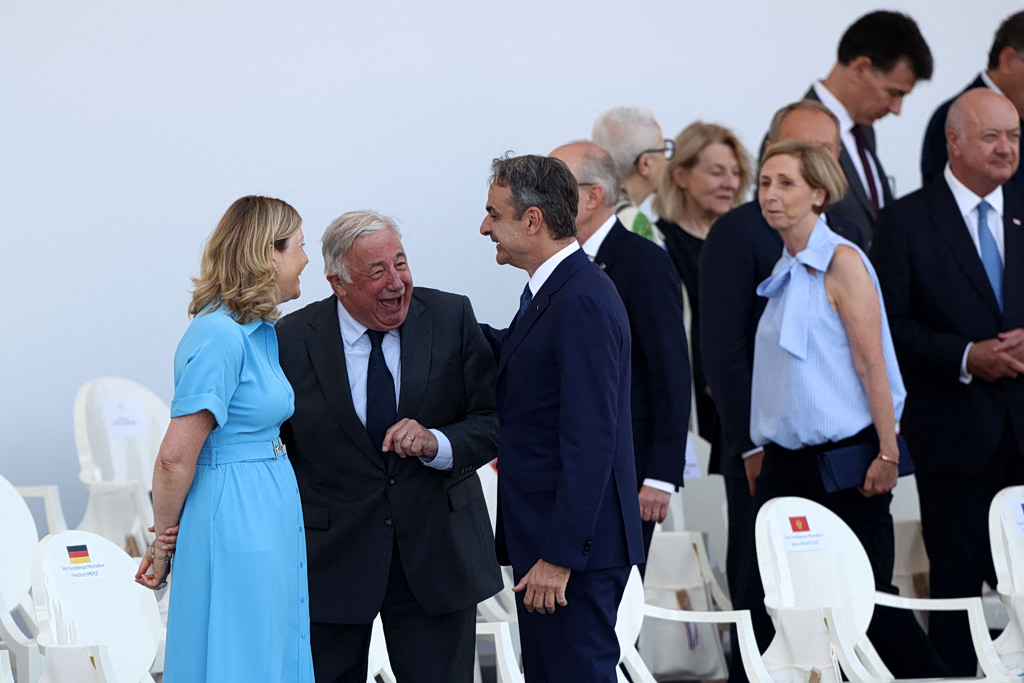
President of the National Assembly Yael Braun-Pivet, President of the Senate Gerard Larcher speak with Greek Prime Minister Kyriakos Mitsotakis before the start of the annual Bastille Day military parade on the Place de la Concorde in Paris, France, July 14, 2026. REUTERS/Tom Nicholson
Bastille Day, celebrated on July 14, commemorates the 1789 storming of the Bastille prison, a turning point in the French Revolution. The military parade is its centerpiece and one of the largest in Europe. This year’s edition was substantial: more than 6,500 soldiers, 315 military vehicles, 98 aircraft, 31 helicopters and 193 horses.
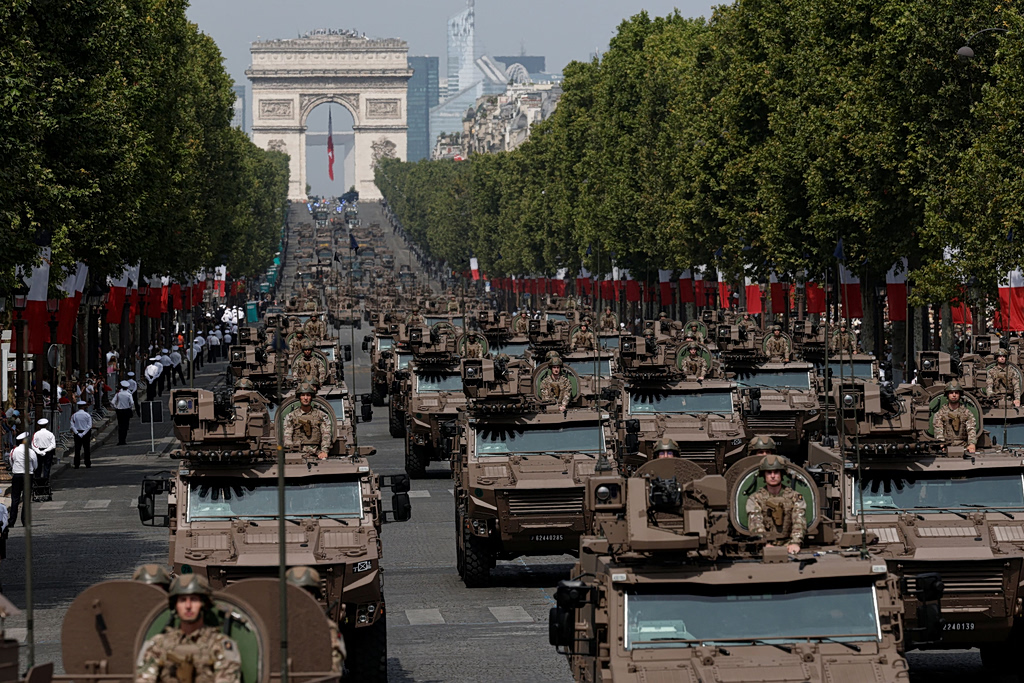
Vehicles of the French 9th Marine Infantry Brigade drive down the Champs-Elysees avenue during the annual Bastille Day military parade in Paris, France, July 14, 2026. REUTERS/Benoit Tessier
Opening the procession was a contingent of 500 troops drawn from countries in the “Coalition of the Willing,” the French-British initiative that has pledged military support to Ukraine. Their presence was a deliberate signal, meant to project deeper European defense cooperation and the strategic autonomy championed by French President Emmanuel Macron. It also tied the parade to the summit unfolding the same day in Paris, where Mitsotakis and other leaders had gathered.
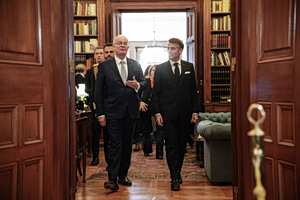
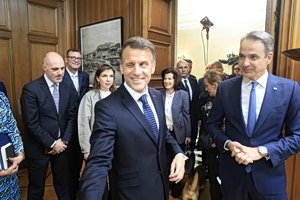
Macron received Mitsotakis at the start of the day, and the two leaders spoke briefly. The Greek prime minister was expected to reiterate Athens’ consistent support for Ukraine, while stressing that European security, close coordination with allies, and the preservation of transatlantic cooperation remain preconditions for that support.
A summit focused on Kyiv
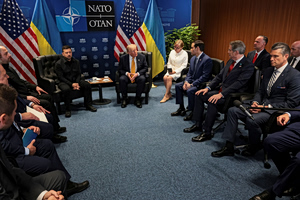
That message aligned with the broader purpose of the gathering. The coalition brings together mostly European nations that have committed to backing Ukraine militarily, including the potential deployment of troops on the ground once the war ends, as a deterrent against any renewed Russian attack. The 37 countries that took part reaffirmed their intention to support Kyiv “faster and more strongly,” in order to pressure Russia toward negotiations.
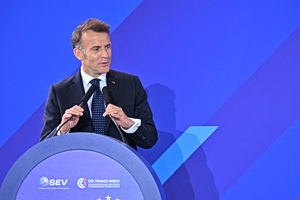
“We are determined to keep supporting Ukraine even faster and more strongly,” Macron said as the summit closed. German Chancellor Friedrich Merz added that it was time to end what he called the needless bloodshed in Ukraine. Around 20 heads of state and government gathered in Paris, among them outgoing British Prime Minister Keir Starmer and Poland’s Donald Tusk, with Ukrainian President Volodymyr Zelensky also present.
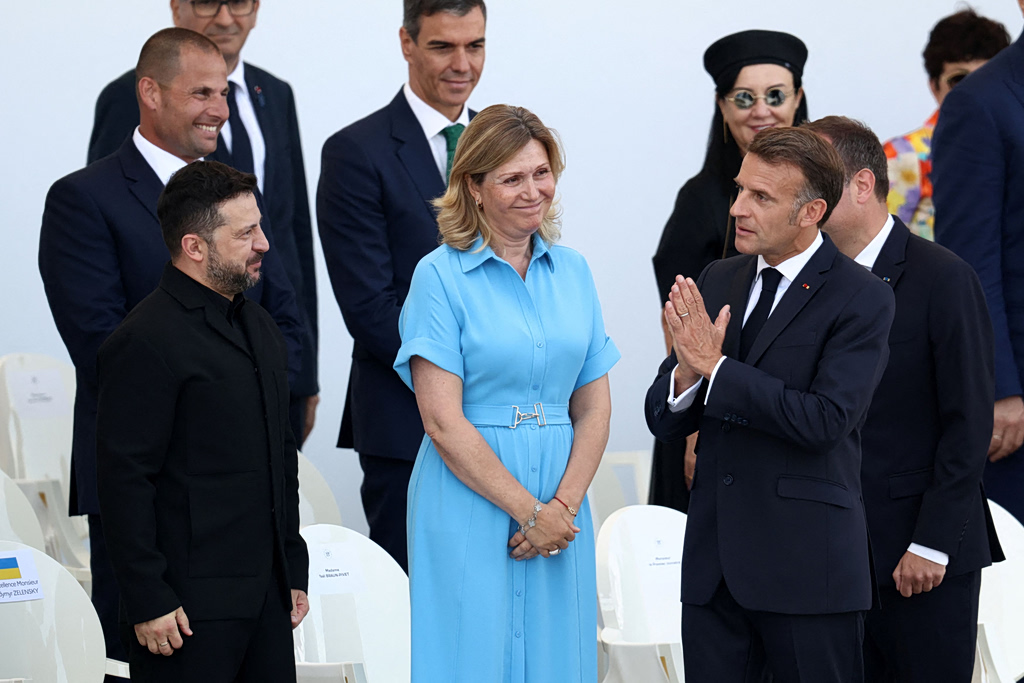
French President Emmanuel Macron shakes greets Ukraine’s President Volodymyr Zelenskiy as President of the National Assembly Yael Braun-Pivet looks on during the annual Bastille Day military parade on the Place de la Concorde in Paris, France, July 14, 2026. REUTERS/Tom Nicholson
Nine European countries went further, forming what they described as a purely defensive coalition with Ukraine to develop anti-ballistic capabilities. In a joint statement, the leaders of Denmark, France, Germany, Italy, Norway, Spain, Sweden, Ukraine, the Netherlands and Britain said the aim was to build a shared European capability against ballistic missiles, adding that the effort was not directed against any people but intended for their own defense.
Zelensky presses for air defenses now
Zelensky called it a historic day and repeated his appeal for more air-defense systems to counter the Russian ballistic and hypersonic missiles striking his country daily. He said Ukraine and its partners could produce an anti-ballistic missile within 12 months, promising mass, low-cost production, but insisted Kyiv needs defensive means immediately. He explained that Ukraine requires 100 Patriot missiles each month, a figure that rises to 300 during winter.
Macron announced that France would deliver 16 Rafale fighter jets to Ukraine, with the first ready in 2028 to 2029. He said Kyiv would also receive radar and a first battery of the new-generation SAMP/T air-defense system, a French-Italian design, and that Ukraine would be licensed to manufacture AASM bombs and Aster 30 and Scalp missiles.
The multinational force to be deployed in Ukraine after the war would hold military exercises in neighboring countries in the coming months, Macron said. He added that European nations would step up cooperation against Russia’s so-called shadow fleet, the network of vessels that allows Moscow to bypass sanctions and finance its war effort.