 Μake us preferred on Google
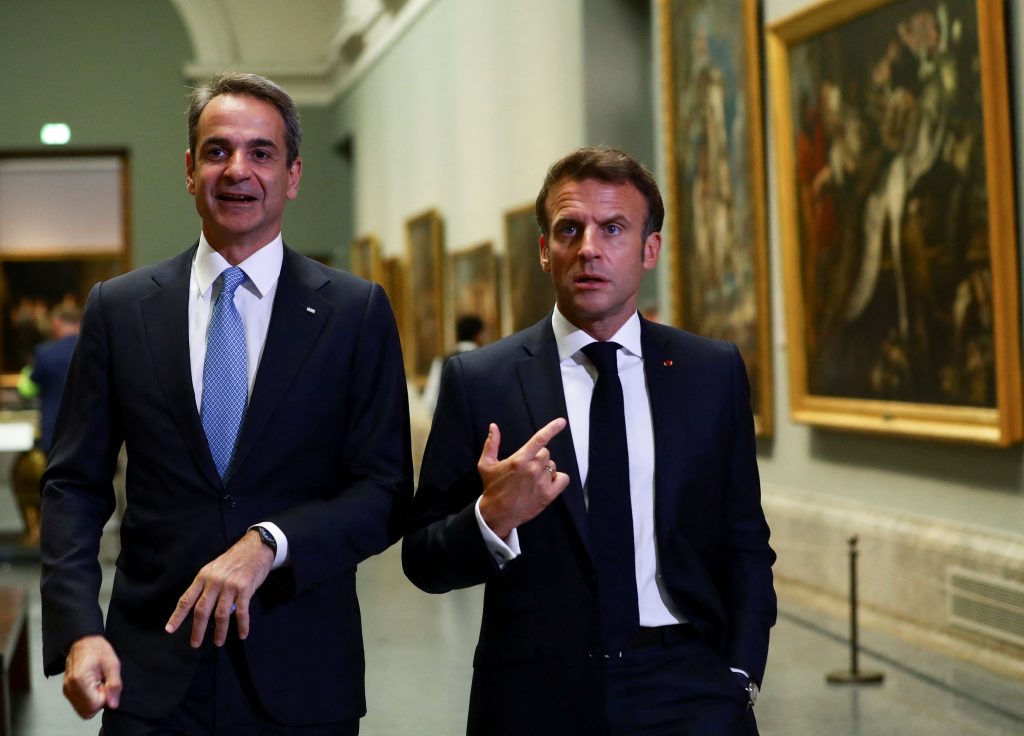
 French President Emmanuel Macron voiced firm backing for Greece during a public discussion with Prime Minister Kyriakos Mitsotakis in Athens on Friday, stressing that Paris would stand by Athens if its sovereignty were threatened.
Speaking at a livestreamed event from the Roman forum (agora) archaeological site, in the shadow of the Acropolis, Macron made clear that Franco-Greek ties go beyond rhetoric. He pointed to France’s stance during past regional tensions, including in the eastern Mediterranean and Cyprus, arguing that real alliances are proven in moments of crisis, not in declarations.
Macron indicated that France would be present if Greece faced threats, framing this as a matter of principle and a defining element of the bilateral defense partnership. His remarks align with France’s broader push in recent years to strengthen security cooperation with Athens.
Europe must act as a global power
The French president used the very high-profile occasion and his joint appearance with Mitsotakis to deliver a broader message about Europe’s role in an increasingly unstable world. He described the current global order as being reshaped by major powers such as the United States, Russia, and China, urging Europe to position itself as a reliable and independent force.
Macron also argued that the EU’s strength lies in its institutions and legal framework but said it must move beyond being merely predictable to becoming strategically influential. Europe, he noted, represents a major share of global trade and defense capacity when acting collectively.
Economic competition and China
Macron warned that Europe has been too slow and, at times, naive in responding to global competition—particularly from China. Among others, he cited what he called heavy Chinese subsidies and market distortions; pressure on European industries, including the automotive sector, as well as the need for fair competition rules and stronger protection of EU producers.
Macron emphasized that ensuring equal rules for all is not protectionism but a necessary response to global realities.
Lessons from Ukraine
Referring to the war in Ukraine, Macron said initial doubts about Europe’s unity proved unfounded, as EU countries quickly agreed on unprecedented sanctions against Russia. He also noted Europe’s key role in supporting Kyiv financially and militarily.
At the same time, he pointed to emerging new security formats, including cooperation with partners like the UK, Japan, and Indo-Pacific countries—sometimes outside traditional US-led frameworks—signaling a gradual move toward greater European autonomy.
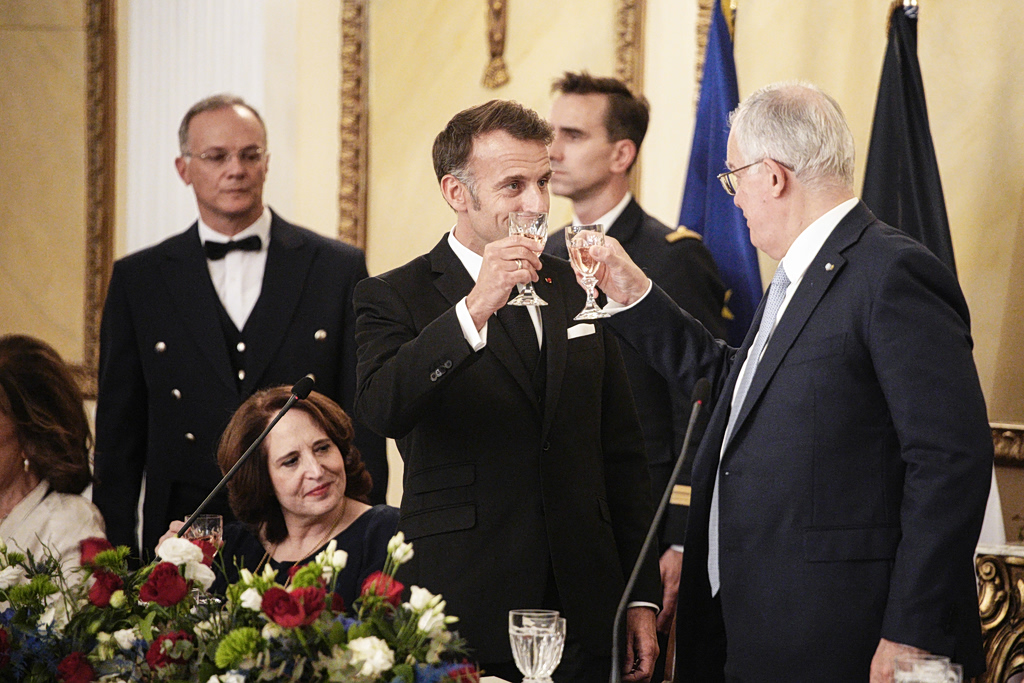
(POOL/ΜΕΝΕΛΑΟΣ ΜΥΡΙΛΑΣ/SOOC /EUROKINISSI)
Call for defense integration
Macron stressed that Europe’s fragmented defense systems—multiple standards and parallel programs—lead to inefficiency and higher costs. Along these lines, he called for joint European defense projects, simplified rules and less bureaucracy, as well as greater industrial coordination.
Greek-French cooperation
Concluding, Macron said Europe is moving away from decades of reliance on US security guarantees toward strategic autonomy, i.e. the ability to produce and procure its own defense systems.
He added that this approach would also shape bilateral projects, noting that Greece’s acquisition of French frigates will include increased participation from Greek industry.