 Μake us preferred on Google
 In one of Europe’s republics, Italy, governments used to change as often as shirts. In another, the United Kingdom, they have recently been changing prime ministers just as frequently. Belgium once needed 541 days to agree on a new coalition government, and throughout that entire period the outgoing prime minister remained in office in a caretaker capacity, even though his government had collapsed before the election—without, astonishingly enough, the country itself collapsing.
In Portugal, meanwhile, the party that finished second governed with the support of the parties that came third and fourth, in an arrangement dubbed geringonça—which, interestingly enough, means contraption or makeshift fix, not government of the defeated. Many other countries are governed through coalitions. The Scandinavians, for example, are as seasoned in coalition governments as their Viking ancestors were in the salt of the sea.
Many of these cases amount to what we call government crises. Yet nowhere is such a crisis regarded as an existential threat to the country itself—to its democracy and economy, its institutions, its public administration, and the other pillars of its political system. Nowhere has chaos been invented as the only alternative to a particular individual. It was never May or chaos, Johnson or chaos, Truss or chaos, or Sunak or chaos, until the latest prime minister happened to take office. It was simply one after another. Next, please. Not to keep the country standing, as Churchill did in wartime, but to make it better—which is every politician’s job in a democratic system during peacetime.
Above all, nowhere have all these contraptions been described as a constitutional anomaly, a distortion of the popular will, or anything similarly grandiose. Nowhere else—but here, in the country supposedly obsessed with constitutional sensitivities.
A prominent public figure remarked in a private conversation that if PASOK, which came third in the elections, were to make cooperation with the election-winning New Democracy conditional on appointing someone other than the current prime minister to head the government, that would amount to a constitutional deviation. Yes, something akin to a coup.
What if the second- and third-placed parties formed a government? Government of the defeated would be the mildest and most politically charitable description. After that, the rhetoric would escalate. One public figure would claim that such a government constitutes a clear violation of the principle of majority rule. Another would argue that the principle of the declared parliamentary majority is being undermined. A third would inevitably invoke the Apostasia—surely, somehow, it must be connected.
And that is the heart of the matter.
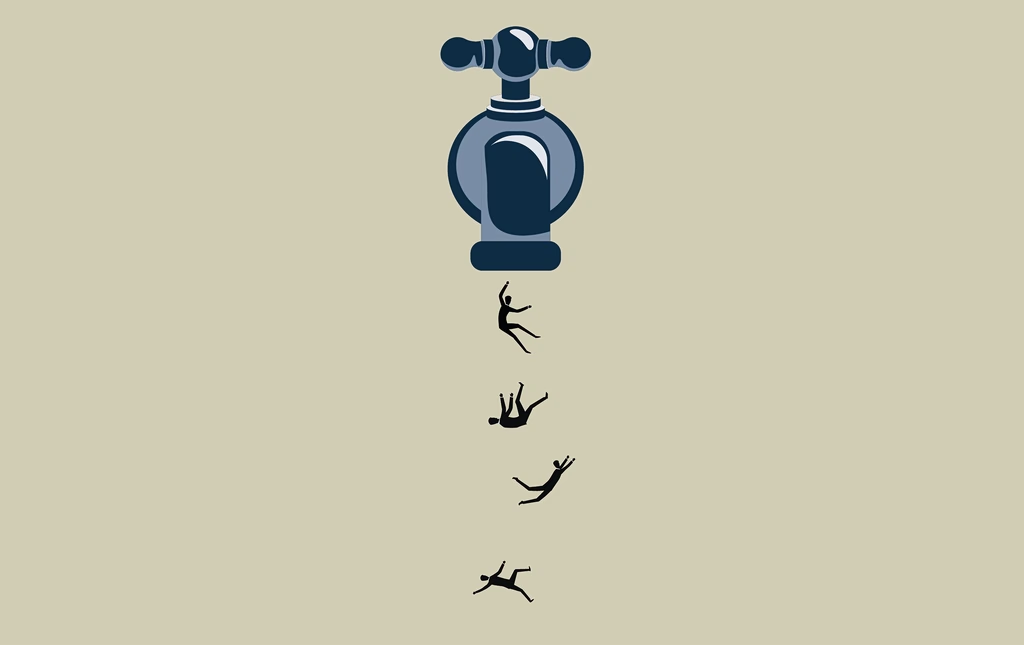
Elsewhere in democratic Europe, a government crisis has all the force of a firecracker or all the insignificance of a broken faucet. Life does not freeze in terror. The entire political system does not grind to a halt. It is not as though a nuclear bomb has exploded and a tsunami has struck at the same time.
Not here.
Seeing constitutional deviations everywhere, we still live in the era of Konstantinos Karamanlis famous post-dictatorship remark that “you don’t send a prime minister to prison—you send him home.” Politically, it was a witty line, but since then the toolbox has been enriched with all sorts of sophistries.
Should prime ministers and ministers face criminal investigations over cases of corruption or abuse of power? No, no—that would be government by judges. Besides, “vested interests are trying to bring him down” (the colloquial omission of the final syllable in the Greek word for interests is, in this context, almost obligatory).
“Political persecution,” declared two politicians in one of Europe’s democracies—France—who now wear electronic monitoring bracelets: former president Nicolas Sarkozy and far-right presidential hopeful Marine Le Pen. Yet nobody batted an eyelid, nor did the institutions begin melting like wax.
“I’ve already been buried ten times during my career. Perhaps the eleventh funeral will be free,” the far-right candidate eventually quipped, perhaps realizing that it is better to joke about your personal drama than to identify yourself with democracy itself—as though you were Marianne.
Must individuals here continue to identify themselves with democracy, normality, and stability? Must even Le Pen be the one giving us lessons in democracy?
Surely not.