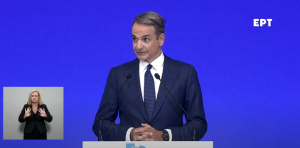
Prime Minister Kyriakos Mitsotakis is set to announce a package of measures worth more than 2 billion euros from the podium of the Thessaloniki International Fair (TIF) this Saturday, according to exclusive reporting by To Vima. The scope of the package and the timeline for rolling it out suggest the government wants to keep open the option of calling elections as early as the start of 2027.
The fair, is Greece’s largest annual trade exhibition and has become the traditional stage for the sitting prime minister’s keynote address on economic policy for the year ahead.
An early election option
Even with only limited details available so far from the Ministry of National Economy and Finance, government circles told To Vima that the sequencing of the measures leaves room for Mitsotakis to call an early election, whether prompted by geopolitical developments or some smaller, unforeseen shock. Mitsotakis has previously said he expects elections in the spring of 2027, with the government completing its full term.
Those same sources point to when beneficiaries will actually feel the impact of the measures, suggesting the most favorable window for elections could turn out to be January or early February rather than April or May.
This year’s fair, the 90th edition, is being described by government officials as a second chance TIF, a bid to win back voters and professional groups who have, according to recent polling cited by the same sources, turned away from the government to varying degrees. Those groups include the self-employed and small and medium sized businesses such as restaurants and taxi operators, which have faced steep tax bills under the presumptive taxation regime the government has been implementing, along with farmers and pensioners.
Relief on presumptive taxation, but no repeal
Presumptive taxation assumes a minimum taxable income for self employed professionals regardless of what they actually report, and the government has defended it for more than two years as a central weapon against tax evasion. The policy has proved deeply unpopular since its introduction, with professional associations, chambers of commerce and small business groups arguing that it applies a blanket standard to widely varying circumstances and pushes many professionals into paying tax on income higher than what they actually earn.
Finance Ministry circles told To Vima the system is not being scrapped. “We are not talking about dismantling it,” the sources said, noting that beyond the roughly 500 million euros it generates annually for public revenue, presumptive taxation has also pushed many professional groups toward greater compliance, a word Mitsotakis and the ministry’s political leadership have increasingly used in public remarks as they describe the improvements ahead.
According to ministry officials, the relief will apply to professionals who are linked to the digital tools of AADE, Greece’s independent tax authority, and who have a track record of paying on time. Reports that the relief could also apply retroactively to past tax years have not been confirmed.
The overall effect, officials said, would cut the roughly 500 million euros presumptive taxation currently raises each year down to about 300 million to 350 million euros, amounting to a tax refund of 150 million to 200 million euros. Officials were clear that this amounts to a reduction, not an abolition, of the system.
Advance tax payments and corporate rates
Hopes for a sharp, immediate cut to Greece’s advance tax payment requirement, under which businesses prepay a share of their estimated future tax bill, appear unlikely to materialize. Speculation had centered on a reduction from 80 percent to somewhere between 50 percent and 55 percent. Finance Ministry officials instead pointed to a four year horizon for the measures and the possibility that Mitsotakis will lay out a road map for gradually easing the burden on small, medium and larger businesses.
In practice, that means the prime minister is expected to announce a reduction in advance tax payments, but phased in over three to four years rather than all at once.
A bigger surprise could come in the form of a cut to the corporate tax rate, from 22 percent to 20 percent or lower, also phased in over four years. Separately, businesses have long pushed to reduce or eliminate the flat annual charge that every registered business must pay regardless of size. Sources said officials have been running the numbers in recent days on a gradual reduction, though a final decision is expected only at the last minute.
Support for farmers and families
The government is expected to direct much of what remains of the package toward farmers and families with children. According to To Vima’s reporting, one of the few planned VAT cuts targets baby diapers, which would drop from the standard 24 percent rate to 6 percent, while officials are also discussing further tax relief for families with three or more children.
Separately, a benefit of 150 euros per child is expected to be paid out in December to married couples and single parent households that meet the same income criteria used for a similar payment earlier this year.
Farmers have emerged as a particular political priority after months of friction with the government and signs, based on polling cited by government sources, that farm voters are drifting toward parties to the right of Mitsotakis’ New Democracy. Kyriakos Pierrakakis, the minister of economy and finance, has visited rural areas in recent weeks. On his instructions, Deputy Finance Minister Dimitris Markopoulos, who oversees tax policy, traveled to Crete, the Peloponnese, Thessaly and central and western Macedonia to meet with farmers.
Government sources said the visits confirmed the need for targeted support, aimed both at speeding up payments through the EU linked farm subsidy declaration system, and at delivering meaningful tax relief that Mitsotakis is expected to announce himself. Deputy Minister of Economy and Finance Thanos Petralias, who oversees the fiscal accounting of the measures, has played a central role in shaping the package, according to the same sources.
No 13th salary or pension, but a bigger November bonus
Officials have firmly ruled out reinstating the 13th month salary and 13th month pension for public employees, saying the state’s finances cannot support it. Even so, sources say the government plans to announce measures for public sector workers that, without formally reviving the 13th payments, move in that general direction.
Pensioners are expected to see their annual November benefit rise from 300 euros to roughly 450 euros, an amount that would slightly exceed the monthly rate of Greece’s national pension, the flat rate minimum payment guaranteed to all retirees regardless of contribution history. Sources described the scale of the planned public sector announcements as likely to surprise many.
A possible cut to rental income tax
Government officials have also left open the possibility that Mitsotakis will announce a further cut to the tax on rental income, this time benefiting landlords who collect up to 12,000 euros a year in rent. As with several other elements of the package, a final decision is expected to come only at the last minute.