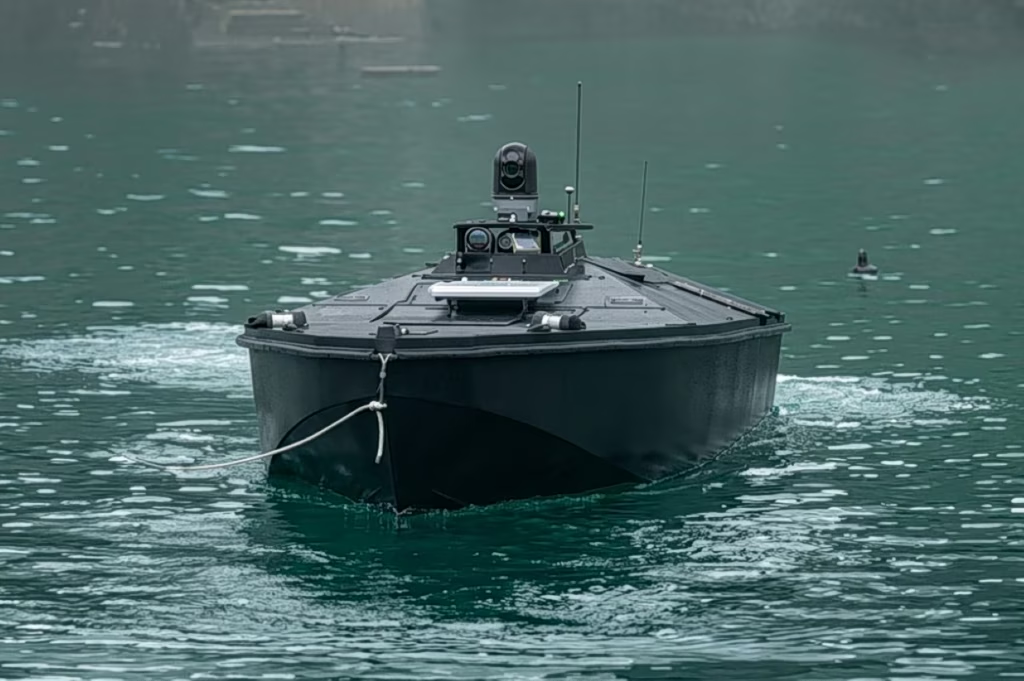
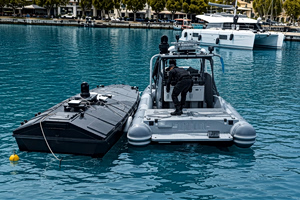
Comments made by senior NATO officials regarding the Ukrainian unmanned surface drone discovered in a cave on Lefkada, have sparked strong reactions, as the Alliance appeared to fully defend Kyiv’s use of such systems in its war against Russia.
According to the Athens-Macedonian News Agency, NATO Military Committee Chair Admiral Giuseppe Cavo Dragone was asked whether incidents involving unmanned maritime drones pose risks to navigation safety in the Mediterranean. In response, he described these methods as “typical” forms of asymmetric warfare used by smaller nations facing more powerful adversaries.
“Asymmetric warfare — you can call it unconventional or irregular warfare — is characteristic in such conflicts, especially when smaller states confront major powers,” he said, sending what many interpreted as a clear message of support for Ukraine’s tactics.
He went a step further, stating that if he were in Ukraine’s position, he too would attempt to make full use of every available capability. “I am not justifying anyone, but if I were in their place, I would try to use every available means,” he said, while adding that issues related to sovereignty and international law remain matters for political management.
At the same time, the Italian admiral sought to shift attention toward Russia’s actions, saying the international community is dealing with a power “that strikes civilian infrastructure, kills civilians, violates the borders of a sovereign state and abducts thousands of children.”
“Isn’t that asymmetric warfare as well?” he asked.
The statements were made on the sidelines of a press conference in Brussels, attended also by NATO Supreme Allied Commander Europe General Alexus Grynkewich. The discussion focused primarily on the lessons of the war in Ukraine and the rapid transformation of modern military operations.
The comments came after reports that Greece had contacted Kyiv regarding the unmanned Ukrainian sea drone discovered near Lefkada in the Ionian Sea.
Admiral Cavo Dragone argued that drones and artificial intelligence are fundamentally changing the way wars are fought, shifting the focus away from weapons systems themselves and toward decision-making speed and real-time data management.
“Drones are revolutionizing the battlefield,” he stressed, explaining that the cycle of detecting, identifying and striking targets can now be completed within seconds thanks to artificial intelligence.
According to him, these technologies enable continuous intelligence gathering and immediate operational feedback, dramatically reducing response times.
A similar assessment was offered by Admiral Pierre Vandier, head of NATO’s Allied Command Transformation, who said the war in Ukraine has demonstrated that modern military power now depends primarily on software, data and the ability to adapt technologically at high speed.
As he explained, Ukraine developed within a very short period an extremely flexible model for drone production and software upgrades. Soldiers reportedly send real-time operational data directly to manufacturers through QR codes, allowing systems to be updated within days depending on battlefield needs.
The remarks by NATO officials reflect what many now describe as the new reality of modern warfare, where unmanned systems, artificial intelligence and digital combat technologies are playing an increasingly decisive role in global military balances.