

 Μake us preferred on Google
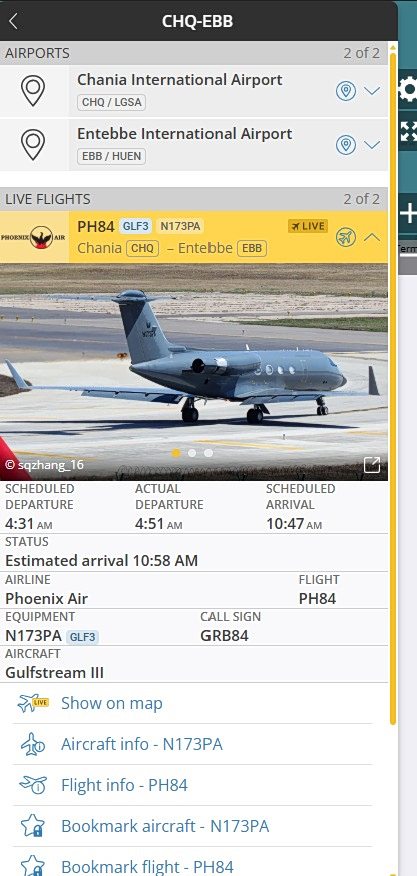
 Two specialized medical evacuation aircraft linked to international Ebola evacuation missions departed from Chania International Airport in Crete on Tuesday, according to flight-tracking data and open-source monitoring accounts. Phoenix Air Gulfstream III aircraft N163PA and N173PA were tracked leaving Chania and heading towards Entebbe, Uganda, before continuing a mission associated with the ongoing Ebola outbreak in the Democratic Republic of the Congo (DRC).
Flight-tracking data reviewed by TO BHMA International Edition shows Phoenix Air aircraft N163PA and N173PA departing from Chania and heading towards Uganda, consistent with reports that specialized medical evacuation aircraft had been dispatched to transport several high-risk contacts to Europe. However, authorities have not publicly released operational details of the transfer.
View this post on Instagram
Flight tracking data showed that Phoenix Air Gulfstream III aircraft N163PA and N173PA left Chania, bound for Entebbe, Uganda. According to the flight radar, the aircraft will return to the Greek base after a short stop on the African continent.

Earlier media reported that American missionary physician Dr. Peter Stafford, who contracted Ebola in the Democratic Republic of the Congo, was transferred to Germany for treatment at Berlin’s Charité Hospital. The US Centers for Disease Control and Prevention (CDC) said it was working to evacuate at least six other Americans who were exposed to the deadly virus. The patients are expected to be transferred to Germany and the Czech Republic.
The mission comes as international health agencies intensify efforts to contain an outbreak of the rare Bundibugyo strain of Ebola in eastern Congo. The World Health Organization has declared the outbreak a public health emergency, while U.S. authorities have mobilized resources for treatment, monitoring and contact tracing.
The Chania International Airport is located adjacent to Souda Bay, home to a major U.S. military facility that serves as a strategic hub for American operations in the Eastern Mediterranean.
Specialized Aircraft for Biological Emergencies
The two Gulfstream III jets are operated by Phoenix Air, a U.S.-based aviation company is known for conducting highly specialized aeromedical missions around the world. Phoenix Air operates global passenger and cargo charter services, supporting corporate, military and air ambulance operations.
Its dedicated air ambulance fleet includes specially modified Learjet aircraft for domestic and international missions, as well as three civilian Gulfstream G-III jets equipped with factory-installed cargo doors. The larger Gulfstream aircraft can accommodate multiple patients, oversized medical equipment and VIP transport requirements while providing a stand-up cabin for medical teams.
Both Gulfstream III jet aircraft are equipped with advanced medical systems, including intensive-care monitoring equipment, ventilators, video laryngoscopes, multi-channel intravenous pumps, suction systems, emergency medications and expanded oxygen capacity. They have an Aeromedical Biological Containment System (ABCS), a portable isolation unit developed jointly by the U.S. Centers for Disease Control and Prevention and the Department of Defense. The system allows medical teams to transport patients infected with highly contagious diseases while protecting crew members and preventing pathogen exposure.
The company says it provides medical transport services for the U.S. Department of Defense and the U.S. Department of State, having safely evacuated government personnel across the globe for more than a decade. Previously, it gained international recognition during the 2014–2015 Ebola outbreak, when it transported more than 40 infected patients using specialized biological containment systems.