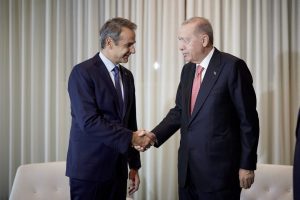
A meeting in Luxembourg between Greek Foreign Minister George Gerapetritis and his Turkish counterpart Hakan Fidan appears to have fallen short of its goal: easing tensions that have recently escalated between Athens and Ankara.
The talks were difficult from the outset. Just hours earlier, Fidan had launched a sweeping verbal attack against Greece, criticizing Athens’ insistence that Turkey’s participation in the European defense initiative SAFE be linked to Ankara’s withdrawal of its long-standing casus belli threat — a 1995 parliamentary declaration authorizing war if Greece extends its territorial waters to 12 nautical miles.
A widening divide across the Aegean
Athens’ explicit threat to veto Turkey’s participation in SAFE -arguing that Ankara is seeking access to European defense resources while threatening an EU member state with war—is steadily widening the gap across the Aegean. President Recep Tayyip Erdogan is seen as increasingly irritated with the Greek government and particularly with Prime Minister Kyriakos Mitsotakis, while the Turkish Foreign Minister openly accuses Athens of an “anti-Turkish stance” and of instrumentalizing bilateral raltions for domestic political gain.
It is certain that Fidan raised the SAFE issue directly with FM Gerapetritis, testing how far Athens would go and signaling Ankara’s strong displeasure. It is notable that in the informal briefing that followed the meeting between the two Foreign Ministers, there was no explicit mention of casus belli. Instead, the statement merely noted that “the foreign minister outlined Greece’s position regarding the European defense industry and its commitment to building a stronger, more resilient, and strategically autonomous Europe.”
Athens seeks to avoid escalation
Despite the sharp rhetoric, Greece is not seeking further escalation. Senior diplomats maintain while talking to To Vima that Athens will not change its position: Turkey’s participation in SAFE depends on its repeal of the 1995 casus belli law.
During the meeting, Gerapetritis reiterated Greece’s firm stance that it is only willing to discuss maritime boundary delimitation — not issues touching upon national sovereignty.
A frozen dialogue
Next month marks a year since both ministers publicly acknowledged that political dialogue between Athens and Ankara had effectively “frozen,” with no common ground for renewed talks that could potentially lead to some form of arbitration. Since then, there has been no setting nor a framework for discussing the legal and diplomatic disputes dividing the two countries. And there seems unlikely to be one in the immediate future.
While Fidan recently referenced past progress in exploratory talks over territorial waters between 6 and 12 nautical miles — a remark some analysts saw as a possible opening for dialogue — others interpreted it as a challenge to Greece’s sovereign right to extend its waters when it sees fit.
The 5×5 initiative in the Eastern Mediterranean
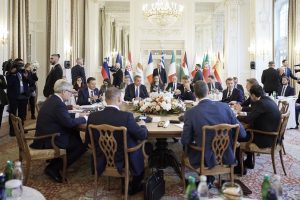
Gerapetritis also briefed Fidan on Greece’s initiative to convene a five-party cooperation framework in the Eastern Mediterranean, including Turkey. The plan aims to foster regional partnerships amid shifting geopolitical dynamics.
Despite the initiative’s slim chances of resolving the thorny issue of maritime zones, Athens appears determined to project itself as the driving force for dialogue. Ankara’s response remains uncertain, given its refusal to recognize the Republic of Cyprus and its continued pursuit of a revisionist agenda in the Aegean and Eastern Mediterranean.
Greek officials argue that by grounding its position in international law, Athens is ensuring that responsibility for the lack of progress falls squarely on Turkey — though this approach carries risks, particularly as global interest in upholding international norms wanes.
No sign of a next step
In the Greek Foreign Ministry’s post-meeting informal briefing there was no mention of any upcoming encounter between the two ministers or plans to reconvene the High-Level Cooperation Council. This absence underscores the stagnation of the Greek-Turkish dialogue, especially at the highest level.
As one diplomatic source told To Vima, “It won’t be Athens pushing for more talks with Turkey. But keeping communication channels open is crucial to prevent tensions from escalating into crisis.”
Cyprus talks may bring them back to the table?
The only forum likely to bring Gerapetritis and Fidan together again soon is the informal five-party meeting on Cyprus, which has gained renewed momentum following the election of Tufan Erhurman as the new Turkish Cypriot leader.
Athens and Nicosia now face the challenge of gauging both Erhurman’s independence from Ankara and President Erdogan’s broader intentions, given that Turkey continues to advocate for a two-state solution on the island.