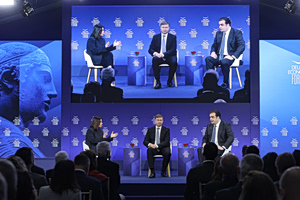
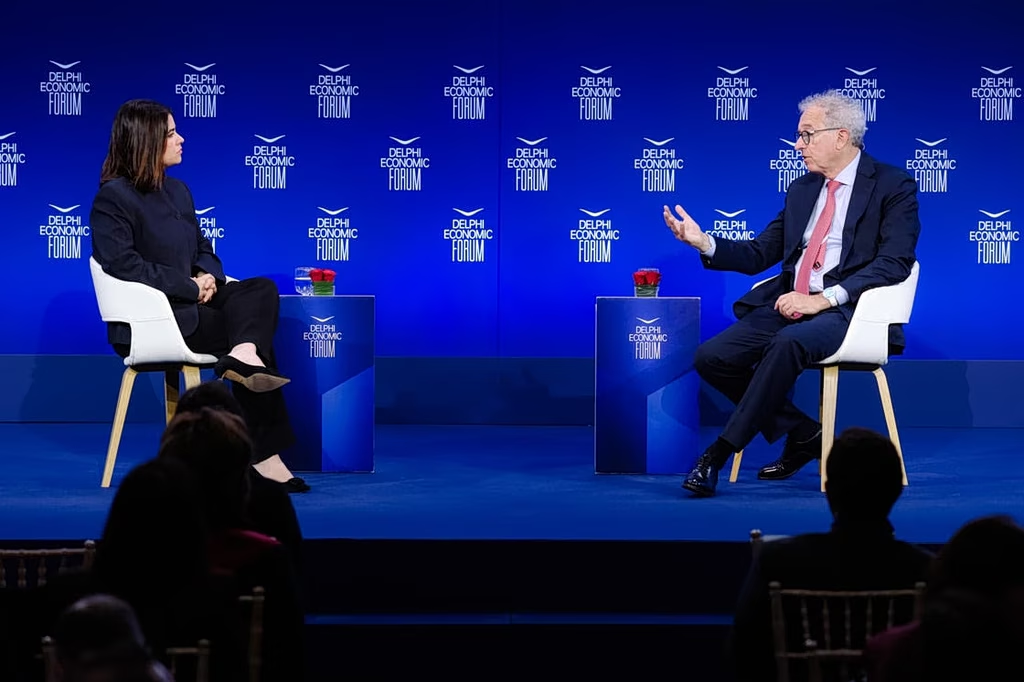
The absorption of Recovery Fund resources took center stage at the 11th Delphi Economic Forum, held in Delphi from April 22–25.
Deputy Finance Minister Nikos Papathanasis stressed that Greece is leading the pack, noting that “Greece is the first country in the EU in disbursements” and has already secured the 7th tranche of €1.2 billion. He said the government is steadily advancing on reforms and that “in the first days of May we will complete the submission of the 8th request,” expressing confidence that “Greece will be an example for all countries and we will not lose a single euro.”
He noted that a significant number of businesses and organizations have already benefited from the Fund’s loans and grants, and highlighted that for the 2026–2030 period the country will have “more than double the development program.”
On the new 2021–2027 ESIF (European Structural and Investment Funds) framework, he said €2.1 billion has already been redirected, with an expected benefit of over €1 billion, adding that “€7 billion remains to be deployed by 2030” and that Greece is in negotiations for new funding totaling €49.5 billion.
Health Minister Adonis Georgiadis highlighted the Recovery Fund’s contribution to upgrading the National Health System, noting that “when the Fund launched, there was a question mark over whether Greece could absorb the money.” The original target was to renovate 80 hospitals, but “we’ll reach 100,” he said, adding that “we will exceed our targets.” He also pointed to substantive reforms beyond infrastructure, including the “Prolamvano” (Prevention) program and the digitization of healthcare.
Minister of Digital Governance Dimitris Papastergiou described the work underway as “titanic,” noting that his ministry manages €3.4 billion in resources. He cited the digitization of the justice system through a digital case file as marking “a new day,” and referenced strategic investments including a €200 million microsatellite program. He also highlighted AI infrastructure, saying that the “Daedalus” system will operate in Lavrio through Pharos, offering free AI infrastructure, alongside the creation of a National Cybersecurity Authority.
Infrastructure and Transport Minister Christos Dimas presented specific projects, including the E65 highway, set to open to traffic within the coming months, and the restoration of damage caused by Storm Daniel, with “€600 million to be covered by the Recovery Fund.” He also referenced the Northern Road Axis of Crete, noting that these projects “improve citizens’ daily lives and safety” and create more resilient infrastructure.
From the European Commission, Michael Sket, Deputy Head of Unit, acknowledged Greece’s significant progress, noting that 53% of milestones have been completed and 68.5% of funds have been disbursed. He called it “an achievement,” but warned that 47% of targets remain, roughly 178 milestones and reforms, all of which must be completed by strict summer deadlines. He said the coming months will be critical, requiring “additional effort,” while expressing confidence that Greece can successfully complete its next payment requests.
The discussion was moderated by journalist Dora Anagnostopoulou of Mega Channel.
In the panel that followed, Evi Dramaliotis, Secretary General for Coordination at the Office of the Prime Minister, emphasized the role of reforms, noting that “reforms are an important pillar of the program” and that the Greek plan was designed from the start to be “front-loaded — reforms first.” She said Greece is strictly adhering to its timeline, as “we committed to submitting 2 requests per year and we are doing so exactly on schedule.”
Orestis Kavalakis, Director of the Special Recovery Fund Coordination Service, described the intensity of the effort: “we are now in the last mile of a marathon that we ran at a sprint pace,” stressing that the program’s philosophy remains front-loaded, with clear completion milestones.
Ioannis Kaltsas, Head of Investments for Greece and Cyprus at the European Investment Bank, underscored the importance of institutional continuity: “it is essential that the structures that have been created remain in place,” adding that “never before have so many funds reached Greece.”
Particular emphasis was placed on the role of leveraging private capital. Haris Lambropulos, President of the Greek Development Bank of Investments, described an innovative model: the bank “operated as an equity platform from the loan arm of the Fund,” combining “€600 million from the Recovery Fund and €700 million from private resources” to create a total capital pool of €1.3 billion.
From the banking side, Panos Lymveropoulos, General Manager and Head of Large Corporate, Loan Syndications and Development Programs at Eurobank, called the loan component “a major innovation” and “a very successful effort,” despite initial reservations about how the model would work.
Similarly, Theodoros Tzouros of Piraeus Bank called it “the most successful program for strengthening Greek companies in the history of Greece.”
The social impact of the Fund was highlighted by Ismini Papakyrillou, CEO of the Greek Development Bank, who noted that through the “My Home II” program, “22,000 families have bought a home,” with total approvals “exceeding €1.6 billion.”
Finally, Panagiotis Prondas, Partner and Head of Strategy and Investments at Grant Thornton, underlined the macroeconomic dimension, calling the Fund “a real accelerator for the Greek economy” and noting that “the increase in private investment from the loan arm alone exceeds €3 to €3.5 billion,” with the Fund overall delivering “at least a 25% boost to private investment.”
The panel was moderated by journalist Yannis Agouridis of ot.gr.