 Μake us preferred on Google
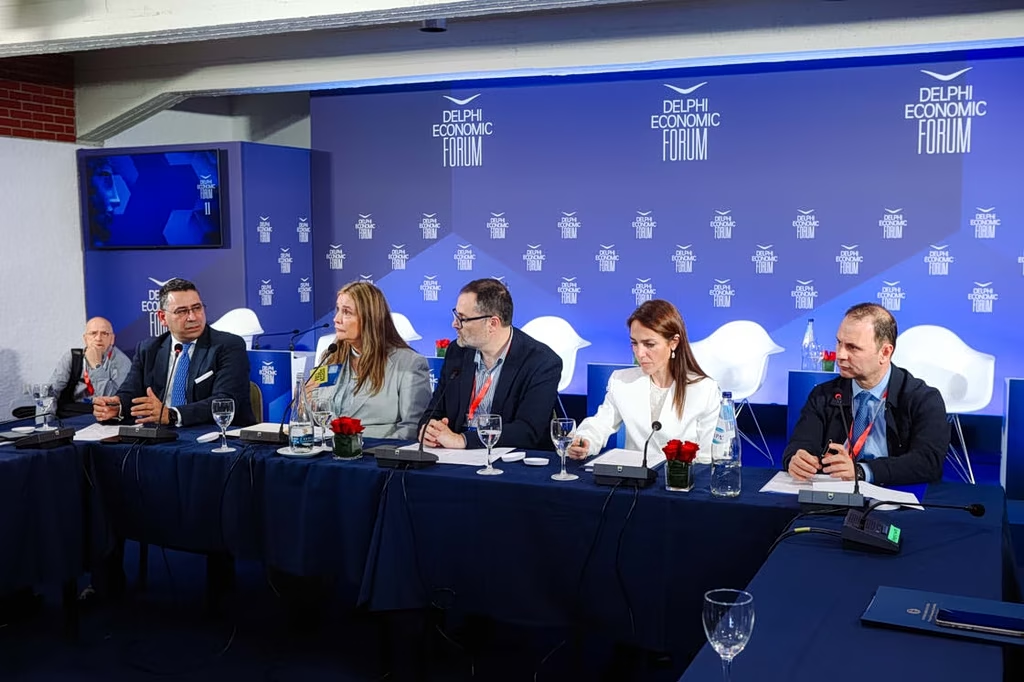
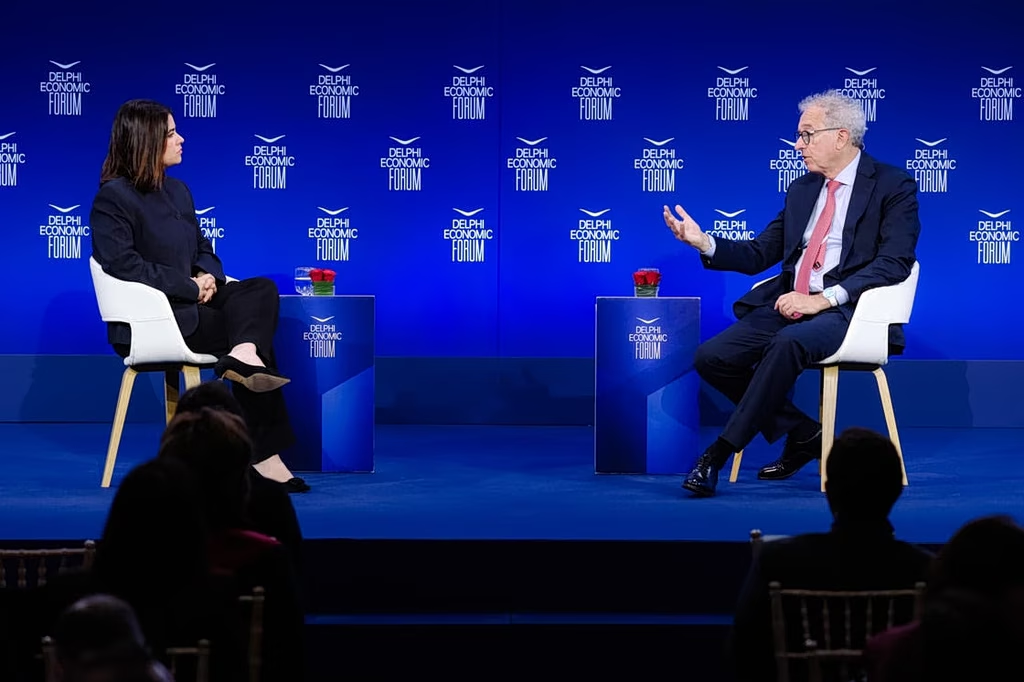
 Pierre Gramegna, Managing Director of the European Stability Mechanism (ESM), addressed the risks that geopolitical instability and the energy crisis pose to financial stability and the European economy, during a discussion at the 11th Delphi Economic Forum, held in Delphi from April 22–25, 2026.
He warned that markets have not fully priced in the duration and depth of the crisis, noting that they “are operating under the assumption that the crisis will end soon,” while “recent developments show that it is easier to start a war than to end one.”
He stated that the crisis has already left a deep mark on the real economy, pointing out that “the disruption caused by the war has done damage that will not be easily repaired,” and stressed that “the supply of oil and gas will not normalize quickly,” which is directly weighing on energy prices and the cost of living.
He noted that “the EU has shown greater realism in its forecasts than other organizations and markets,” adding that markets have been slower to incorporate the real data of the crisis, though “in recent days they have been more in a wait-and-see mode.”
He placed particular emphasis on inflation, noting that “inflation is already above target” and “is now reaching around 3%,” while explaining that “it would be close to 2% if everything stopped immediately” — something that cannot be taken for granted. As he stressed, “it is important to understand that what matters most are inflationary pressures, as these translate directly into the daily lives of citizens.”
He also pointed out that “the impact is rapid and felt across many countries,” emphasizing that although the conflict may be considered regional, “its consequences are global,” with an immediate effect on fuel prices, transportation, and production.
Analyzing the difference from the 2022 crisis following Russia’s invasion of Ukraine, he highlighted that back then inflation rose “from near-zero levels,” whereas today interest rates are already at higher levels, meaning “the impact is faster,” while “governments have less room to maneuver” due to the burdens left by the pandemic.
Regarding Greece, he noted that it “is in a better position now compared to four years ago, as structural reforms were carried out and the results are now being enjoyed,” underlining that the country’s growth in recent years has been above the Eurozone average, which strengthens its fiscal space.
He stressed the importance of fiscal discipline, noting that “if you look at the average debt-to-GDP ratio in the EU it is around 90%,” which “is much less than the US or China,” pointing out that Europe has a framework that imposes rules and constraints.
On crisis response policies, he emphasized that support measures must be “targeted, temporary, and tailored” so as not to create permanent fiscal burdens, while stressing that the strategic goal of the energy transition must not be undermined.
He noted that Europe must remain committed to expanding renewable energy sources, describing it as a matter of “strategic and energy autonomy,” and referred to Greece’s progress, highlighting that increasing the share of renewables is a critical element of resilience.
“This crisis proves that we are more vulnerable than any other region in the world when we are overly dependent on fossil fuels,” he said, underlining that the answer is not to change course but to accelerate the transition: “We must be smart in the way we move, but under no circumstances should we change direction.”
He noted that Europe has already strengthened its reserves and significantly reduced its dependence on Russia, pointing out that “we have diversified our energy sources” and that expanding renewables is a strategic choice.