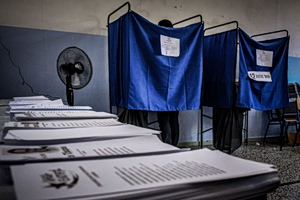
A new nationwide poll suggests that Greek voters are increasingly inclined toward political change, but remain uncertain about what should replace the current order. The survey, conducted Feb. 12-14 by GPO for the news website iefimerida.gr, finds that nearly 7 in 10 respondents would prefer a different government after the next elections. Yet that desire has not coalesced around any single opposition party, leaving the governing New Democracy party with a clear lead in voting intention despite evident public fatigue.
The findings also point to a country weighing its place in a tense regional environment. Greeks are divided over the recent meeting between Prime Minister Kyriakos Mitsotakis and Turkish President Recep Tayyip Erdogan, overwhelmingly wary of Turkey, and broadly supportive of most proposed constitutional reforms. Taken together, the results depict an electorate unsettled but not yet realigned — skeptical, fragmented and still searching for a credible alternative.
Majority Want a Different Government
The clearest finding of the survey is the electorate’s preference for political change. A total of 67.9% of respondents say they would like to see a different government emerge after the next national elections, while 29.8% prefer the current administration to remain in office.
That preference, however, is not reflected in a consolidated opposition.
In voting intention, New Democracy (ND) maintains a decisive lead at 24.9%, up from 23.5% in January. PASOK follows with 10.9%, slightly lower than the previous month. Plefsi Eleftherias records 9.2%, narrowly ahead of Elliniki Lysi at 9%. The Communist Party (KKE) stands at 7.6%, while SYRIZA trails at 4.6%.
Undecided voters account for 16%, and 7.1% indicate support for another party, highlighting the fluidity of the political landscape.
When recalculated based on valid ballots, ND rises to 30.1%, extending its lead over second-place PASOK, which stands at 13.2%. Despite broad dissatisfaction with the incumbent government, the opposition vote remains fragmented across several parties, none of which approaches the governing party’s share individually.
Limited Confidence in Opposition Cooperation
The possibility of cooperation among center-left and left-wing parties does not appear to command widespread confidence. Only 18.5% of respondents believe such a coalition could win the next elections, with an additional 23.6% saying it “probably” could. By contrast, 23.8% say “probably not,” and 30.3% say “no.”
Potential new political formations also draw limited support. Asked how likely they would be to vote for a new party led by Alexis Tsipras, 68.5% say “not at all,” while 7.9% describe themselves as “very likely” to do so. Similarly, 62.5% say they would not support a party led by K. Karystianou, and 80.3% reject the prospect of backing a new party under former Prime Minister Antonis Samaras.
Divided Views on Greece-Turkey Diplomacy
Foreign policy, and particularly relations with Turkey, remains a central concern.
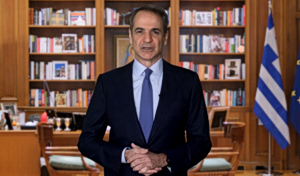
The recent meeting between Prime Minister Kyriakos Mitsotakis and Turkish President Recep Tayyip Erdogan divides public opinion. A total of 43.9% assess the meeting positively, while 49.2% view its outcome as rather negative.
On whether such meetings contribute to improving relations between Greece and Turkey, 25.5% say yes and 25.2% say “probably yes.” Meanwhile, 19.8% say “probably not,” and 28.1% say no.
Perceptions of Turkey remain predominantly negative. A combined 76.4% consider Turkey a threat to Greece. Attitudes toward President Erdogan are overwhelmingly unfavorable, with 61.9% expressing a negative view and 18.7% a rather negative one. Just 6.5% report a positive opinion.
Evaluations of the government’s broader foreign policy record are similarly mixed. A total of 38.9% rate it positively or rather positively, while 59.7% view it negatively or rather negatively.
Asked whether Greece’s international standing has changed during the seven years since New Democracy took office, 35.3% say it has improved, 29.9% say it has remained the same and 33.7% believe it has worsened.
When respondents were asked who they would prefer to represent Greece in Europe and internationally, Mitsotakis leads with 31.2%. Notably, 30.4% spontaneously answered “none of them,” suggesting a significant degree of political disaffection.
Broad Support for Most Constitutional Reforms
While party alignments appear unsettled, several proposed constitutional reforms receive substantial public backing.
A combined 71.4% agree or rather agree with amending Article 68 concerning ministerial liability. Support also stands at 69.1% for allowing supreme courts to determine their own leadership. The proposal to establish a single six-year term for the president of the republic is backed by 64.6%, and 62.4% favor universal evaluation in the public sector along with lifting permanent tenure for civil servants.
One proposal stands out as more divisive: a constitutional provision allowing the establishment of non-state universities. In this case, 44.8% express support, while 51.3% oppose it.
Taken together, the results depict an electorate that distinguishes between institutional reform and partisan politics — broadly supportive of certain structural changes, yet divided over leadership and uncertain about which political force should guide the country forward.