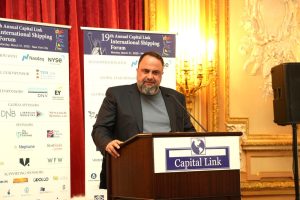
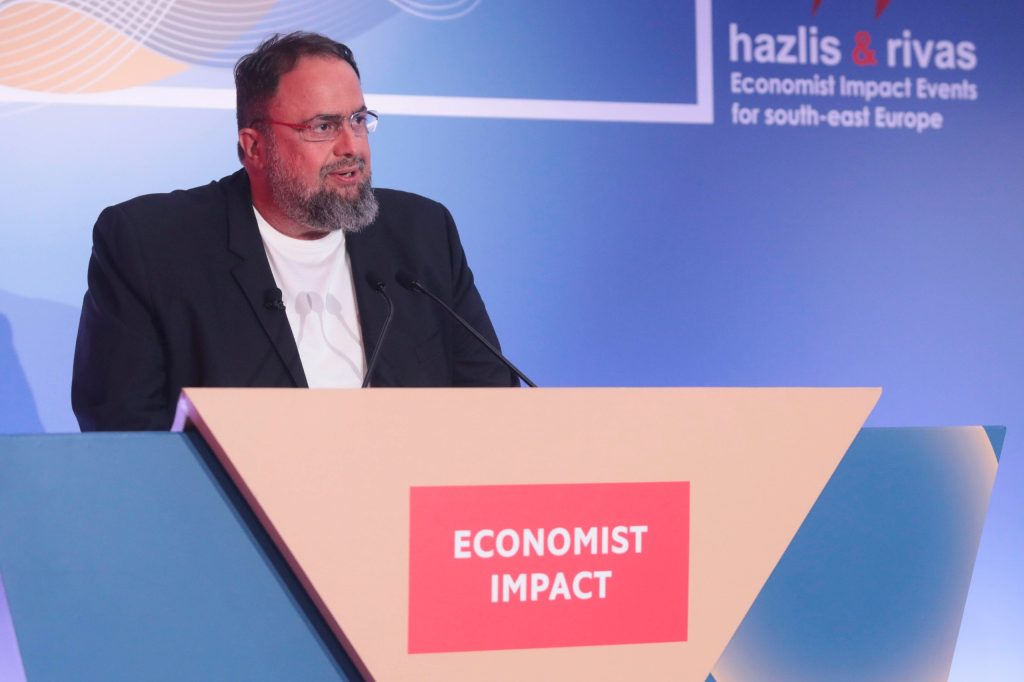
With an appeal to stop the war in Ukraine “so that children stop being killed,” the founder and president of the shipping group Capital Maritime & Trading Corp and main shareholder of Alter Ego Media, Evangelos Marinakis, sealed his intervention at the Economist. At the same time, however, he made a clear and explicit reference to the real situation prevailing in Greece today.
During the discussion he had with former Prime Minister of the United Kingdom Boris Johnson, as well as with Economist journalist Alasdair Ross, in response to the latter’s comment that Greece seems to be going through a period of great stability with the government possibly heading to a third term, with growth rates enviable compared to many European countries, Evangelos Marinakis underlined: “You mentioned the [economic] indicators; and we have seen that the indicators are doing very well, because we compare them with the bottom. And of course, whatever we compare with the bottom, there’s only way to go- up.”
In relation to the improvement of the economic indicators, he underlined that at the same time “a family, the average Greek wage earner suffers from the 20th of the month because the income is not enough to cover the essential needs. We see the prices going sky high and the real income for the average Greek wage earner is diminishing. So this is something that the government hasn’t been very successful at and has not protected the Greek people. According to Eurostat data, Greece and Bulgaria have the worst real income. So is something that is a real problem that most of the Greeks are facing. This is something that the government should take serious and drastic measures to solve.”
At the same time, he underlined the importance of the problem of corruption, such as that of the Greek farming scandal at OPEKEPE. “We see that instead of having a government that can try to solve these scandals and this corruption and let the judges do their work, we see that maybe there is a cover-up.” For this reason, Evangelos Marinakis noted that “we see that at this moment the polls for the government are extremely low. So, I am not so optimistic about its third term unless we see radical changes
Answering a related question, Evangelos Marinakis underlined the ineffectiveness of the sanctions towards Russia as they are applied without secondary sanctions for the countries that buy, process, and sell Russian oil, as well as the need to end the war. “So that children stop being killed,” as he characteristically said, a compromise is preferable.
“We are sailing in uncharted waters”
In his opening statement, Evangelos Marinakis, stressed:
“We are living in a period marked by increased geopolitical complexity.
To use a maritime analogy, we are sailing in uncharted waters.
We are facing three major conflicts that still have the potential for further destabilization: the continuing war between Russia and Ukraine, the Israel – Palestine conflict and the closure of the Suez Canal by the Houthis, as well as the war with Iran. All affect global trade, energy flows, and shipping.
Directly, in the case of the war in Ukraine, because of the sanctions imposed upon Russia.
Indirectly, in the case of the war in Gaza, because of the repercussions in the broader Middle East region, and because of increased risk for shipping in the Red Sea by the Houthis. And there is always the risk of another confrontation with Iran, which runs the risk of severely disrupting oil flows, given the importance of the Strait of Hormuz.
To this, the new direction American policy has taken under Donald Trump has to be added.
Trump seems to be more assertive than in his previous tenure and more ready to take initiatives that change the ‘rules of the game’, especially with his extensive use of tariffs.
On the other hand, Trump seems to be more willing to end conflicts and avoid ‘forever wars’ and we need to see how his latest initiatives to discuss with Putin a possible peace agreement with Ukraine might develop.
At the same time, we need to see how the relation – and negotiation – between the US and China goes:
Will it lead to some form of agreement that would help global trade, or lead again to some form of trade war?
Some aspects of American economic policy are contradictory: for years, they tried to cultivate good relations with India. Now they are imposing sanctions on India, and India is increasing its cooperation with Russia and China.
Moreover, of course, we need to see how other aspects of Trump’s policy might play out, such as his attempt to push the Federal Reserve to lower interest rates, which some see as a challenge to the necessary independence of the central bank, but at the same time any reduction will be beneficial for the economy and the stock exchanges.
All these have added uncertainty, but they can also be part of a negotiating tactic.
Perhaps in the end, what the current US administration wants is indeed a better deal. After all, President Trump is a tough businessman with proven track record.
Europe could have played a larger role in bringing stability and conflict resolution, but let us be honest, they have failed so far; instead, all of us in Europe have paid a greater price for the global geopolitical tensions of the past years. And unfortunately, we will continue to do so.
I think that some of these challenges apply to Britain as well, a country that can also play a significant role in initiatives for peace and stability.
Can we be optimistic? It is difficult to say. But definitely not if Europe continues on the same path of the last three years.
However, at some point, we need to understand that conflict resolution is better than conflict management, and this should be the goal.
Problems will persist as long as the underlying causes persist, but there are ways to avoid escalation.
Shipping is obviously heavily affected.
Global conflicts affect trade routes, and sanctions impose specific restrictions.
Supply chains can be affected both by geopolitical instability and the possibility of a trade war. All these come at a price.
In these challenging times, the role of large shipping companies, such as our Capital Group, which is a major oil and gas transporter, is even more strategically significant for the energy efficiency of countries in the West and worldwide.
Capital Group operates a total fleet of 154 modern ships with carrying capacity of approx. 12.5 million tonnes. This includes tankers, containers, 30 ultra modern LNG, LPG/Ammonia, Liquid CO2 carriers, offshore and dry bulk vessels with an enterprise value of $ 13 billion.
The fleet under management includes the vessels of Nasdaq-listed Capital Clean Energy Carriers Corp. (‘CCEC’).
The Ukraine war, the needs for US energy transportation, the changing geopolitical landscape – all make it necessary for governments and countries to have access to a commercial fleets in these turbulent times and large shipping companies will be able to meet these new needs.
Therefore taking into consideration the current geopolitical landscape shipping of energy plays a critical role worldwide. It makes the world go around.”
Boris Johnson: “We are not doing enough to pressure Putin”
“We’ve got to stop this war…Putin won’t stop unless he has more pressure put on him,” stressed former Prime Minister of the United Kingdom Boris Johnson from the stage of the Fifth Metropolitan Summit in Thessaloniki, adding characteristically that if Ukraine ‘falls,’ the consequences for the West will be disastrous, since such a development would encourage, as he said, other authoritarian leaders. “If we are weak now, we will pay for it later,” he noted.
He himself described as “painful the fact that Narendra Modi participated in the recent Summit of the Shanghai Organization,” as well as “the fact that India buys Russian oil.”
Johnson referred in warm terms to his relationship with Greece, which he visits often, and made special mention of the role of Athenian democracy in shaping the Western world: “Let us show confidence in the Western values that we inherited from Athenian democracy,” he characteristically noted.
He defended his choice to support Brexit. Asked if it is something he recommends to other countries, such as Greece, he replied: “That lies with the Greeks. There are certainly geostrategic parameters that they should take into account. It is a different case. I never wanted the dissolution of the EU. I simply considered that it was wrong for us. What matters is democracy, to be able to make your own decisions. When the EU makes a decision, a national Authority is obliged to follow it, and that was a problem for us,” he underlined.
“I do not believe that Trump is an authoritarian and that he will try to remain in his position after the end of his term,” he said at another point of the discussion. In addition, he declared himself particularly optimistic about the course of the Greek economy, stressing that it has already achieved a lot.
Interventions against the backdrop of geopolitical and economic turbulence
With political interest focused on Alexis Tsipras’s speech scheduled for Friday afternoon, the Economist conference, which started yesterday, hosts a series of interventions against the backdrop of the geopolitical and economic turbulence shaping the global scene.
Finance Minister Kyriakos Pierrakakis is expected to speak about the resilience that Greece has shown in dealing with the recent crises and about what the government describes as a model of economic adaptation and reform. Former Prime Minister of Israel Ehud Olmert will discuss with former Commissioner and former Foreign Minister Dimitris Avramopoulos the destabilization of the wider Eastern Mediterranean region due to long-standing disputes, such as that between Greece and Turkey, but also due to the war in Gaza. Among other things, Energy Minister Stavros Papastavrou will describe projects that are under way in the energy sector and aim at filling gaps in supply chains and improving Europe’s energy security.
At the end of the conference, Alexis Tsipras’s intervention on Greece in 2030 is expected, with interest both from friends and from opponents—as it is estimated that with what he will say he foreshadows his return to the political stage.