Turkey is once again demanding that its approval come first for work on the Greece-Cyprus electricity interconnection, keeping the dispute over the project alive.
In its October 1 briefing, the Turkish Defense Ministry said it will not allow unlicensed activities in areas it considers part of the Turkish continental shelf.
It cited its maritime delimitation agreements with Libya and the pseudo-state, as well as the boundaries it submitted to the UN in 2020.
More specifically, in its statement, the Turkish Defense Ministry claims that the project involves “research activity within the Turkish continental shelf” and makes clear that it will not allow it to go ahead without prior coordination with and approval from Ankara.
“Under international law, any installation of cables or pipelines, or any scientific research on our continental shelf, must be coordinated in advance with our country as the coastal state,” the Turkish Defense Ministry stated, adding: “Within the framework of our rights in the Eastern Mediterranean, we will not allow any unlicensed activity.”
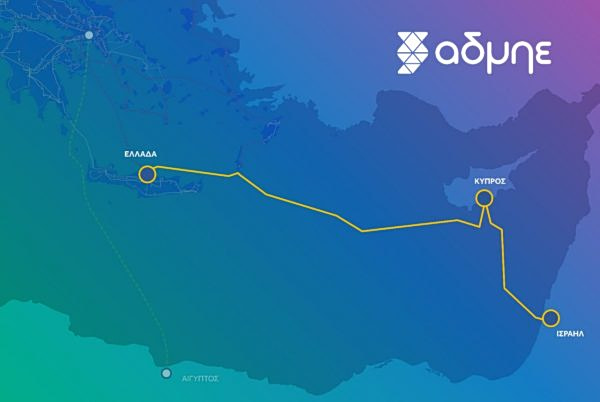
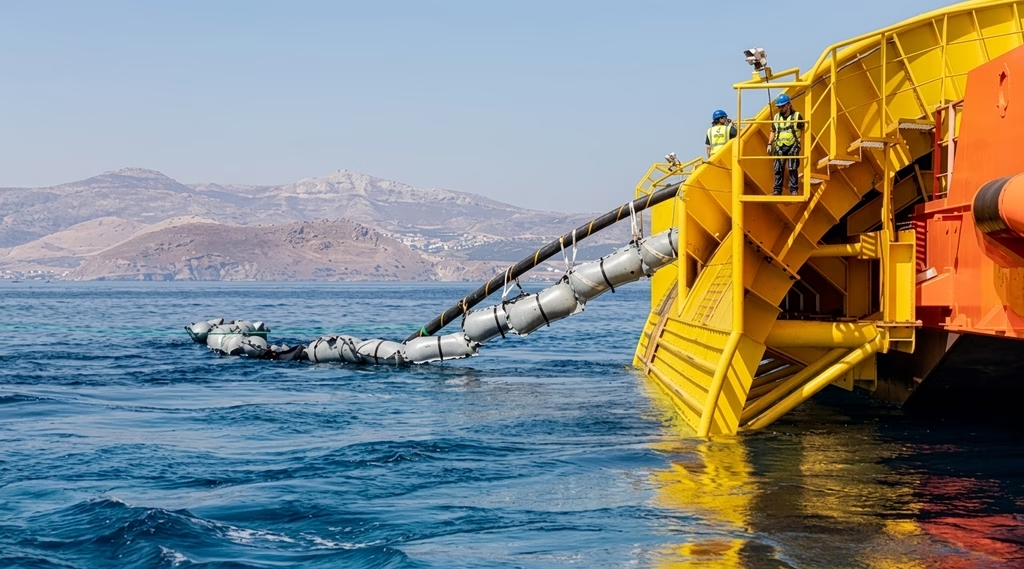
An illustration of the Great Sea Interconnector. Source: ADMIE
Athens’ Position
Greece’s position, however, has already been stated publicly: informing others about the work does not mean recognizing any Turkish authority to issue permits. Speaking to SKAI on September 29, Foreign Minister Giorgos Gerapetritis stressed that the relevant request will be submitted to the Greek government. “Permission, however, will be granted only by Greece,” he said, explaining that a NAVTEX serves to inform neighboring states and seafarers for the safety of navigation.
In the same interview, the minister acknowledged that the route passes through maritime zones that have not been delimited, while underlining Greece’s position that it concerns Greek continental shelf. He also dismissed scenarios of changing the route because of Turkish marine parks, saying the planned route already lies dozens of miles further south. He also repeated that the survey and cable laying will be carried out according to the contractor’s plan.
The Turkish demand shifts the debate from the safety of navigation to accepting jurisdiction over the work. For Athens, however, what is at stake goes beyond building an energy infrastructure project: it also involves the possibility of setting a precedent for future activities in the Eastern Mediterranean. This explains why the distinction between notification and permission is at the center of Greek statements.
In any case, Greece’s public statements do not reflect a new government line. In July 2025, Kyriakos Mitsotakis had stated that laying energy and telecommunications cables does not require the approval of a coastal state, calling Turkish objections unjustified. He had also pointed out, however, the need for a fair sharing of construction costs, highlighting the financial side of the interconnection.
The Kasos precedent remains a key background factor. After Turkish warships appeared in the survey area in the summer of 2024, Mr. Gerapetritis told Parliament that the work was completed as planned, without requesting Turkish permission and without recognizing Turkish claims. He had also repeated that Greece does not recognize the Turkish-Libyan memorandum.
At the same time, Athens is highlighting the European dimension of the project. On September 12, the foreign minister described it as a Project of Common European Interest and said that Greece, France and Cyprus have expressed their political support for its implementation. He avoided, however, linking any hypothetical obstruction in advance to the activation of the EU’s mutual assistance clause.
The next critical stage will be the start date of the work. That is when it will become clear whether Turkey’s insistence will remain at the level of statements or turn into obstruction, putting Greece’s commitments and its partners’ political support to a practical test.
Criticism Over the Military Parade in Cyprus
At the same time, the Turkish Defense Ministry is targeting Athens and Nicosia over the military parade marking the 66th anniversary of the declaration of independence of the Republic of Cyprus, describing it as “provocative actions.”
“We closely monitored the military parade. It is clear that the provocative actions of Greece and the Republic of Cyprus do not contribute to trust, but instead heighten tension and undermine the climate of stability on the island,” Ankara’s statement concludes.
Oruc Reis Heads to the Occupied Areas for Gas Pipeline
Ankara’s new intervention comes as Turkey moves ahead with its plans to build a 101-kilometer undersea natural gas pipeline to the occupied areas.
NAVTEX 0953/26 has already been issued, announcing the deployment of the research vessel Oruc Reis, accompanied by three support ships, in the sea area stretching from Antalya and Mersin to south of the occupied areas. The surveys, which will last until October 25, are the first step in implementing the agreement Turkey signed with the pseudo-state on July 10, confirming Ankara’s intention to impose faits accomplis in the region.