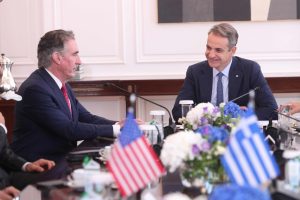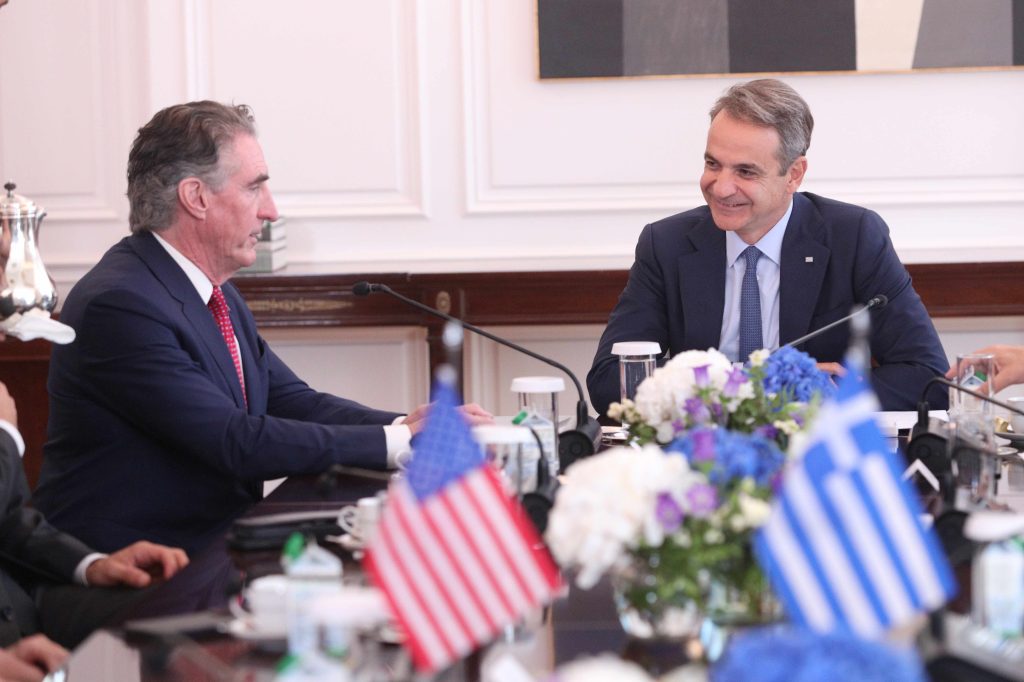

The United States reaffirmed Greece’s role as a key energy and strategic partner in Southeastern Europe on Thursday, with U.S. Interior Secretary and head of Washington’s Energy Sovereignty Council, Doug Burgum, visiting the Revithousa LNG terminal.
Burgum stressed in Athens that Greece is not simply a transit point but a central hub in Washington’s plan to replace Russian gas with American LNG. His arrival at the terminal on the islet in the Gulf of Megara drew leading figures of Greece’s energy sector, with discussions continuing aboard a boat trip from Revythousa to Agia Triada hosted by Environment and Energy Minister Stavros Papastavrou.
Washington’s Strategic Energy Plan
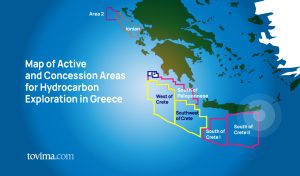
Burgum’s visit followed a joint bid by Chevron and Helleniq Energy for offshore exploration south of Crete and the Peloponnese. In talks with officials and energy executives, he outlined Washington’s strategy to fully replace Russian gas with U.S. LNG, framing it around two pillars: prosperity and peace.
He argued that reliable, affordable energy underpins both economic growth and the future economy, increasingly driven by electricity and artificial intelligence.
On peace, Burgum was blunt without naming names. “Two major conflicts today are being financed by the oil and gas revenues of countries that are either waging war against us and our allies, or funding terrorism against us and our allies,” he said, pointing unmistakably toward Moscow and Tehran. Energy diplomacy, he stressed, is the way America intends to deliver global stability.
Long-Term Supply, Stable Prices
Burgum said Washington’s plan is to ensure its allies stop purchasing gas from countries fueling conflict. The U.S. aims to provide long-term contracts that guarantee not just abundant supply but also stable, affordable prices—shielding households across Southeastern Europe and Ukraine from the volatility of the spot market. Greece and the Vertical Gas Corridor will serve as the backbone of this strategy.
Expanding Greek Infrastructure
Revithoussa, he noted, can expand its capacity to handle greater LNG volumes, while Washington will also back the Alexandroupolis FSRU. Currently, Revithoussa processes about 7 bcm of gas annually, with Alexandroupolis adding another 3 bcm. DESFA’s ongoing investments will boost export capacity to 8.5 bcm.
“We see tremendous potential here in Greece,” Burgum emphasized, praising the country as a “superb partner” capable of extending energy security and stability across Southeastern Europe. He also underlined that abundant gas will be key to sustaining the global race in artificial intelligence.
Athens Sends Its Own Signal
For his part, minister Papastavrou highlighted the rising role of U.S. LNG, noting it made up 81% of Greece’s imports in 2025—nearly double the previous year. Through Revithoussa and Alexandroupolis, this gas flows via the vertical corridor into Southeastern Europe, strengthening growth, stability, and the U.S.-Greece partnership.
Burgum closed with a broader message: “Through unity, energy can be a force for global stability. With strategic partnerships, we can reduce dependence on rivals, secure supply chains, and ensure a safer, smarter energy future for the world.”