As the year draws to a close, the Greek government finds itself caught between two competing imperatives: containing a wave of farmer protests that has proven stubbornly resistant while trying to remind the public of its purported progress on several economic and social issues.
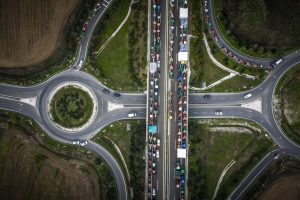
The protests, marked by tractor blockades on major roads, have become an acute political headache for the government and, by extension, for the prime minister’s office, commonly referred to in Greece as “Maximos,” shorthand for the Maximos Mansion, the seat of executive power. Despite appeals for dialogue, the standoff remains unresolved, and government officials now openly acknowledge that earlier communication tactics failed to defuse tensions.
A looming “Plan B”
Over the past several days, senior government figures have begun floating the possibility of a so-called “Plan B,” an alternative approach should the blockades continue. While officials stress that this option is not yet being implemented, its contours are becoming clearer.
According to government sources, one proposal under consideration involves administrative fines for tractor owners who obstruct transport and logistics routes while refusing to come to the table and discuss their demands. The argument, as presented by officials, is that such actions harm not only the wider public but also farmers who are not participating in the blockades.
The message, delivered pointedly but cautiously, is that the government does not want to escalate, but is prepared to do so if the situation drags on.
That tone was reinforced in a recent radio interview by government spokesperson Pavlos Marinakis, who warned that authorities should not be forced into a second line of response. Should that happen, he said, tougher sanctions would follow for those rejecting dialogue “to the detriment of all farmers.”
Marinakis cited recent incidents at highway toll stations, where barriers were lifted during protests, prompting police to forward evidence directly to judicial authorities. Those responsible, he noted, would face both criminal and administrative or civil consequences.
Drawing lines within the protest movement
At the same time, the government is making a concerted effort to differentiate between groups within the protesting farmers. Officials insist that many participants in the agricultural sector have legitimate and reasonable demands. Compensation for losses due to disease outbreaks, such as livestock affected by sheep pox, and state support to offset rising production costs are cited as examples of claims the government considers justified.
But the government argues that the protests also include individuals who are reacting less to current hardship than to intensified financial scrutiny. In this context, officials point to ongoing audits linked to the OPEKEPE farm subsidy scandal, a long-running case involving irregular and allegedly unlawful agricultural payments.
According to government sources, these audits, initiated months before the blockades began, are now reaching their final stages. Central to this effort is the Independent Authority for Public Revenue (AADE), which has the technical capacity to cross-check income declarations, subsidies and other financial data. Some of the the resistance seen on the roads, officials suggest, reflects discomfort with tighter oversight rather than opposition to reform itself.
To support this argument, government figures often cite a numerical contrast: Greece has roughly 400,000 professional farmers, yet only about 4,000 tractors have appeared at blockades nationwide. The conclusion they draw is that the protesters, while highly visible, represent a small fraction of the sector.
Ending the year on a different note
Against this tense backdrop, the government has launched its attempt at a year-end review highlighting what it presents as its key achievements, an attempt to reclaim political ground and shift public attention.
At the top of the list is unemployment, which officials say has fallen from 18% to 8%, the lowest level in 15 years. The minimum wage, they note, has risen from €650 to €880, while a broad package of tax cuts targeting the middle class, families and young people has been enacted, enabled by economic growth and a clampdown on tax evasion.
Other measures include the reduction or elimination of basic banking fees and the expansion of mandatory out-of-court debt settlements to better protect the middle class, further reducing non-performing loans.
The government also points to reforms with longer-term implications, such as energy agreements framed as delivering both geopolitical and economic benefits, and the expansion of the Digital Work Card. Within a year, officials say, declared overtime increased by 74%, a sign of improved labor compliance, according to the government.
What lies ahead
Looking forward, ministers have outlined policies that either took effect over the course of the year or are now permanent features of the policy framework. These include across-the-board wage increases in the public sector to ensure entry-level salaries do not fall below the private-sector minimum wage. The measure, first implemented in April, is permanent and recurring, with an estimated benefit of €215 million in 2025 for public employees.
Additional interventions include a one-point reduction in social security contributions, generating an annual benefit of €448 million shared between employees and employers, and the gradual abolition of the business levy for specific categories, with partial reductions already applied and further relief scheduled.
Property owners with insured homes valued at up to €500,000 benefit from a 20% reduction in ENFIA, Greece’s main property tax, a measure the government frames as both fiscal relief and an incentive for climate resilience.
The government also highlights housing and social support measures that are now being implemented on an annual basis. These include the return of one month’s rent per year to nearly one million tenants, as well as a recurring €250
Whether this end-of-year accounting can outweigh the political cost of the cost of living crisis that Greeks have been facing for the last few years or the unresolved farmer protests remains uncertain. For now, the government appears to be betting that a combination of firmness, selective empathy and a reminder of economic gains will resonate with a broader public.