
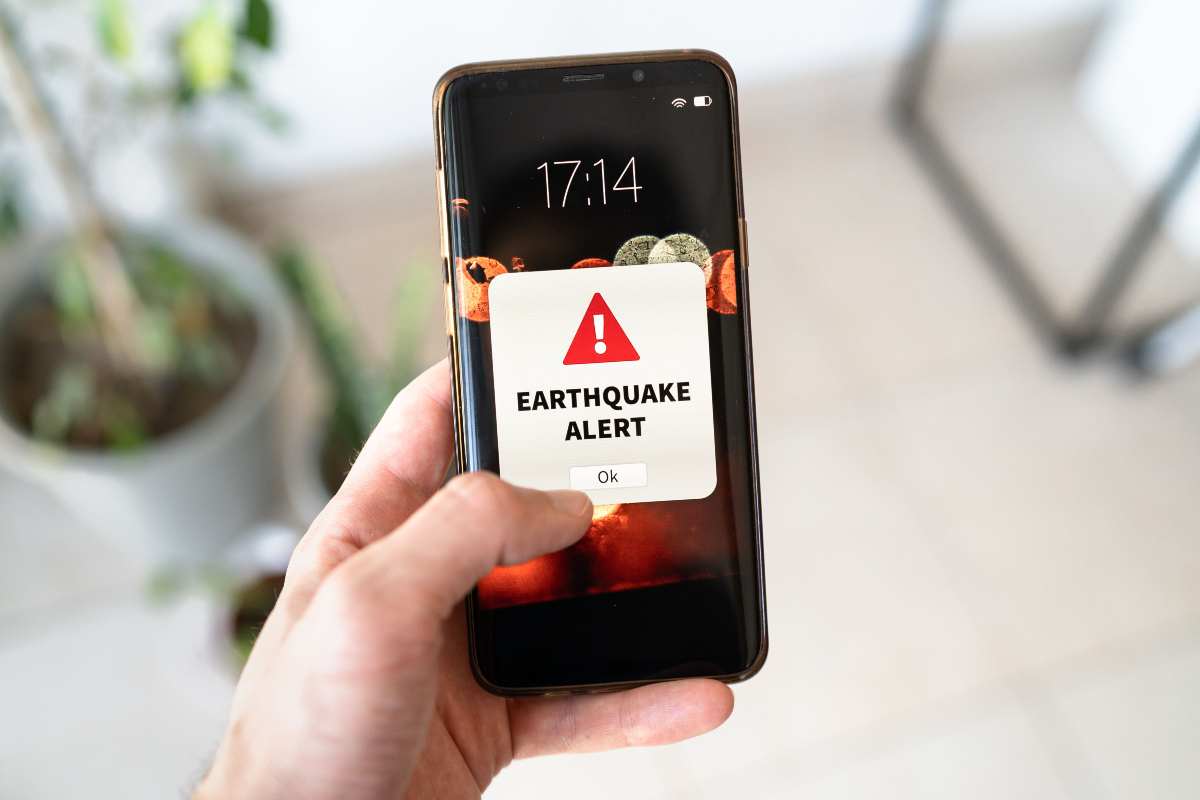
Researchers at Google have published an evaluation of their Android Earthquake Alerts System (AEA), using real-world data collected over the past three years. The study, featured in the journal Science, assessed the app’s effectiveness in issuing early warnings to residents in earthquake-prone regions, including Greece.
The system has been active in several Greek regions since 2021, when the country — along with New Zealand — became one of the first outside the United States to pilot the service. It has already sent alerts in Crete, the Dodecanese, the Ionian Islands, the Peloponnese, Evia, and Halkidiki, warning people to take protective measures before strong tremors struck.
How It Works
The AEA can be enabled in Android phone settings. It uses the accelerometer sensors built into smartphones to detect sudden movements that match the patterns of primary (P) and secondary (S) seismic waves. When a stationary phone registers such a signal, it sends acceleration data and an approximate location — with reduced accuracy to protect user privacy — to Google’s servers.
Advanced algorithms then determine whether the data indicates an actual earthquake. If confirmed with sufficient certainty, the system automatically sends alerts to users in the path of the oncoming seismic waves, giving them crucial seconds to seek safety.
Real-World Performance
From 5 February 2023 to 30 April 2024, more than one million users responded to surveys embedded in the alerts, answering questions such as whether they felt the quake, when they received the notification, and how they reacted.
Key findings include:
- 85% of respondents who noticed the quake rated the alert as “very useful.”
- Only 36% reported receiving the alert before the shaking began.
Between April 2021 and March 2024, the app detected 11,231 earthquakes and sent 412 million alerts across 98 countries. On average, it identifies around 312 earthquakes per month. In Greece, an estimated 1,000 to 2,000 earthquakes occur annually.
Setbacks and Improvements
The evaluation also acknowledged a major failure in 2023, when the system underestimated the severity of devastating earthquakes in Turkey. Researchers say improvements have since been made to better assess high-risk events.
While not flawless, Google’s system offers a novel way to crowdsource seismic detection using billions of connected devices — a capability that, in seismically active nations like Greece, can provide vital early warnings to reduce harm.