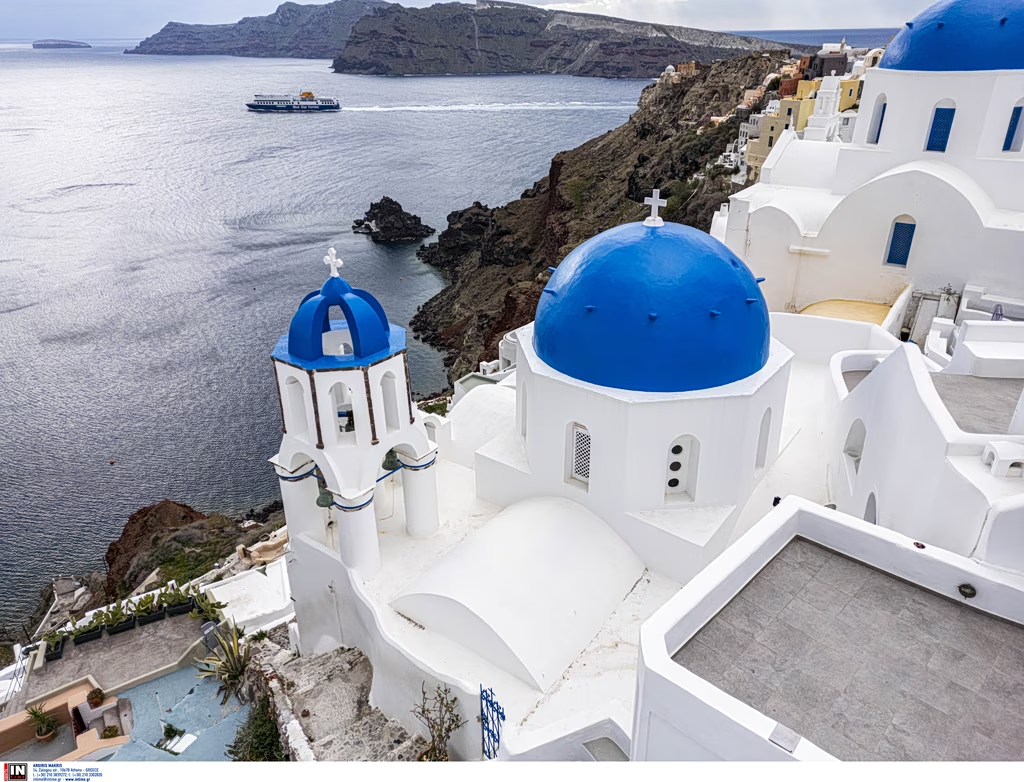
A new international scientific study has uncovered a previously unknown geological structure beneath the Santorini–Kolumbo volcanic complex, offering fresh insight into the evolution of one of Europe’s most active volcanic systems. The research was published in Geochemistry, Geophysics, Geosystems, a journal of the American Geophysical Union (AGU).
Drawing on high-resolution seismic imaging and data from the International Ocean Discovery Program’s (IODP) Expedition 398 drilling campaign, researchers identified the Kolumbo Graben, a major tectonic structure northeast of Santorini that appears to have played a key role in the formation of the submarine Kolumbo volcano and the wider volcanic field.
According to Professor Evi Nomikou of the University of Athens, the findings reveal “a fundamental mechanism linking tectonic deformation to the evolution of volcanic activity within the Santorini–Kolumbo volcanic field.” The study combines years of geophysical research with evidence obtained through deep-sea scientific drilling in the Santorini volcanic complex.
A Turning Point 330,000 Years Ago
The findings suggest that around 330,000 years ago the region underwent a major increase in tectonic stretching, with accelerated fault activity and ground subsidence marking a turning point in the evolution of the volcanic system.
According to Nomikou, this period preceded both the emergence of the Kolumbo volcano and the eruptions that shaped Santorini’s present-day caldera, while the newly identified Kolumbo Graben appears to have played a crucial role in the formation of the submarine volcano and the wider Kolumbo volcanic chain.
Rethinking How Magma Reaches the Surface
One of the study’s most significant findings challenges long-standing assumptions about magma migration. Rather than forming directly above major fault lines, volcanic centers appear to have developed within the graben itself, in zones where the Earth’s crust had become more intensely fractured.
Researchers found that these highly deformed areas created ideal pathways for magma to rise toward the surface.
Linking Tectonics and Volcanic Activity
The study links accelerated tectonic activity to a major shift in Santorini’s volcanic behavior. Data suggest that increased crustal extension and fault movement around 330,000 years ago preceded the emergence of Kolumbo and coincided with the onset of a new phase of large, caldera-forming eruptions that shaped modern Santorini.
Implications for Future Research
A particularly important conclusion is that the Kolumbo Graben may extend beneath Santorini’s northern caldera, reinforcing the view that the region functions as a single, interconnected tectonic and volcanic system.
The study takes on added significance in the wake of the seismic crisis that affected the Cyclades in early 2025, when thousands of earthquakes were recorded between Santorini, Anydros, and Amorgos. That episode renewed scientific interest in understanding the links between seismic activity and magma movement beneath the Aegean seafloor.
“The discovery suggests that accelerated crustal extension and the concentration of tectonic deformation were key factors controlling the location, evolution, and explosivity of volcanic activity in the southern Aegean over the past 250,000 years,” Nomikou said.
She added that understanding the interaction between tectonic processes and volcanism is essential for interpreting the geodynamic evolution of one of Europe’s most important active volcanic systems.