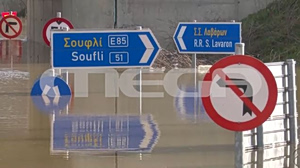
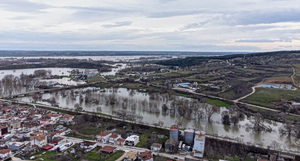
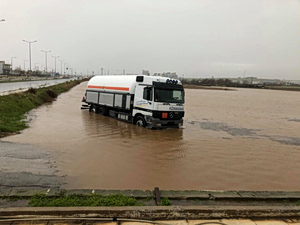
The mud is a heavy, metallic color. It sits in courtyards, clings to boots, climbs into ditches. In the Evros plain, the land has lost its edges. Roads end abruptly in a glossy surface you can’t tell is field or lake. From afar, the place looks still. Up close, you hear only pumps. Everywhere, people fear the water level.
Ten centimeters of water is enough. Thousands of hectares disappear beneath a quiet sheet that looks harmless—until you try to cross it.
In recent days, Evros has been living through something its residents no longer call an “extreme event.” For them, it’s become familiar—something that returns every few years. Huge volumes of water descend from the northern catchment. Local waters have nowhere to go and become trapped in the fields. They press against the levees, which in some spots give way or overflow under the force of the increased flow.
In places, the water reaches roads and creeps toward homes. Elsewhere, destruction arrives silently where it hurts most: in the soil that should now be worked for spring sowing.

Hens secured by their owner on a makeshift ledge. Photo by Giorgos Kalkanidis
“It’s Receding”—But That Doesn’t Mean It’s Over
In Lavara, at the village entrance, the water reached close to courtyards without crossing house thresholds. Tractors move slowly, pulling local waters toward lower ground, as if trying to push the plain back into place.
Rafail Giannakopoulos, a farmer from Soufli, stands by a pump, on shift since early morning.
“The municipality has hired our tractors so we can pump the water out. Fortunately, at least there was no issue with houses. The water is slowly receding, the level is dropping. But the damage is huge,” he tells To Vima.
In Evros, “receding” doesn’t mean the alarm is over. It means constant monitoring of the water level. It means shifts and exhaustion. The region has lived it before—under harsher terms.
Dimitris Petrovits remembers 2015, when, as deputy regional governor for Civil Protection, he faced flows that reached, as he says, 2,500 cubic meters per second.
“Back then we spoke about a once-in-a-century flood. The volumes were enormous,” he notes.
The River as a Tree
Today, flows have hovered around 1,600 cubic meters per second—lower than in 2015. But, Petrovits explains, the story isn’t just the numbers.
“Think of the river like a big tree. The trunk is the Evros. When the trunk carries water and the ‘branches’—the tributaries—also carry water at the same time, that’s when the big pressures build.”
Those “branches” have names.
The Ardas, which meets the Evros in the Trigono area, carries water released from Bulgarian dams. Farther downstream, on the Turkish side, the Tundzha and the Ergene add their own flows. When their surges coincide, pressure on the trunk multiplies.
Evros, Petrovits insists, is not a local river swelling after a storm, but “a huge cross-border hydrological system” that requires constant planning, coordination beyond borders, and projects that reduce the flood peak—beyond levees.
Because when the water level reaches the crest of a levee, physics takes over.
“Either it will overflow, or it will break it. Water always finds the weak point,” he says.

Children’s toys tied to high bars to protect them from being swooped away by the floods. Photo by Giorgos Kalkanidis
At “Che’s” Coffeehouse, the Farmers’ Parliament
On a cobbled narrow street in the center of Didymoteicho sits “Che’s” hangout—the city’s unofficial farmers’ parliament. A small, low-ceilinged café with wooden paneling halfway up the walls, green tables marked by decades of debate, and a stove that never stops, rain or snow.
On the wall, Che Guevara in a wooden frame watches who comes and goes, next to a gold-framed mirror and AEK football stickers from neighborhoods across Greece: Nea Ionia, Peristeri, Livadia, Didymoteicho.
“The Serb” sits by the stove, slightly hunched. He has ankylosing spondylitis—an autoimmune disease that, as he puts it, “cements the vertebrae.” He takes a biological injection every month.
“If my feet or knees get cold, it hits me all the way up the spine,” he says quietly.
They call him “the Serb” because of his grandfather’s origins. His name is Giorgos Markou, 49, and for the past few days he has been among those affected by the latest flood.
“In another era, I would have gone into the water without a second thought. Now I think twice because of the autoimmune,” he says, as we head toward his property.
His house is just outside Didymoteicho, right after the bridge: a small, standalone building on a small, uneven plot.
“This time the water reached the yard. If you’d come a day earlier, you would have seen it touching the boxes I’d stacked.”
Furniture is raised on top of other furniture, belongings piled hastily—an entire life on alert. Before leaving, he moved his chickens so they wouldn’t drown, lifting them onto a makeshift platform.
“They turned into ducks,” he says, trying to smile.
Thirty chickens, two dogs, a small vineyard, a few machines. It’s not a big fortune. But it’s his life. He gathered what he could, took his two dogs, and temporarily moved to his family home inside the city.
Every two or three years he lifts his life up to protect it from the river—then waits, like everyone here, for the level to fall.

‘Che’s’ cafe in the Didymoteicho area is the unofficial meeting place for farmers in the region. Photo by Giorgos Kalkanidis
Crops Under Water, a Year at Risk
In Ormenio—the first village to “see” the waters when they come down from Bulgaria—Stratis Vasileiadis, 40, counts the damage not only as the community president, but as a farmer himself. He cultivates about 800 stremmas (around 80 hectares) of wheat and cotton.
“About 4,000 to 4,500 stremmas are under water in the Ormenio community,” he says. “The wheat has been damaged. And where we had prepared fields for spring crops, we may not be able to get in for up to two months. Essentially, we’ll lose the year.”
His tone is calm, almost technical.
“I’ve been hit on about 300 stremmas. But that won’t show anywhere. Only we will realize it again.”
At the end of the sentence, his voice deflates—as if the air drains out of something he has already lived through.
The water level no longer threatens homes in Ormenio, but anxiety lingers.
“The plain doesn’t have big elevation differences, so the water level rises slowly before it becomes dangerous for the settlement. But if it rises another ten centimeters, another 300 stremmas will flood.”
The scene repeats every few years: 2012, 2015, and now again.
“Unfortunately, this situation keeps coming back,” he says. And when the conversation turns to what’s being done wrong, his answer is blunt:
“We don’t plan for anything. We only do management and communication.”
“Now 190,000 Stremmas Under Water—Then No Water to Irrigate”
A few kilometers south, in Orestiada, the head of the farmers’ association, Ilias Angelakoudis, waits in the main square. In recent years he has repeatedly traveled to Athens for meetings—some even at the Maximos Mansion, the seat of the prime minister—carrying the same picture that returns every two or three years in northern Evros.
“It’s not that they don’t know,” he says. “We’ve explained it. We said it at Maximos, too. The problem isn’t only when we flood. It’s that three months later we may not have water to irrigate. We told the Prime Minister that clearly.
“We can’t be looking at 190,000 stremmas under water now, and in three months be searching for water.”
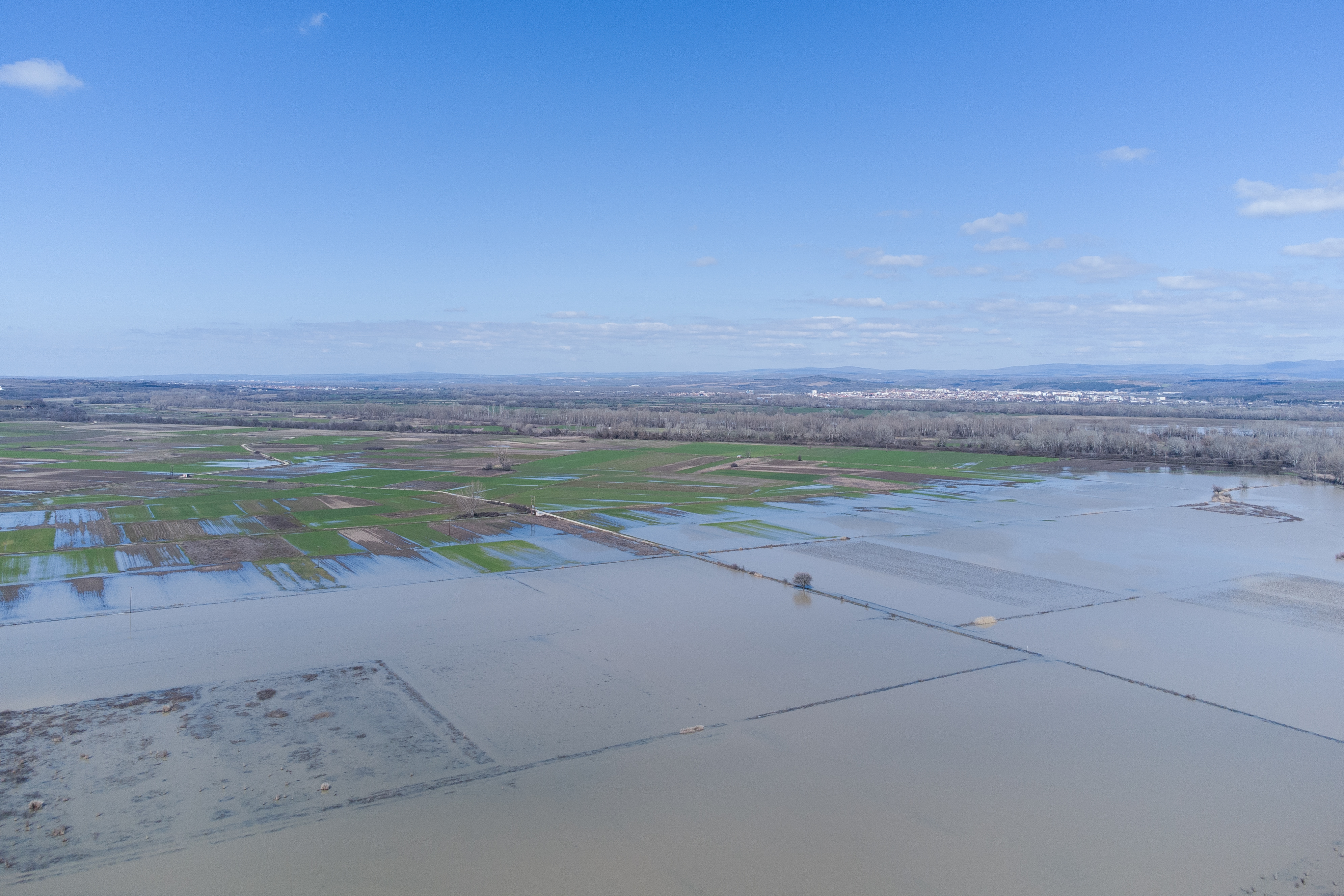
Thousands of acres of farmland have turned into lakes. Photo by Giorgos Kalkanidis
Water Management Projects: Nowhere to Be Seen
The contradiction is almost ironic. In winter and spring, water rushes through. In summer, the plain thirsts.
For Angelakoudis, the issue isn’t compensation after disaster. It’s prevention—above all, permanent water management.
“The water leaves. Everything you see now will end up in the sea. Nothing stays here,” he stresses.
“That’s why for years we’ve been saying we need management of the local streams. Small dams where possible. Hold back part of the water—not to stop the Evros, that can’t be done—but to have reserves.
“In Evros you can’t do whatever you want. But in the tributaries and local waters you can do things. The point is to design them in time.”
Delay, he says, costs twice: first as flood pressure, then as summer drought.
“Now we’ll wait six to seven days for drainage. Some fields will keep trapped water. With evaporation and sun, maybe they’ll dry. But we probably won’t get in before Easter. And early crops like sunflower fall behind. There you already have production losses.”
And the flood, he adds, is hitting land that was already fragile.
“Pressure on us farmers didn’t start with the water. Prices are low, costs are high, incomes are down. This is another blow—maybe the final one for some.”
In a region that depends almost entirely on agriculture, the damage doesn’t stay in the fields.
“When the farmer loses, the shop on the square loses. Restaurants lose. The whole market loses.”
“The Levee Is a Defense Line, Not a Solution”
Kostas Venetidis, deputy regional governor for Civil Protection in Eastern Macedonia and Thrace, knows that in Evros the word “emergency” has lost its meaning.
“The issue isn’t only how many cubic meters are coming down,” he explains. “It’s when they coincide. When the Evros trunk rises and at the same time we have intense local rainfall, the ground—already saturated—can’t absorb anything. The water stays.”
He reminds that a levee is a line of defense, not a permanent solution.
“We maintain about 200 kilometers of levees. There are interventions, reinforcements, monitoring. But when the level reaches the crest, it’s over.”
He doesn’t sugarcoat the situation.
“Evros is a cross-border river. Its drainage basin lies mostly outside Greece. The flows that arrive here started hundreds of kilometers away. So management can’t be unilateral.”
In this context, Venetidis speaks of the need for a multi-layer strategy: constant maintenance and strengthening of levees, small retention works in local streams, and better cross-border cooperation with Bulgaria on flows.
“We can’t control the trunk. But we can manage local waters better,” he stresses.
That brings the discussion back to long-debated projects—small dams or reservoirs in areas such as Therapio and Komara.
“The goal isn’t to ‘close’ the river. It’s to relieve the system—to reduce the flood peak and have reserves for irrigation season.”
From the Field to Politics—and Back Again
At a recent New Democracy pre-conference in Alexandroupoli, Prime Minister Kyriakos Mitsotakis spoke about “shielding” Evros, promising faster flood-protection works, the use of European funds, and stronger cooperation with neighboring countries on water management.
The announcement of a “comprehensive plan” may sound institutionally sufficient. But for farmers, the damage is not only the lost harvest—it’s the year that gets pushed back, the soil that changes, the uncertainty that piles up.
And so the same questions return, almost mechanically: Why does Evros flood again and again? Is it only the rain? Is it the volumes coming from Bulgaria? Is it the levees that confine the river to a narrow corridor? Is it the lack of water-management infrastructure—or all of it together?
Those who live here say the answer is never single.
Evros is a river of three countries, with a drainage basin that ignores borders and policies that don’t always align in time. Peaks released from Bulgarian dams, timing overlaps with the Tundzha and Ergene flows, local rainfall on already saturated ground, levees that are maintained but aging—together they form an equation that cannot be solved through cycles of announcements and post-disaster management.
In Evros, each wave of water tests the same limits: technical, administrative, political.
Farmers lift furniture, raise chickens, move animals, wait for the level to fall. The state speaks of plans, projects, cooperation.
The question is whether these two timelines—the plain’s and the administration’s—will ever meet.
Because if they don’t, then in two or three years the image will be the same again. Pumps will run through the night. The same stremmas will be counted. And the word “emergency” will keep being used for something that, here, has long since become normal.