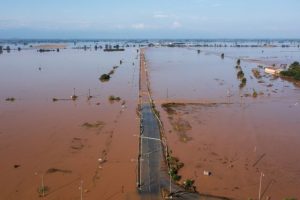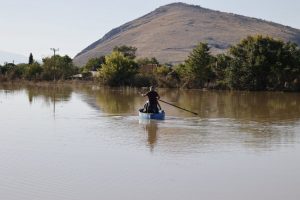
Thessaly now lives with a strange familiarity with destruction. Not with the terror of the days of “Daniel” or “Ianos” in 2023, but with that numbed feeling of a person who, after many losses, no longer lifts their head every time it rains. Two years on, floods have become a constant reminder that “here on the plain, promises disappear faster than the soil carried away by the water.” Residents no longer speak with anger, but with weary clarity: “They forgot us.” And perhaps this hurts more than the water that covered their property.
Yet while memory fades, reality persists. And while nature continues to test the region’s resilience, as it did recently with storm “Byron,” available funds for projects that could mitigate the destruction remain unused. Of the €50 million donated by banks—mainly for studies—less than €5 million has been spent to date.
At the same time, funds from the Recovery and Resilience Facility earmarked for restoring the road and railway network after the floods have been cut, while for four major flood-control projects announced by the government after the disasters, not even the studies have moved forward. How, then, did Thessaly “hold up” during the recent bad weather? Localized flood-control works by the Region diverted water into farmland, narrowly saving cities and villages—and with rainfall levels lower than those of 2023.
Plans Left on Paper…
The major projects announced by Prime Minister Kyriakos Mitsotakis—namely the dams at Mouzaki, Pyli, and Enipeas, and the canal from Gyrtoni to Lake Karla—remain idealized plans on yellowing paper. Speaking in Larissa in September 2024, the Prime Minister referred to the “great dowry” being prepared for Thessaly, highlighting these four projects, which, as he said, “will be studied using resources from the Hellenic Bank Association,” meaning secured funding and speed at the same time. “In this way, within a year we will have mature studies for projects we had been discussing for a very long time, but which essentially remained in our imagination,” he said.
More than a year later, the projects remain imaginary. The studies have not even begun, and the funds remain parked in Greek banks. A source closely monitoring the much-publicized Thessaly restoration plan, based on the master plan of the Dutch firm HVA International, notes: “When HVA delivered the master plan for the plain, it was agreed with the government that they would also proceed with the studies for the four projects. There was, as they were told, a ‘base’ of older studies that needed updating. But coordination was lost in translation, because what was handed over could hardly be called studies at all.” Remarkably, the fate of the Enipeas dam—tendered years ago and intended to proceed as a public-private partnership—also remains unknown.
It also remains unexplained why the €50 million provided by the Hellenic Bank Association (HBA) for waterworks studies—and possibly later for covering construction costs—remains unused. To date, only €4.8 million has been disbursed. The remaining €45.2 million remains with the donor banks, as no payment requests have been submitted by the contracting public authority, according to the HBA in response to a question from To Vima.
The core projects that would provide effective flood protection for Thessaly are estimated at around €1 billion. These include small-scale mountain watershed projects, expected to be tendered by the Hellenic Corporation of Assets and Participations in early 2026 and completed by autumn 2027, with a budget of around €200 million; as well as the dams at Pyli, Mouzaki, and Enipeas, with an estimated total budget of around €600 million. Also significant—as proven during the recent storm—are the completed projects of the Region of Thessaly and those under construction to be delivered in the coming months, totaling €140 million, as well as flood-control works on the Pineios River, for which €50 million has been secured from the NSRF.
At the same time, resources from the Recovery and Resilience Facility (RRF) have also gone unused. In the latest revision proposal of “Greece 2.0” (submitted to the Commission on November 20), intervention points for restoring the road and rail network in Thessaly have been reduced, along with available funding. Total cuts exceed €80 million, according to calculations by PASOK MP Pavlos Geroulanos, who monitors the Recovery Fund with a dedicated team.
Nevertheless, for both project packages—amounting to approximately €1.35 billion in total (including RRF funds)—contracts with contractors have been signed, and deadlines remain unforgiving. After next August, no further disbursements from the Recovery Fund will be possible. As for the Region’s projects, just days ago the inclusion of the Pineios River flood-protection operational plan in the NSRF was approved, with €4.7 million to begin studies, followed later by works using the €50 million already secured. In the coming months, the master plans for flood protection in Karditsa and Volos are also expected to be delivered. Moreover, from the €140 million package, most flood-control projects have already been completed and were precisely those that held the Thessaly system together in recent days.
The recent storm “Byron” was a reminder of how fragile the system on the plain remains. In the Enipeas River, water flow reached 80% of that of “Daniel” (950 cubic meters per second versus 1,190). “It was inevitable that the makeshift bridge there would not withstand it,” Thessaly Regional Governor Dimitris Kouretas told To Vima.
“If the Dam Existed”
At Tempi, where the waters of the Enipeas and Pineios meet, flow levels were only slightly lower than during “Ianos.” “However, during ‘Ianos’ we had 24 times more flooded farmland than during ‘Byron.’ The flood-control works we designed worked. But if the Enipeas dam and the mountain watershed projects existed, we would not have had a single hectare under water. Flood protection, compared to ‘Daniel,’ would have reached 80%,” Mr. Kouretas emphasized. The rainfall of “Byron” represents the limit of what Thessaly can withstand. “The embankments protected settlements and cities, and farmland was flooded. The water had to go somewhere. The government must fast-track the major projects so that we do not relive such disasters,” he stressed.
In any case, full protection will require years of systematic effort. HVA’s master plan includes a mix of technical works and organizational interventions with a total budget of around €4.5 billion, of which €2.6 billion αφορά infrastructure and flood-control projects, and the remainder other actions such as agricultural restructuring, strengthening civil protection mechanisms, and more.