
The gap between what men and women earn in Greece has changed little in recent years.
Women earned 13.4% less per hour than men in 2024, according to figures released today by the Hellenic Statistical Authority (ELSTAT). The rate was the same in 2022 and slightly higher, at 13.6%, in 2023.
The data mark the first official publication of gender pay gap statistics for 2024 and provide a three-year snapshot of earnings differences across the Greek economy.
ELSTAT defines the gender pay gap as the difference between the average gross hourly earnings of men and women, expressed as a percentage of men’s earnings. The measure is used to track disparities in pay across sectors and age groups.
Wide gaps in some sectors
Although the national average has remained stable, the differences vary sharply depending on the type of economic activity.
The largest gap was recorded in the Information and Communication sector, which includes media and telecommunications and according to the data, it keeps widening. In that field, women’s hourly earnings were lower than men’s by 24.5% in 2022, 24.9% in 2023 and 25.3% in 2024.
By contrast, the smallest gap — and one that favored women — was found in Water Supply, Waste Management and Remediation Activities. In that sector, men’s hourly earnings were lower than women’s by 4.8% in 2022, 4.4% in 2023 and 5.5% in 2024.
A negative gap indicates that, on average, women earned more per hour than men in that category.
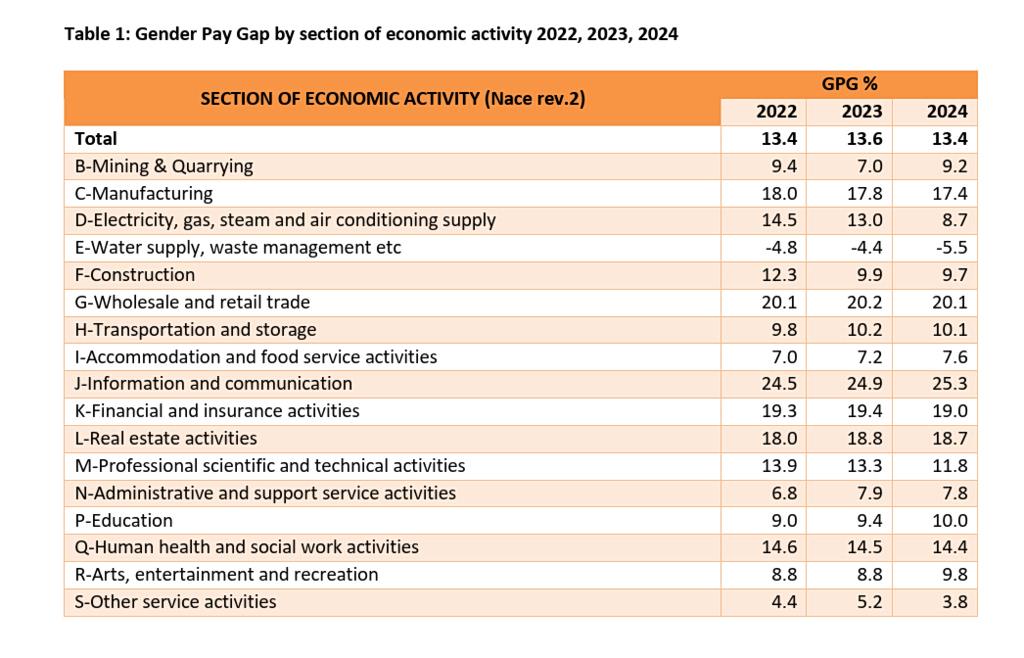
Source: Hellenic Statistical Authority ELSTAT
Differences by age
The disparities were also pronounced across age groups.
Workers aged 65 and older recorded the highest gap. In that group, women’s hourly earnings were lower than men’s by 27.1% in 2022, 25.1% in 2023 and 21.5% in 2024.
The smallest gap, again with a negative sign, was observed among workers under 25. In that age group, men’s hourly earnings were lower than women’s by 3.7% in 2022, 4.4% in 2023 and 3.4% in 2024.
The statistics cover enterprises with 10 or more employees. It doesn’t include employees working in public administration, defense and compulsory social security.
ELSTAT states that the 2022 results are drawn directly from the four-year Structure of Earnings Survey for that reference year. The figures for 2023 and 2024 were calculated using administrative data, with the 2022 Structure of Earnings Survey serving as the benchmark.