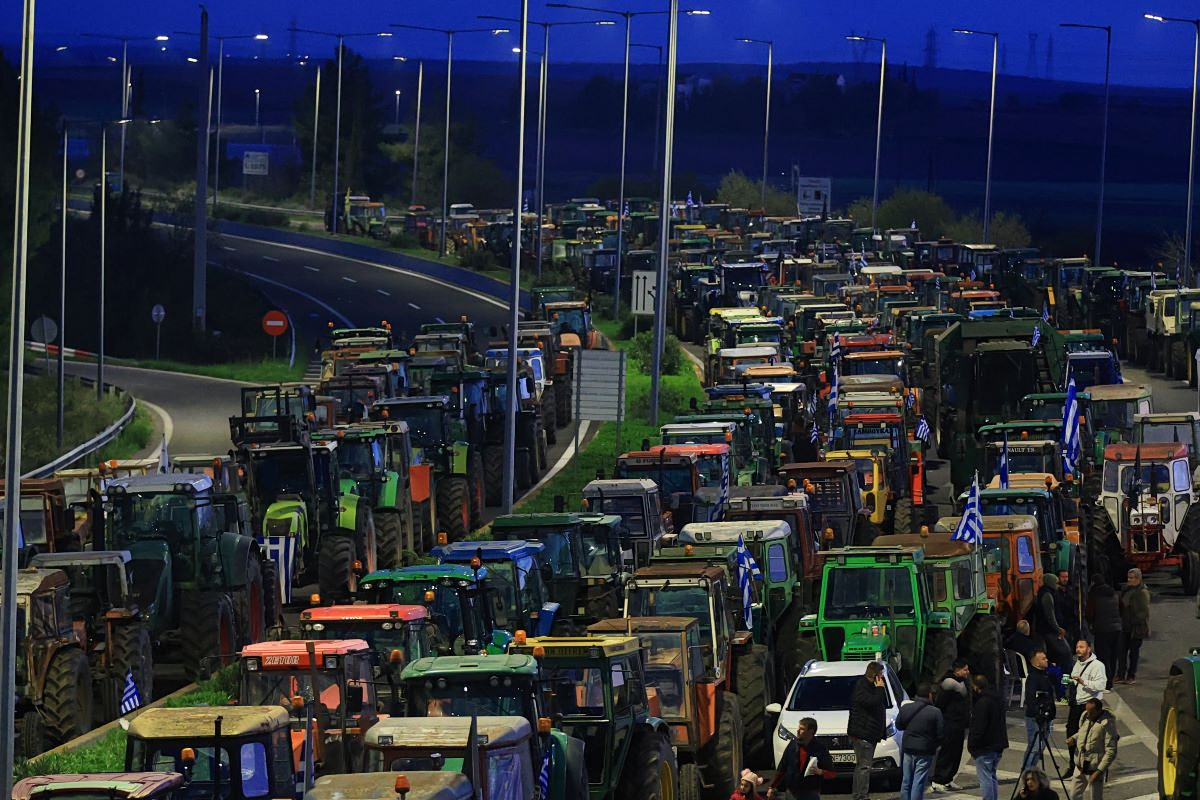
Farmers across Greece have intensified their protests for a fourth consecutive day, expanding roadblocks on key national highways and signaling an escalation that is drawing in other transport sectors. Demonstrators say they remain determined to continue their mobilization until their demands are met.
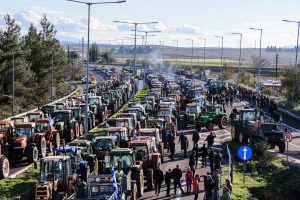
The country’s main north–south highway, connecting Athens and Thessaloniki, remains blocked at the Nikaia junction near Larissa, where farmers are also considering shutting down nearby detour routes. In Karditsa, the E65 motorway is also closed, with roughly 2,000 tractors positioned at the blockade.
The situation is similar at the Malgara tolls, where the northbound lanes toward Athens have been closed since Monday. On Tuesday evening, farmers also shut down the lanes toward Thessaloniki for at least two hours. Many protesters spent the night at the site in makeshift shelters, keeping fires lit as temperatures dropped.
The mobilizations continue to gain momentum. At Malgara, farmers are now joined by truck drivers who arrived on Tuesday, while taxi owners—already in the middle of a 48-hour strike—are expected to bolster the blockade today. The site currently hosts more than 200 tractors, and numbers continue to rise.
In Western Macedonia, farmers and livestock breeders from the regions of Kozani, Kastoria, Grevena, and Florina agreed during a meeting on Tuesday to move toward the Niki border crossing with North Macedonia on Thursday, aiming to block it. The decision follows the creation of a new protest point along the vertical axis connecting Kozani and Florina, part of the Pan-European Corridor X.
More mobilizations are planned in the coming days. On Saturday, farmers from Grevena, Kozani, and Kastoria will gather with their tractors at the Siatista junction on the Egnatia Highway to establish a joint blockade.
The protests have already disrupted border traffic. The Evzoni crossing on the frontier with North Macedonia reopened late Tuesday night after being blocked for four hours by farmers.
As the demonstrations widen and additional sectors join in, Greece faces growing transport disruptions and increasing pressure to address the demands of the agricultural community.