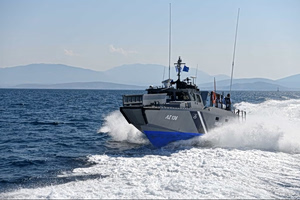
A vessel carrying 520 migrants was rescued off the southern coast of Gavdos island, south of Crete, in the early hours, marking the latest in a string of migrant arrivals that have pushed local services to the brink. This group, along with others already on the island, is now being gradually transferred to the mainland, starting with Piraeus.
Greek port and municipal authorities are struggling to manage the situation, as the number of migrants hosted in Chania and Rethymno now exceeds 1,500—the highest ever recorded in Crete. The migrants are being temporarily housed in makeshift facilities, such as the former Regional Market in Agia and the commercial port in Rethymno, both described as unsuitable for long-term accommodation.
Crete Under Pressure
In the town of Agia alone, nearly 900 migrants are currently housed, many of whom were rescued just days ago, including 45 people saved off the coast of Gavdos. Rethymno, too, is overwhelmed, with 624 migrants now sheltered in emergency spaces after new arrivals swelled existing numbers.
Local officials and port authorities have warned that the continued influx risks spiraling out of control. “We are suffocating under the weight of the migration crisis,” said Vasilis Katsikandarakis, president of the Western Crete Port Authority Union. He described Sunday’s arrival of 963 migrants along Crete’s southern shores as a record high, with the island experiencing a 380% increase in arrivals.
Katsikandarakis criticized the central government for failing to establish a strategic response plan, stating that port workers are “exhausted, working without rest or family life.” He also warned that the situation poses risks not only to public order but to the safety and well-being of coast guard personnel managing the crisis.
Transfers Begin Amid Logistical Hurdles
The first group of migrants has now begun transferring from Rethymno to Piraeus by regular ferry routes, from where they will be relocated to Reception and Identification Centers (RICs) on the Greek mainland. However, the process is slow due to limited passenger space on ferries, especially during the peak summer tourist season.
Eleni Zervoudaki, Deputy Mayor for Social Policy in Chania, acknowledged the strain, noting uncertainty over available capacity at mainland facilities. “The government should have planned ahead, instead of letting the situation escalate,” she said.
Mayor Giorgos Marinakis of Rethymno echoed the criticism, saying authorities had “no strategy” and failed to designate appropriate reception centers or increase support for overworked coast guard units.
Humanitarian Support on the Ground
Despite the challenging conditions, humanitarian efforts are underway. Volunteers from the Hellenic Red Cross have been assisting migrants in Agia from the start, distributing essential supplies such as blankets, sleeping bags, food, baby care items, and hygiene products. A truckload of aid was dispatched from Athens by order of Red Cross President Dr. Antonios Avgerinos.
Most of the newly arrived migrants are reported to be from Egypt, with smaller numbers from Eritrea, Sudan, and Ethiopia.