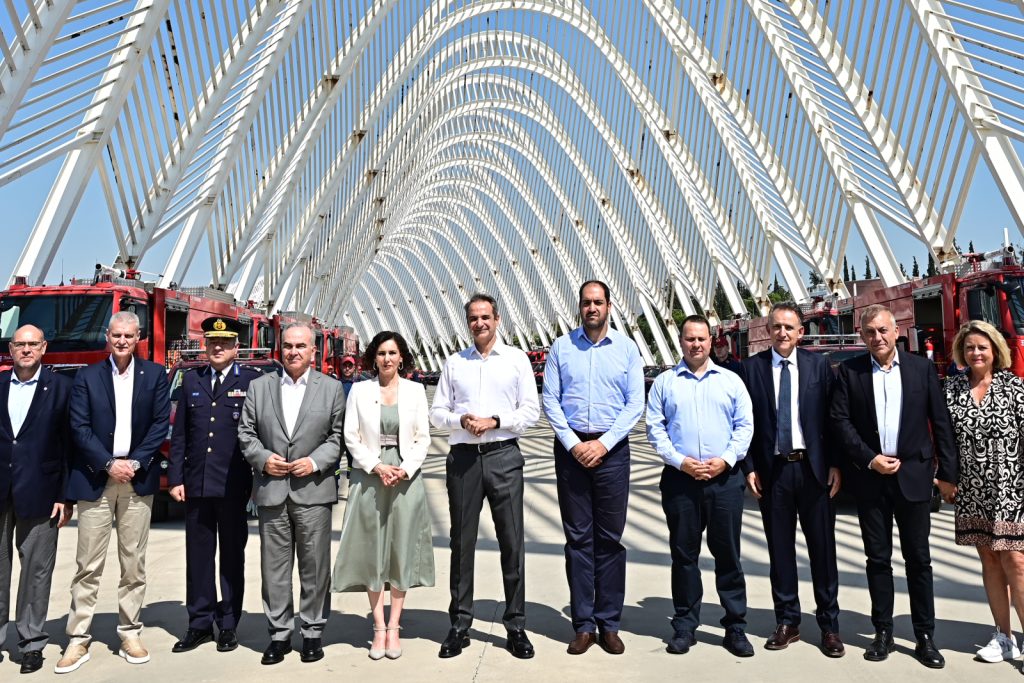
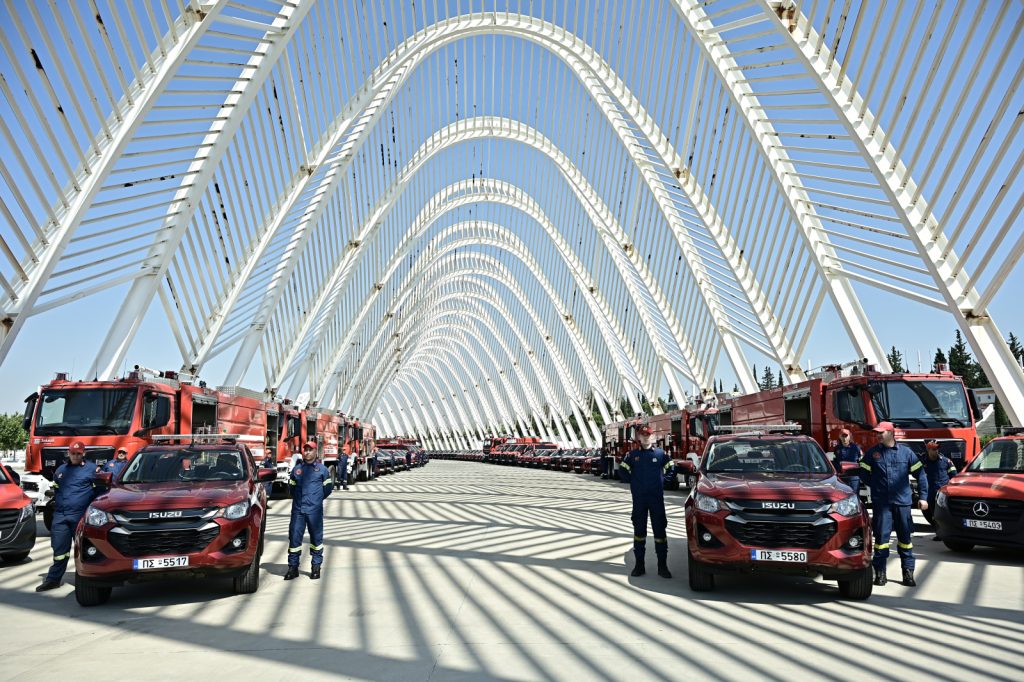
In a major step to strengthen Greece’s civil protection capabilities during one of the most challenging wildfire seasons in recent years, Prime Minister Kyriakos Mitsotakis announced the addition of 164 new vehicles to the Hellenic Fire Service. The vehicles were presented during an official ceremony held at the Athens Olympic Sports Complex (OAKA) on Friday, July 18, attended by EU Commissioner for Equality, Preparedness and Crisis Management Hadja Lahbib.
The vehicles — a mix of personnel carriers, all-terrain water tankers, and equipment transporters — are valued at €15.55 million and are equipped with cutting-edge communication and firefighting technologies. Each tanker can carry up to 12,000 liters of water, significantly enhancing the operational capacity of ground crews tackling both urban and forest fires.
Part of the Broader “AIGIS” Program
This delivery marks just the beginning of Greece’s broader strategic overhaul of its firefighting capabilities through the national civil protection program known as “AIGIS.” Financed by the EU’s Recovery and Resilience Fund, the program aims to renew and expand the fire service’s entire fleet. By the end of 2025, a total of 296 vehicles are expected to be delivered, with another 331 to follow in 2026.
When fully implemented, the “AIGIS” program will provide the Hellenic Fire Service with 1,400 new vehicles, advanced aerial firefighting tools, and modern equipment. It represents a €2 billion national investment in preparedness and response infrastructure, positioning Greece as a leader in civil protection within the European Union.
A Unified National and European Effort
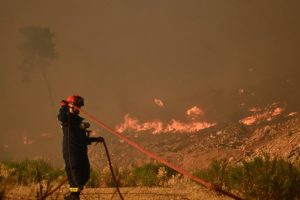
During his remarks, Mitsotakis highlighted the increasing intensity of the wildfire season due to climate change, which has brought extreme heat, strong winds, and rising fire risk. “This is one of the most demanding fire seasons in recent years,” he said, adding that the state has mobilized “the largest firefighting force we’ve ever had” — including 18,000 firefighters, over 1,500 forest commandos, 85 firefighting aircraft, 80 drones, and nearly 4,000 vehicles.
He emphasized the importance of prevention as well as rapid response, noting that “wildfires in the summer are extinguished in the winter” through forest maintenance, firebreak construction, and early intervention. More than €400 million has been allocated for these preventative efforts.
The Prime Minister also praised the role of European solidarity. Addressing the EU officials present, Mitsotakis thanked partner countries for standing with Greece during times of crisis, while affirming Greece’s commitment to reciprocate. He welcomed the European Commission’s recent proposal to increase civil protection funding in the next EU budget (2028–2034), and urged more investment in climate adaptation measures.
Commissioner Lahbib: “These Vehicles Represent Readiness and Solidarity”
European Commissioner Hadja Lahbib hailed the delivery of the vehicles as a symbol of EU cooperation. “These fire trucks are not just impressive machines,” she said. “They represent protection, collaboration, and readiness. Greece has shown time and again that solidarity is not an empty slogan—it’s a commitment.”
Transparent Procurement and Rapid Delivery
The equipment was procured through the Hellenic Republic Asset Development Fund (HRADF), with project oversight from the Ministry of Climate Crisis and Civil Protection. Panagiotis Stampoulidis, the HRADF’s Special Advisor, stated that over 90 contracts have been signed with 50 contractors. “The AIGIS program is not just an equipment procurement initiative—it’s a model of efficiency and institutional cooperation,” he said.
Minister of Climate Crisis and Civil Protection, Ioannis A. Kefalogiannis, underlined the life-saving importance of the program: “This isn’t just about legal contracts and tenders. This is about human lives saved, forests protected, and communities that remain resilient.”
Prime Minister Mitsotakis closed his remarks by reaffirming the government’s full backing for Greece’s firefighters: “Your mission is sacred. Our job is to ensure you have the tools, training, and technology to carry it out safely and successfully.”