Greece’s Ministry of Environment and Energy has sparked debate with a draft bill that would permit urban development in areas previously shielded under the European Union’s Natura 2000 network — the continent’s flagship system for protecting wildlife habitats and natural landscapes.
The legislation, which was opened for public consultation Tuesday evening, targets zones classified as Sustainable Natural Resource Management Areas that border existing towns or city boundaries. Under the proposal, local planning authorities could designate these buffer zones for residential development, provided that certain environmental safeguards are met.
A green light with conditions
Development would only be permitted if it is deemed compatible with an approved Environmental Impact Assessement (EIAs) and does not degrade the surrounding habitat. Crucially, no more than a fifth of each protected zone may be opened up to development.
Notably, some of these zones can include land already subject to additional special protections, such as forests, archaeological sites and their buffer zones, and designated biotopes.
A broad amnesty for illegal structures
The bill pairs the development proposals with a series of deadline extensions for legalizing unauthorized buildings across a range of protected and publicly managed spaces such as parks and forests — a longstanding and politically sensitive issue in Greece, where illegal construction has historically been widespread.
Municipalities will have until Dec. 31, 2027, to secure the necessary approvals for unauthorized structures inside public parks and green spaces, shielding them from the threat of demolition in the interim.
The same 2027 deadline extends to a sweeping range of structures in forests and forested areas that have long been operating outside the law. Livestock facilities, game farms, monasteries and auxiliary buildings — many without valid permits — are all brought within the scope of legalization. Ski resorts and their mechanical installations, whose previous regularization window had expired in 2025, are given another chance to get their paperwork in order. Water supply, irrigation, sewage and municipal sports facilities that have been operating unlicensed since their own deadline lapsed in 2020 are similarly covered. Summer camps that have been running without valid permits since before 2010 are also brought back within the legalization window. Unmanned mountain refuges operating without licenses can be formally approved through a joint ministerial decree, while tourist facilities on state-owned forest properties — also lacking proper documentation — will be retroactively recognized as legal through an administrative order.
Unblocking frozen property sales
The draft also addresses a practical headache for property owners caught in the slow-moving process of updating Greece’s national forest maps — documents that determine whether a piece of land carries forest status and which frequently delay or block real estate transactions.
For plots where objections or revision requests have been accepted, the bill allows notarial deeds to proceed by attaching the relevant committee decision and a topographic diagram, bypassing the requirement for a separate forest classification certificate. The change is designed to clear a backlog that has left many property sales in legal limbo.
The draft also takes aim at a problem that has left thousands of Greek property owners unable to sell their land. Greece’s national forest maps — which determine whether a plot of land is classified as forest, and therefore subject to strict restrictions — have been mired in disputes and revisions for years, effectively freezing many real estate transactions.
Under current rules, any property sale involving land of uncertain forest status requires a forest classification certificate, a document that can take years to obtain while objections and appeals work their way through the system. The bill would cut through this by allowing sales to proceed using the decision of the relevant review committee instead — provided that decision has gone in the landowner’s favor — along with a topographic survey of the plot. It is a pragmatic workaround, but one that critics could argue allows disputed land to change hands before its legal status has been fully resolved.
Ymittos and building bonuses
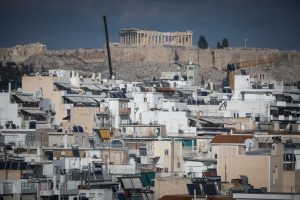
The bill also extends the suspension on building permits for Mount Ymittos — the iconic forested mountain overlooking Athens — until a new presidential decree is enacted, and no later than Dec. 31, 2026. The absence of such a decree is itself a years-long saga: Greece’s supreme administrative court struck down the previous decree governing (est. 2011) the mountain’s protection back in 2017, and a replacement has yet to be issued, leaving authorities to repeatedly renew the moratorium.
Certain exemptions to the Ymittos ban are written into the bill, however, including the installation of prefabricated school classrooms, the creation of open-air sports facilities in the municipalities of Voula and Kropias, and the construction of a chapel within the grounds of a local monastery.
Separately, the deadline for applying to reissue building permits under the so-called “environmental equivalence” scheme has been extended to the end of 2026. The scheme allows property developers to preserve construction bonuses that were previously invalidated by Greece’s Council of State — the country’s highest administrative court — by paying a fee into an environmental fund. A legal challenge against the scheme, brought by several municipalities and civic groups, was heard in court in early March, with a ruling still pending.