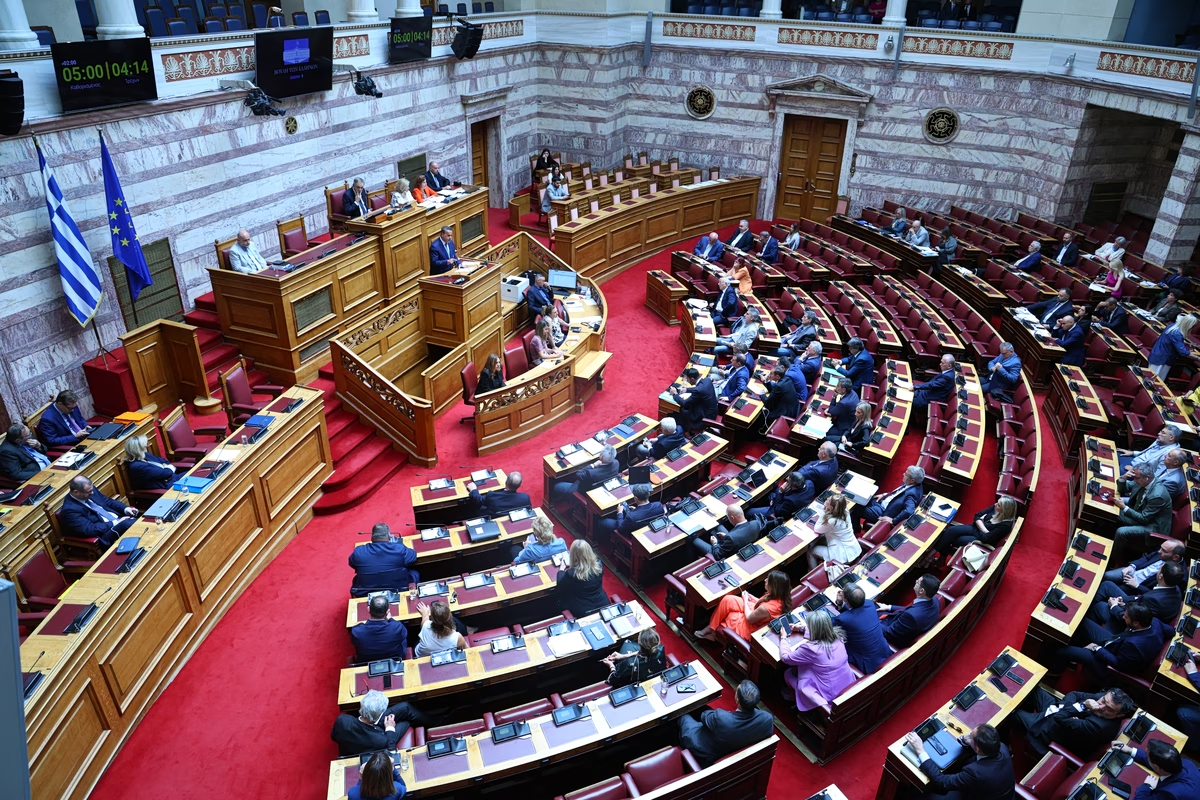
The Greek government has introduced a new legislative framework aimed at breathing new life into abandoned and declining villages, seeking to encourage sustainable development while preserving cultural heritage and protecting the environment.
The proposed measures, included in a bill submitted to parliament by the Ministry of Environment and Energy, amend Greece’s spatial planning and urban development legislation. The initiative is designed to create new opportunities for investment and the reuse of existing settlements that have been deserted or have experienced long-term population decline.
New planning framework
At the heart of the proposal are Special Environmental Upgrading and Development Plans, which will serve as dedicated urban planning tools for eligible settlements. These plans will be approved by presidential decree and may either stand alone or be incorporated into broader local urban planning strategies.
Municipalities and other authorized bodies will be able to submit comprehensive redevelopment proposals, including inventories of historic buildings, monuments, public spaces, natural features and adjacent land proposed for development.
According to the government, the objective is to promote the reuse of existing housing stock, preserve architectural heritage and attract investment without compromising environmental safeguards.
Which settlements qualify?
The legislation also updates the criteria defining eligible settlements.
An abandoned settlement is defined as one that existed before 1923 and recorded no permanent population in both Greece’s 1981 census and the country’s most recent national census.
A small and declining settlement is defined as one with fewer than 150 permanent residents that has experienced stagnant or falling population levels over the past 30 years. These settlements must either predate 1923 or have been officially designated under existing planning legislation.
Strict environmental safeguards
The proposed framework imposes strict conditions on any surrounding land that may be included in redevelopment projects.
Eligible areas must lie outside existing urban plans and cannot include forests, reforested land, archaeological sites, Natura-protected areas, other environmentally protected zones or highly productive agricultural land.
Projects will generally require a minimum area of 50 hectares, while redevelopment around abandoned settlements will be limited to areas between 50 and 200 hectares. A separate cap of 200 hectares will apply to inhabited islands.
The legislation will continue to exclude areas covered by the metropolitan planning frameworks of Athens and Thessaloniki. However, it extends eligibility to abandoned settlements on other inhabited Greek islands, provided they meet the required criteria.
Extensive review process
Before approval, each proposal will undergo a detailed technical and scientific assessment.
Applicants will be required to submit topographical and cadastral surveys, geological and geotechnical studies, land ownership documentation, forest classification decisions, stream boundary proposals and spatial planning studies demonstrating that the project is compatible with the wider area’s character.
Final approval will also require an opinion from Greece’s Central Council for Urban Planning Issues and Disputes.