July has traditionally marked the first of the two peak months of the tourist season, with Greek islands at its center. But alongside the crowds, relaxed pace, and packed beaches and lanes comes a set of problems, some of which have become permanent fixtures.
Chief among them, especially during these vacation weeks, is one that island municipalities must constantly manage: water supply. Water scarcity, which in recent years has grown into a lasting threat across many parts of Greece, is back in the spotlight, exposing the limits of existing infrastructure, the natural “endurance” of many islands, and the need for long term planning.
The climate crisis, declining rainfall, the increasingly rapid depletion of aquifers, rising demand during the summer months, and mounting pressure on natural resources overall combine into a complex problem.
Scientific estimates suggest the Eastern Mediterranean is among the regions expected to be hit hardest by climate change, with more frequent prolonged droughts and shrinking water reserves.
Against this backdrop, the state has recently placed several islands under a state of emergency due to water shortages, in order to speed up the implementation of water supply and desalination projects. These include Tinos and Alonnisos, as well as Meganisi, and Patmos.
The causes, however, run deeper and are more numerous than they might appear. Although public debate often links water scarcity solely to overtourism, something that undeniably plays a role, mayors on many of the affected islands insist the reality is more complicated.
As they emphasize, the cause isn’t simply the rise in visitor numbers, but a combination of factors: years of below average rainfall, a deteriorating water table, outdated infrastructure, and, in some cases, unchecked consumption.
A problem that’s here to stay
The five cases examined in this “TA NEA” investigation share notable similarities, but also key differences.
- Tinos points to overconsumption
- Alonnisos to depleted reserves
- Meganisi to inadequate supply
- Patmos to the decisive role winter rains played this year, and
- Kythnos to an aquifer that has now reached its limits
What they share, though, is a need for new infrastructure and better water management. Desalination units, new storage tanks, cutting network losses, and building a culture of conservation have become permanent fixtures of daily life for island municipalities.
At the same time, similar pressures are being recorded on other islands in the Aegean and the Dodecanese, such as Leros, as well as in other island regions closely monitoring their water reserves ahead of summer, as water scarcity becomes one of the defining environmental and development policy issues of the coming decade.
No time to wait
The reality, in any case, is unforgiving and leaves no room to sweep the problem under the rug. Water scarcity is no longer an occasional phenomenon tied only to periods of low rainfall. It’s becoming a permanent feature of the new climate reality, especially in Greece and the wider region.
With July now well underway and thousands of Greeks and tourists already on vacation, local authorities face a delicate balancing act: ensuring residents and visitors enjoy a summer free of water supply problems, while knowing full well that the real battle over water won’t be decided this year, but in the years ahead.
The water comes from Lefkada, but it doesn’t arrive
Meganisi has its own particular situation. The island doesn’t rely solely on local water sources; instead, it’s supplied from Lefkada through an undersea pipeline. The problem, according to Mayor Gerasimos Katopodis, is that the existing borehole feeding the system can no longer meet demand. The municipal authority itself requested that the island be placed under a state of emergency, in order to cut through bureaucratic delays and move forward with infrastructure projects.
A new desalination unit with a capacity of 600 cubic meters per day has already been installed, and a 1,000 cubic meter storage tank is next. Last summer, residents experienced nightly water cutoffs from midnight until 6 a.m. “We’re hoping that with the new unit, this will stop,” the mayor notes. He’s also appealing to both residents and visitors to use water wisely, stressing that conservation remains essential even as infrastructure improves.
The problem isn’t overtourism, it’s overconsumption
Tinos is among the islands recently declared to be in a state of emergency due to water shortages, a development that understandably raised concern ahead of the summer season. Still, Mayor Panagiotis Krontiras sounds reassuring about water supply for this summer. “Right now we have normal water service with no problems at all,” he says, explaining that the emergency status functions mainly as an administrative tool to speed up procedures that would otherwise take months.
According to him, funding for renting desalination units was recently approved, and the emergency declaration allows for their rapid installation within a few weeks instead of several months. The mayor rejects any link between the water shortage and overtourism, telling “TA NEA”: “Tinos doesn’t have an overtourism problem. We face pressure for about forty days a year, and that’s manageable.”
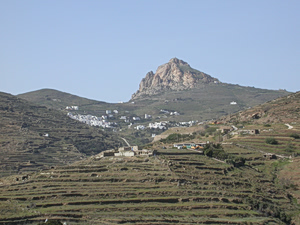
The traditional village of Sperados. Tinos, Greece. Source: Wikimedia Commons
Instead, he points to changing consumption habits. As he notes, the uncontrolled spread of private swimming pools, unauthorized boreholes, and excessive irrigation of large gardens are putting extra strain on an already burdened system. “We need to change our mindset. Water is a precious resource,” he emphasizes. Tinos’s case shows, perhaps better than any other, that water scarcity isn’t purely a matter of visitor numbers. It’s also a matter of management, consumption, and adapting to a new environmental reality.
Seven boreholes, shrinking reserves, and a race against time
Alonnisos is one of the clearest examples of an island where rising tourism coincides with dwindling water resources. Despite being placed under a three month state of emergency, Mayor Panagiotis Anagnostou insists the measure isn’t about optics.
“This isn’t a PR move or small scale political opportunism. It’s the official acknowledgment of a reality we live with every day,” he says. Years ago, the municipality had just a single borehole. Today there are seven, though many show reduced output as underground water reserves have shrunk significantly. The mayor also makes clear that tourism growth isn’t seen as a threat to the island. “We’re not at saturation on the tourism side. We have no problem welcoming visitors,” he tells “TA NEA.” The real challenge is different: securing enough water at a time when natural sources are producing less and less.
Winter rains held off the worst
Patmos is probably the clearest example of how decisive weather conditions can be for an island’s water security. Just a few months ago, the island’s reservoir had reached a critical low. “The reservoir had literally hit bottom,” says Mayor Nikitas Tsampalakis. The situation was serious enough that the municipal authority itself requested a state of emergency last November, which will remain in effect through the end of July.
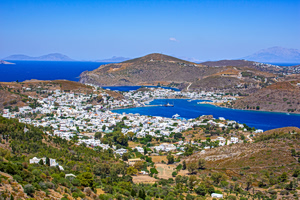
Town of Skala is the port in Patmos island, Dodecanese, Greece. Source: Shutterstock
The picture today, however, is noticeably better, thanks to winter rainfall that refilled the reservoir, along with an expanded desalination network. “The winter rains saved us,” the mayor admits, speaking to “TA NEA.” Beyond the two existing desalination units, a new project budgeted at 830,000 euros is moving forward for the Kambos area, which has long struggled with water shortages. Patmos looks better prepared this year than in the past, but local authorities know that this year’s relative comfort owes much to favorable winter weather rather than a lasting fix to the underlying problem.
In the “red zone” every summer
Kythnos isn’t among the islands currently under a state of emergency over water shortages. That doesn’t mean it’s free of serious pressure, though. Far from it: according to Mayor Stamatis Garderis, the island operates on a razor’s edge every year during the summer months. “We’re in the red zone especially in July and August,” he stresses.
The municipality is constantly making interventions to meet rising demand, but acknowledges these aren’t a permanent solution. The core problem is the depletion of the aquifer. To address it, the municipal authority has drawn up a comprehensive plan centered on desalination and new storage tanks. “Based on the plan we’ve submitted to the Ministry of Environment and Energy, the water supply problem should be resolved for at least twenty years,” the mayor argues. Kythnos stands out as an island where water scarcity isn’t a one off emergency but a chronic condition requiring strategic planning and long term investment.