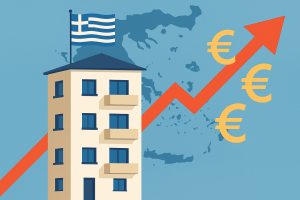
Nearly four in ten Greeks allocate over 40% of their disposable income to rent a house, according to a Bank of Greece (BoG) report, placing them at the bottom of the list in the European Union regarding housing affordability.
The report, compiled jointly by the Bank of Greece and researchers from the Foundation for Economic & Industrial Research, revealed that the percentage of households burdened with higher housing costs rose from 28.7% in 20218 to 30.9% in 2021.
While the rise in housing costs impacts rural, semi-rural, and urban regions, the latter appear to have borne the brunt of the increase, with 32.2% burdened in 2021.
The report indicates a notable discrepancy between geographical regions, with the northern Aegean (45.7%) recording the highest rate, followed by Epirus (38%). The region of Attica, where the largest share of the population is concentrated, shows a housing cost overburden rate of 35.4%, while Thessaloniki follows closely at 35.0%. In contrast, Central Greece records the lowest rate at 23.4%.
Around 60% of households renting a property spend more than 40% of their disposable income on housing – a figure that remained stable between 2018 and 2021. In urban areas, the rate rises to 62.0%. By comparison, only 15.3% of homeowners without a mortgage face similar housing cost pressures.
Demographics play a crucial role in housing affordability. Younger households (18–29 years) face the greatest difficulties, though affordability improves with age before worsening again for those over 85. Employment status is also critical, with unemployed individuals being 15% more likely to experience housing cost overburden than employed individuals.