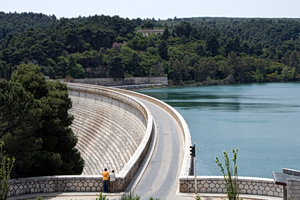
Water reserves in Greece’s Mornos reservoir have more than tripled within six months, marking a dramatic turnaround after concerns over drought and low levels raised alarms in late 2025.
The sharp recovery has reshaped the artificial lake’s landscape, once again submerging the abandoned village of Kallio, which had briefly re-emerged when water levels fell to historic lows.
From record lows to rapid recovery
In October 2025, the reservoir reached its lowest point in 15 years, with water reserves dropping to approximately 157 million cubic meters. By early April 2026, levels had risen sharply to nearly 492 million cubic meters, according to available monitoring data.
The increase has also expanded the surface area of the lake from 8.3 square kilometers in October to 14.7 square kilometers in April, restoring a significantly larger water footprint across the basin.
The recovery has reversed the striking visibility of Kallio, a long-abandoned settlement that had reappeared during the drought period. Recent aerial footage shows most of the village once again submerged, with only fragments of structures visible above the waterline.
Weather conditions drive sharp improvement
Experts attribute the improvement to unusually strong rainfall and improved snow coverage across the wider catchment area feeding the reservoir.
According to meteorological data, precipitation levels during the first quarter of 2026 reached their highest point in a decade in the region. Snow coverage, which had been below average earlier in the year, also recovered following recent weather systems.
While conditions in March were initially weaker, later weather events helped restore more typical seasonal levels.
Cautious optimism over water supply
Despite the significant rebound, experts stress that conditions remain slightly below long-term seasonal averages and caution against complacency.
Higher temperatures expected in the coming months are likely to increase evaporation, while water demand will also rise during the warmer period.
Authorities note that while the situation has improved markedly compared to autumn 2025, continued monitoring and favorable rainfall in the next hydrological cycle will be essential to ensure long-term stability of water resources.