More than 6,150 hectares (15,200 acres)—about 55% of the total area burned—were destroyed during nighttime flare-ups in the major wildfire that swept across the Attica-Viotia (Boeotia) region between July 31 and Aug. 4, according to a preliminary analysis by the FLAME pyro-meteorological team at the National Observatory of Athens’ Meteo unit.
The study estimates that the wildfire scorched a total of 11,173 hectares (27,614 acres) over approximately 91 hours, from the morning of July 31 until the morning of Aug. 4.
Using satellite thermal hotspot data, researchers reconstructed the fire’s progression, concluding that the blaze ignited north of Agios Vasileios in Viotia on July 31 before initially advancing toward the coast, burning about 1,507 hectares (3,724 acres) during its first 10 hours.
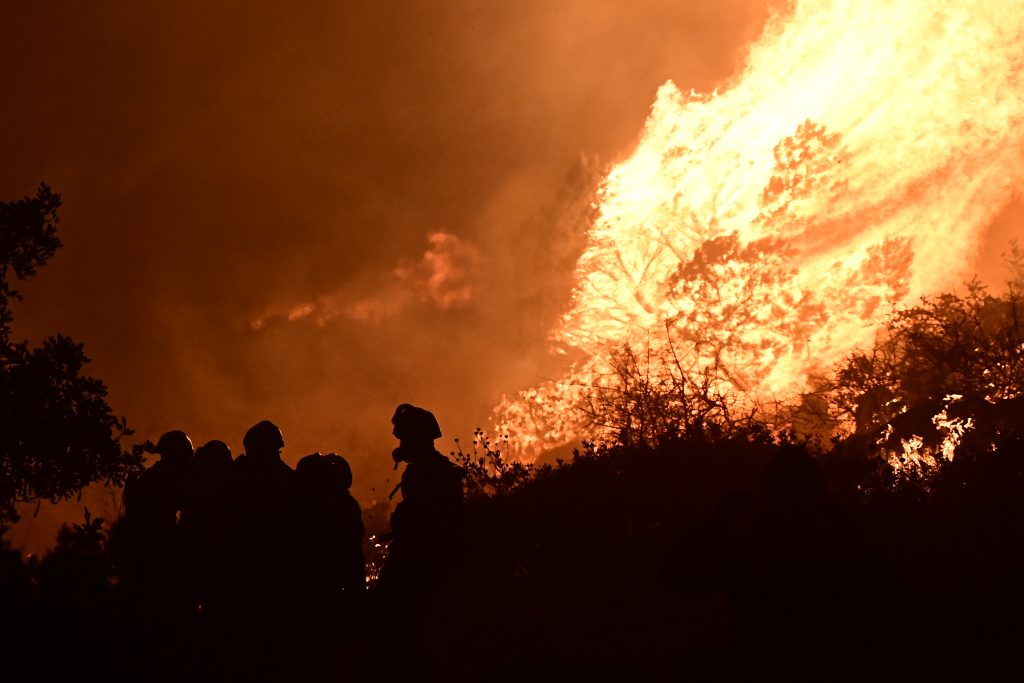
Wildfire in Porto Germeno, Friday 31 July 2026. (ΜΙΧΑΛΗΣ ΚΑΡΑΓΙΑΝΝΗΣ/EUROKINISSI)
The analysis identified two major overnight runs as the defining phases of the wildfire.
During the first, between 7 p.m. on July 31 and 7 a.m. on Aug. 1, nearly 3,400 hectares (8,402 acres) burned as northerly winds intensified to more than 80 kilometers (50 miles) per hour. After continuing eastward during daylight hours on Aug. 1, the blaze entered a second overnight surge, spreading south and southeast between 7 p.m. on Aug. 1 and 7 a.m. on Aug. 2, destroying another 2,781 hectares (6,872 acres) under winds reaching 70 kilometers (43 miles) per hour.
Researchers estimated that the fire released at least 380 terajoules of radiative energy—an amount Meteo said is roughly equivalent to the energy released by six Hiroshima-type atomic bombs.
The reconstruction combined satellite observations from three different sensors and was independently validated against three official intermediate fire perimeters produced through the Copernicus Emergency Management Service.
The findings come after one of the most destructive wildfire outbreaks of this year’s fire season in central Greece.
Over the past week the Attica-Viotia wildfire prompted a large-scale firefighting operation involving ground crews and aerial assets as powerful winds repeatedly fueled rapid fire spread. Firefighters remained deployed for several days to contain flare-ups while civil protection authorities warned that persistent strong winds and exceptionally dry conditions continued to create extreme wildfire risk across central Greece.