 Μake us preferred on Google
A solitary bee that builds its nest underground may hold the key to one of the plastics industry’s biggest challenges: making materials that are durable while in use but do not linger in the environment for centuries.
Researchers from Virginia Tech, the University of Tennessee and the University of Minnesota have found that the plastic-like lining of cellophane bee nests breaks down in ordinary soil far faster than comparable human-made plastics. The findings were published on November 2 in the Proceedings of the National Academy of Sciences.
A Bee That Makes Its Own Plastic
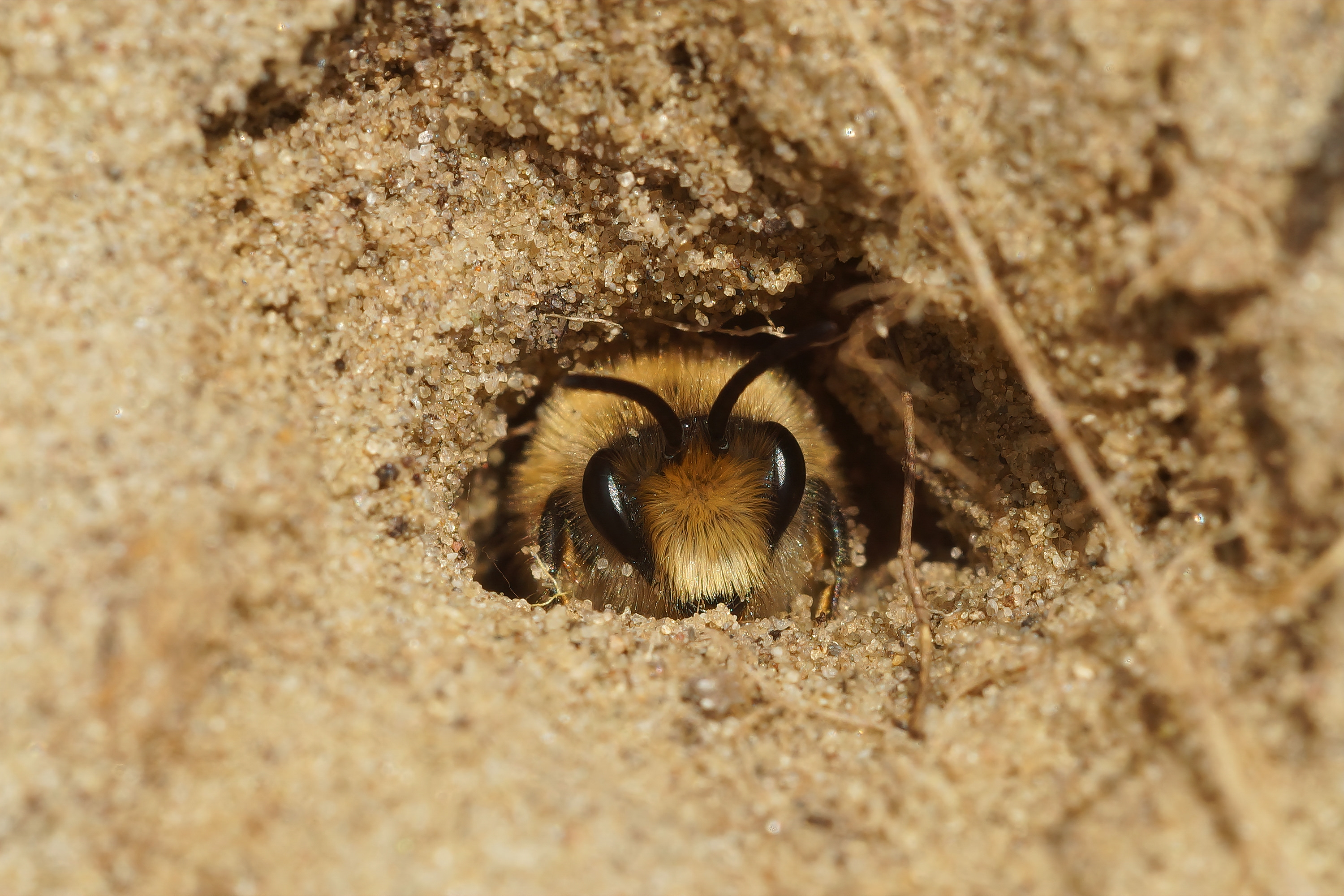
Cellophane bees get their nickname from the thin, transparent film that lines their underground nests, resembling the familiar packaging material. Each female digs her own tunnel and secretes a liquid from a gland near her stinger, spreading it across the walls of a nest chamber. There, small molecules link into long chains to form the lining. She then fills the chamber with pollen and lays a single egg.
Scientists first reported in the late 1970s that these bees make their own polyester, but the material received little attention for decades afterward. The lining is roughly three-quarters plastic and one-quarter silk.
What makes the bee’s polyester remarkable is how closely it resembles polyethylene, the plastic used in milk jugs, food containers and countless everyday products. Polyethylene makes up roughly a third of global plastic production, about 160 million tons a year, and can persist in the environment for centuries. The bee material shares several of its features, including a similar degradation temperature and crystal structure.
Yet cellophane bees nest in colonies of more than 10,000 nests, year after year, and their plastic doesn’t appear to build up in the soil.
How Fast It Breaks Down
To study the material, the team dug up nests of the unequal cellophane bee (Colletes inaequalis), a common North American species, from Tennessee sites in March, July and October 2023 and February 2024, reaching the nest cells about 7 to 12 inches below ground.
For the first four months, the linings stayed largely intact and flexible. By around seven months, when the larvae had developed into adult bees, cracks had formed. Within about a year, the linings crumbled when handled.
Measurements confirmed the trend: polyester made up about 73% of fresh linings by weight, falling to about 40% after just four months. That surprised the researchers, since it meant the plastic was breaking down faster than the silk, a protein fiber known to degrade easily. By comparison, a related lab-made plastic lost only 18% of its mass after 280 days in industrial composting, a far harsher environment than ordinary soil.
The result was all the more unexpected because the material is semicrystalline and likely contains chemical cross-links between its polymer chains, features that usually make plastics harder to break down. Lead author Jonathan Coote, an assistant professor of sustainable biomaterials at Virginia Tech, said the conventional wisdom suggests such features should slow degradation, but that is not what the team observed.
Why It Degrades So Quickly
The researchers don’t yet know exactly why the bee plastic breaks down so fast and plan to investigate further. One possibility is that its polymer chains are of mixed lengths and pack together irregularly, leaving more of the chemical bonds exposed to water. If so, chemists might be able to build similar flaws into synthetic plastics on purpose to make them more biodegradable.
Another possibility is that enzymes play a role. Water rinsed from both fresh and four-month-old nests showed signs of esterase enzymes, which cut the type of chemical bond found in polyester. These enzymes could come from the bees themselves or from microbes in the nest.
The authors note some limitations: each nest holds only a few milligrams of lining, some tests on older nests were run just twice and most of the aging data came from a single nesting site.
Bees as Inventors, Not Factories
The goal is not to farm bees for plastic. Instead, the researchers want to understand the chemistry well enough to reproduce its useful features in manufactured materials that can be made at scale.
“I don’t see a future where we have these massive bee farms making all of our plastic products,” Coote said.
The project grew out of casual conversations between Coote, who studies plastics, and Laura Russo, an ecologist at the University of Tennessee who studies bees and knew of the species. Coote met Russo while he was a doctoral student in Tennessee and later urged her to take a closer look at the bees, noting that little substantive research on the nest material had been done since around 1980.
If the bees’ approach can be copied, the authors say, engineers could create plastics that keep the strength of polyethylene while being far easier for the environment to break down.