 Μake us preferred on Google
The investment, the fund’s first since its establishment, is linked to plans by ICEYE to build its largest production facility in the east Mediterranean country, with the capacity to manufacture and export up to 150 satellites annually and create more than 230 highly skilled jobs.
The financing involves the acquisition of preferred shares in ICEYE and forms part of a broader 485-million-euro funding round involving international institutional investors, including sovereign wealth funds from Qatar, France, Poland and Finland, as well as BlackRock and General Catalyst.
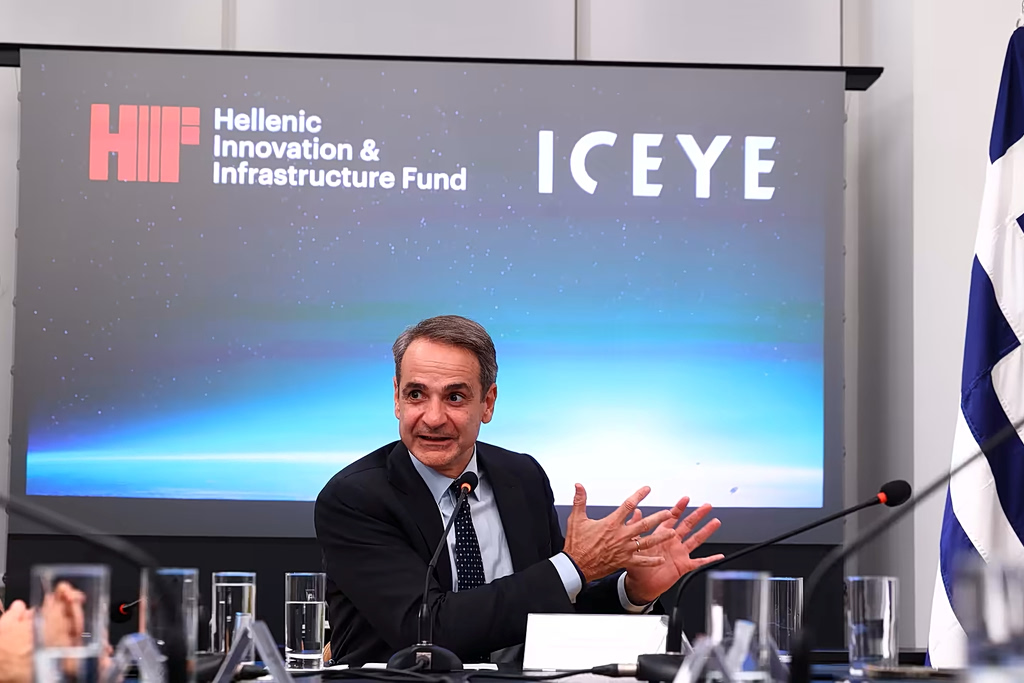
Prime Minister Kyriakos Mitsotakis attends an event announcing an investment by the Hellenic Innovation and Infrastructure Fund in ICEYE, Wednesday, Nov. 11, 2026 (POOL / Ismini Vlassopoulou / INTIME VIA EUROKINISSI)
ICEYE already operates a production line for satellite subsystems in Neo Psychiko, northern Athens. Its planned new facility will incorporate the full range of satellite assembly, integration and testing capabilities, alongside the manufacture of subsystems.
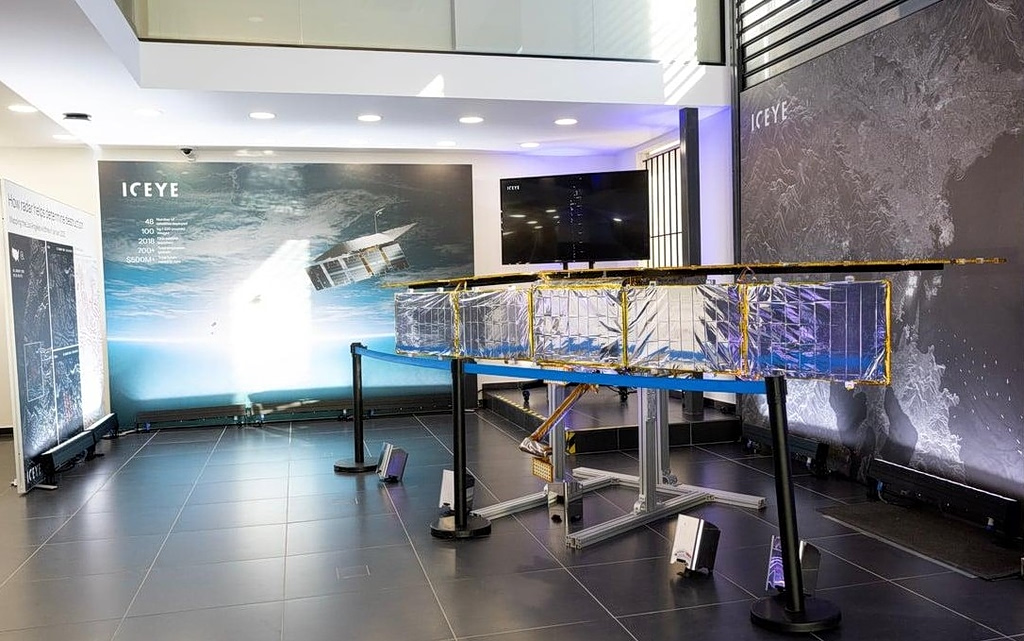
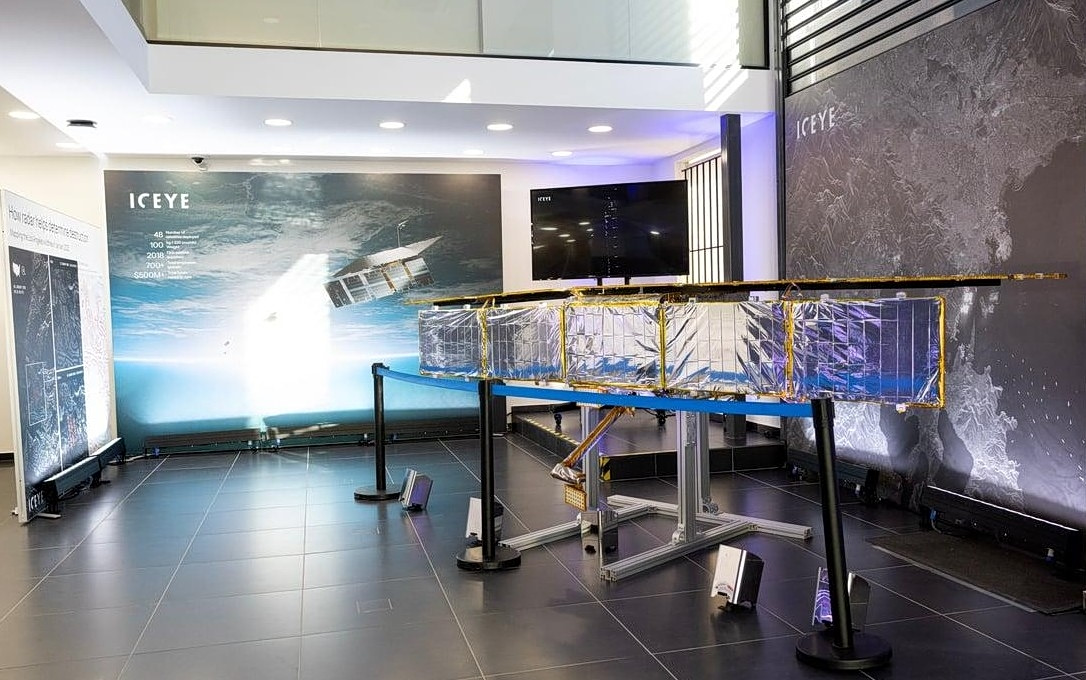
The company is already involved in Greece’s National Microsatellite Program and manufactured the country’s first two Synthetic Aperture Radar (SAR) satellites.
Speaking at a meeting at the HIIF offices, Mitsotakis described the investment as a major step toward transforming Greece’s economic and industrial model, arguing that it demonstrated the country’s ability to attract high-value manufacturing and advanced technological activities.
“This is a major leap that we are making in our country,” he said, adding that the project was evidence that Greece’s productive model was undergoing a substantial transformation.
The prime minister said the investment had both strategic and economic significance, with the Greek state expecting financial returns from its participation in the company.
He also attributed ICEYE’s decision to establish its largest production base in Greece to the quality of the country’s scientific and engineering workforce, as well as the potential to create well-paid jobs and encourage Greek scientists and engineers working abroad to return home.
Greece expands its national space capabilities
The investment builds on a series of developments over the past year aimed at establishing Greece as a producer of satellite technology rather than merely a user of space-based services.
A major milestone came on Nov. 28, 2025, when two ICEYE-built SAR microsatellites were launched into orbit under the National Microsatellite Program. Their radar technology can capture images at night and through cloud cover, providing data for national defense, civil protection, disaster management and environmental monitoring.
On July 7, 2026, Greece launched Hyperion GR-1, the first of seven domestically developed optical microsatellites. Built by Open Cosmos Aegean at its facilities in Pallini, eastern Attica, the satellite provides high-resolution imagery for applications including wildfire detection, flood monitoring, maritime surveillance and precision agriculture. The launch marked another step toward developing domestic satellite design and manufacturing capabilities.
In July, the government also unveiled HELLAS-SPACE 2.0, a 350-million-euro national space strategy designed to expand the country’s infrastructure, research and industrial capabilities, building on the initial microsatellite program. Its priorities include advanced optical and thermal satellites, intelligence-gathering capabilities, secure communications and the development of domestic space technology companies.
Further infrastructure is being developed in Crete, where a satellite ground station at the Foundation for Research and Technology-Hellas is intended to serve as a communications and operational hub for the country’s microsatellite fleet.
Defense, civil protection and scientific research
Mitsotakis said the satellite capabilities already developed provide valuable imagery and data for national defense, civil protection and mapping across Greece.
He also referred to the planned mission of Greek astronaut Adriános Golemís to the International Space Station in 2027. According to the prime minister, Golemís is expected to spend 15 days aboard the station conducting scientific experiments.
The government views the ICEYE investment as part of a broader effort to strengthen Greece’s position in the European space industry, increase high-technology exports and develop a domestic industrial ecosystem.