“If we come across an incident of violence, we’ll pretend we didn’t see it.” Fifteen-year-old G. answers BHMA’s question and lowers his head. Two boys his age, members of his group of friends, pick up where he leaves off and continue: “And even if we did report it, nothing would change. We don’t want teachers or other adults to get involved because things would get worse…”
Our conversation takes place in the central square of Acharnes together with members of the “Street Work” team, who focus precisely on supporting young people and trying to prevent incidents of adolescent violence. Psychologists, volunteers, and specialized scientists talk directly with young people on the streets of areas where violent incidents have been recorded, attempting to trace their causes.
At the meeting in Acharnes Square, the three teenagers answer a series of questions. At the center of the discussion—unsurprisingly—is the Kypseli incident and the 16-year-old girl who stabbed a classmate inside her school last week. Also central is the fact that violence among young people, inside or outside school grounds, has become a reality that continues to shock us: every year, more than 3,000 children end up in pediatric hospitals and clinics as a result of violence between peers.
The members of the “Street Work” team operate within the framework of the pilot program “It’s Up to Youth,” aimed at providing psychological support to young people. The program is being implemented for a second consecutive year by the Society for Regional Development and Mental Health (EPAPSY) in the municipalities of Amarousio, Acharnes, Kifissia, and Pefki, in collaboration with Panteion University and the University of West Attica.
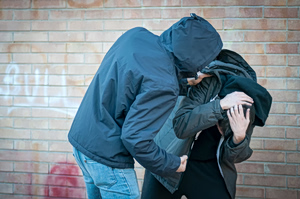
As a result, street-level conversations are becoming increasingly revealing. “Okay, a couple of slaps don’t count as violence,” a 16-year-old in Kifissia replies, revealing that many adolescents do not perceive “minor” physical confrontations as violence—they see them as part of everyday interaction. In short, it is part of their normality. Many even carry, as they say, “something to defend myself if I’m alone and someone attacks me”—a knife, a butterfly knife.
Discussing violence with a group of teenagers, they talk about pre-arranged fights after school or late at night, as well as rivalries between schools or neighborhoods (e.g. Kifissia–Nea Erythraia).
The children, however, want to talk. This also emerges from To Vima’s on-the-ground reporting, which followed the team of scientists and volunteers of the program for a month: outside the electric railway station and at the 8th Gymnasium in Marousi, at the Mela shopping center in Kifissia, in Acharnes Square and the courtyard of the 11th Gymnasium of Acharnes, at the shopping center and along Eirinis Avenue in Pefki. Everywhere, the same picture: teenagers eager to talk about the problem.
In the square, at the mall, on the street between school and tutoring center, they are willing to stop, discuss their experiences and concerns, and help—either by filling out an anonymous questionnaire, placing a pin on a neighborhood map to indicate places where they feel safe or unsafe, or by drawing or writing something.
In Acharnes Square, 14-year-old D. describes feeling more at risk when he is alone—two peers had attacked him with a knife in the past. As he says, he would get involved in a fight to support his group, as he has done before. “There’s a group over there in Kapota… but we also jump them when they mess with us,” a student whispers in the courtyard of the 11th Gymnasium of Acharnes, while nearby some of his classmates are drawing about juvenile delinquency.
“That doesn’t count as violence,” a girl mutters as she tries to glue sequins onto the slogan “No violence in schools,” next to the phrase “we can’t fix it if we never face it,” written in black marker by another classmate. Nearby, a child has stuck the It’s Up to Youth QR code (from the informational material distributed) and written a large “Follow” next to it—I realize that today’s action may indeed have an impact.
“It’s no coincidence that almost all the children who come into the program, either as cases or participants in activities, have either witnessed violence around them or have been involved themselves, or someone close to them has,” Valeria Linardou, social worker and scientific coordinator of It’s Up to Youth, tells BHMA. “Perhaps we have too easily labeled children as being glued to the internet and social media. That’s true—and things have reached extremes,” she says. “But on the other hand, our activities have shown that children can interact and socialize, communicate, and express their views about violence. They are not closed off in themselves and their own world.”
“When we started,” adds psychologist Marialena Stavropoulou, “we were a bit hesitant—we didn’t know if the kids would stop to talk. In practice, we see that they are very willing, because they feel the need to speak. They aren’t shocked when you talk to them about violent incidents; they respond naturally and comfortably, saying ‘of course I’ve seen it,’ ‘of course I’ve been involved.’”
The Answers
The responses to the questionnaire obviously cannot be considered a statistical survey. They are, however, indicative of the prevailing climate among adolescents. More boys—particularly aged 15–17—have completed the questionnaire so far during the activities. Eighty-six percent have seen or heard about incidents of violence in their neighborhood. Thirty-three percent feel unsafe in deserted areas, while 25% say they do not feel at risk. Most (36.7%) would like to feel safer on public transportation, while 35% cite streets and squares.
Notably, only half of those who completed the questionnaire answered the question, “If you saw an incident of violence, what would you do?” Not a single one said they would inform the police. The answers “I would try to separate them” and “I would walk away” were tied at 36.7%—far fewer than those who would inform an adult. The reason why we have already heard in Acharnes Square, as an extreme example of lack of trust: “Because even if we report it, nothing will change.”
A similar program, under the same scientific supervision as It’s Up to Youth, the program Connect Thessaloniki, also operates in Greece’s second-largest city, run by the non-profit organization IASIS.