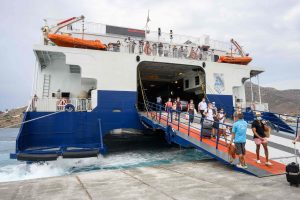
Rafina, one of the two main ferry gateways to the Greek islands from the Athens region, has run short of space this summer. A sharp rise in sailings has left the port without enough berths for all the ships assigned to it, and the shortfall is now affecting ferry operators and their crews.
The strain led the Panhellenic Union of Merchant Marine Seamen (PENEN), to call a three-hour work stoppage on June 26 from 7 p.m. to 10 p.m. The union has warned of further action if the problem is not resolved.
Under rules set by the Rafina Port Authority, only four ships may berth inside the harbor overnight. After SeaJets added two high-speed vessels this year, seven ships now require an overnight place, three more than the port can hold.
As a result, two conventional car-and-passenger ferries are sent each night to anchor offshore until they sail the following morning, leaving their crews aboard for 24 hours at a time.
Why the conventional ferries are sent out
It is the conventional ships that are kept outside, for practical reasons. High-speed ferries have no sleeping cabins for crew and cannot easily remain at anchor overnight without additional staff for the night watch. The conventional vessels, which do have crew quarters, are left to absorb the shortfall.
A ship can, in principle, move to another port such as Lavrio, on the southeastern coast of Attica, if a berth is free, and two vessels, one high-speed and one conventional, already do. But relocating is costly, and the expense falls hardest on the conventional ferries, which work the routes year-round rather than only through the busy summer months, as most of the high-speed fleet does.
The episode also points to a gap in how the system is run. Each year the Coastal Shipping Council, which advises on ferry policy, and the Shipping Ministry approve the season’s routes, but neither guarantees the berths needed to accommodate the additional ships overnight. More sailings are approved without a corresponding provision for harbor space.
The port authority’s plan
The port authority has settled on a rotation. Four ships remain in the harbor each night, two high-speed and two conventional, while the other two conventional vessels take turns spending the night outside.
The authority says the arrangement keeps the overnight count at four, distributes the burden evenly by sending one ship from each company offshore, improves on earlier arrangements for the crews and safeguards the morning departures. It has also asked the companies to schedule restocking and resupply on the nights their ships are in port, to ease the load on the harbor.
The unions reject the plan
The seafarers were not satisfied. PENEN says the arrangement amounts to “exile at the Rafina anchorage” and points to working conditions it considers unsafe and unacceptable.
The union calls it scandalous that a port with five mooring spots is being asked to handle seven ships, and attributes the problem to poor planning. It describes conditions as third-world and holds the government, Shipping Minister Vassilis Kikilias, the Rafina port police and the port authority responsible. The anchorage, PENEN says, is not formally recognized as one, lacks the necessary infrastructure, and would leave neither crews nor ships covered by insurance in the event of an accident. No tugboat is on hand should an anchor chain break, the union adds, asking who would be held responsible if a ship were driven onto the rocks.
Other unions join the protest
Two further unions, PEMEN and STEFENSON, which represent merchant marine engineers and junior engine-room crews, issued their own statement condemning conditions they described as dangerous and an immediate risk to seafarers.
The two unions say the port can safely moor only five ships, yet 11 are scheduled on the route. The extra vessels are left in open water with their engines off, drifting on the wind and current, and crews have to stay on watch all night to keep the ship in place. That leaves them exhausted and without sleep, the unions say, and puts both crew and passengers at risk once the ferries are running. Even at best, the ships sit at anchor in waters never marked as safe, with no real protection, and off-duty crew cannot go ashore.
PEMEN and STEFENSON accuse the Shipping Ministry and the Coastal Shipping Council of approving the routes to “protect shipowners’ profits at the cost of safety.”
Source: ot.gr