 Μake us preferred on Google
 At a time when the Greece’s Ministry of Infrastructure and Transport is promoting the plan to upgrade Athens’ urban transport as one of the largest interventions of recent decades, a new pan-European study comes as a reminder that the picture of transport in Greece remains deeply unequal and problematic.
The government is presenting a series of interventions that include renewing the bus fleet, planning new trains, increasing passenger traffic, digital services and contactless payments. This is undoubtedly a period of mobility in the transport sector, made possible after many years of underinvestment. However, the daily experience of passengers often differs significantly from the picture described in official announcements.
The contrast becomes even sharper through the conclusions of the study “Access Denied: Transport Poverty in Europe” by the Oeko-Institut on behalf of Greenpeace, which ranks Greece among the countries with the most serious problems of access to public transport in Europe.
The study records a reality that is familiar across much of the Greek regions. Outside the major urban centers, public transport often fails to cover basic mobility needs, meaning the private car is transformed from a choice into a necessity.
NEWSLETTER TABLE TALK
Never miss a story.
Subscribe now.
The most important news & topics every week in your inbox.
This is also reflected in the rates of public transport use. According to the research, 72% of Greeks either never use public transport or use it less than once a month. By contrast, only 7% travel daily by bus, metro, tram or train, one of the lowest rates in Europe.
The absence of alternatives
Even more revealing is the indicator of so-called “forced car ownership.” Greece records the worst performance among European countries, as 22.4% of citizens say they are obliged to own a car because of the lack of reliable alternative transport options. The corresponding European average is limited to 6.4%.
This dependence also has a strong economic dimension. Around 1 in 5 citizens goes without basic goods or services in order to maintain a car for daily travel. At the same time, for 14.5% of Greeks, transport expenses represent a significant financial burden, one of the highest rates in Europe.
This picture forms what the authors of the study describe as “transport poverty”: a situation in which access to work, education or basic services depends on a means of transport that many struggle to maintain.
By contrast, the figures presented by the administrations of Athens’ transport bodies point to increased use of public transport.
During the first four months of 2026, passenger traffic on buses increased by 25% compared with the same period in 2025, while on fixed-track transport the increase reached 10%. In total, around 115 million ticket validations were recorded, a figure corresponding to almost one million passengers per day.
At the same time, the expansion of digital services, such as contactless payments by bank card and the integration of the Ath.ena Card into mobile phone digital wallets, is being promoted as a key step toward modernization.
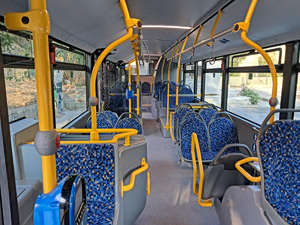
Already, around 10% of validations are carried out by digital means, while their share of transaction value reaches 18%-19%. The renewal of the bus fleet is also considered significant. The number of new vehicles now circulating in the Athens basin has reached 1,076, while the target for 2028 foresees around 1,700 new buses in a total fleet of approximately 2,000 vehicles.
Frozen projects
Despite the progress, several major projects remain far from implementation. Metro Line 4, considered the country’s most important transport project, has already been pushed back to 2032, with several experts considering 2034 a more likely completion horizon.
At the same time, the extensions of Line 2 toward Glyfada and Ilion are facing significant difficulties, with the latter essentially remaining frozen since 2023 because of pending funding issues.
Similarly, the Western Attica suburban railway is facing objections and technical challenges, while the new lines included in OASA’s strategic transport plan, which is currently being prepared, remain at the planning stage.
Among these are Athens’ first circular metro line, which would connect areas such as Zografou, Vyronas, Agios Dimitrios, Nea Smyrni, Kallithea, Egaleo and Haidari, as well as a new line connecting Egaleo with Katehaki via Peristeri and Galatsi.
At the same time, tram extensions toward Perama and Patision are returning to the planning agenda, although there are still no clear implementation timetables.