
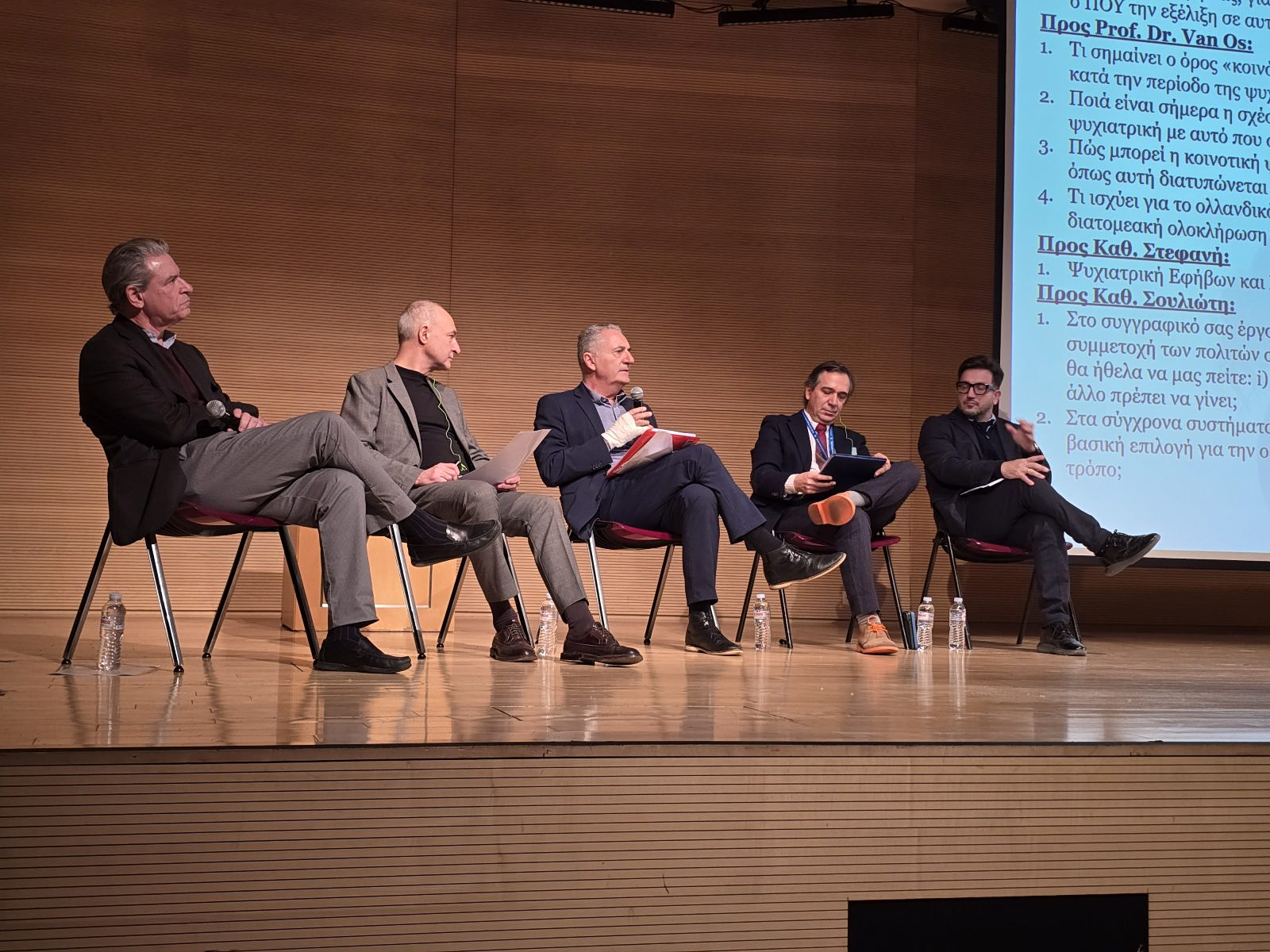
The future of community psychiatry in Europe and Greece was the focus of a high-level public discussion held in Athens, bringing together leading scientists, health policy experts, and institutional representatives to explore how mental health care can better respond to today’s social challenges.
The event was organized by the Society for Regional Development and Mental Health (EPAPSY) and took place on January 16 at a major cultural venue in the Greek capital. Against a backdrop of growing pressure on welfare systems and rising mental health needs, participants examined how psychiatric care can become more effective, democratic, and rooted in local communities.
A Shift Toward Wellbeing-Centered Care
The discussion was moderated by Stelios Stylianidis, a psychiatrist and founder of EPAPSY, while the keynote address was delivered by Jim van Os, Professor of Psychiatric Epidemiology and Head of Neurosciences at Utrecht University Medical Center. Van Os praised EPAPSY’s work, describing it as a model for transforming psychiatric care in Greece.
Central to the debate was the concept of salutogenesis—an approach that focuses on the sources of health and wellbeing rather than on illness alone. This perspective places the individual, not the diagnosis, at the center of care and emphasizes social and environmental factors that support mental resilience.
Policy, Practice, and Reform
Contributions also came from senior figures in public health, psychiatry, and health policy, including representatives of the World Health Organization, university hospitals, and academic institutions. Government and regional officials addressed the event, underlining the importance of aligning mental health policies with real-world community needs.
A review of EPAPSY’s history highlighted nearly four decades of work, particularly in remote and underserved areas. Speakers stressed the need for a “reform within the reform” of mental health services, calling for free, high-quality care without fragmentation or lack of evaluation.
Looking Ahead
The discussion concluded with broader reflections on what community and care mean in today’s society, as well as the internal changes required to sustain humane mental health services. EPAPSY’s leadership emphasized that humanitarian values must be supported by clear structures, noting that reform is an ongoing process driven by the immediate needs of those receiving care.