

In early November this year, Christmas made its appearance in the shop windows of Athens. Christmas decorations across the country have been appearing earlier and earlier in recent years—surpassing even the traditions of Central Europe, where for centuries Christmas markets have signaled the start of the festive season just after November 25. The scene can sometimes appear almost absurd, as in recent days, decorated garlands, Christmas melodies, and wooden nutcrackers coexisted in shop windows with forgotten… pumpkins left over from Halloween.

People take pictures of the festive window decorations for the Christmas season at Printemps Haussmann department store in Paris, France, France, November 6, 2025. REUTERS/Sarah Meyssonnier
The phenomenon of “early Christmas” has reached global proportions, and many refer to it as Christmas Creep. This is no coincidence: it is a well-known secret that the early arrival of Christmas in store windows is an advanced marketing strategy designed to increase sales. Early decorations may blur the spirit of Christmas, but the excitement they generate drives consumers straight to the checkout. Psychologists note that early Christmas decorations heighten the sense of urgency for buying gifts, clothing, and festive items while simultaneously conveying a “comforting” warmth. After all, Christmas is the period with the highest retail turnover across the Western world. Profits are so high during these days that marketing leaves no opportunity unused: in recent years, Christmas decorations have appeared even in Muslim countries, in large malls and hotels in Dubai, Morocco, Bahrain, and elsewhere.
Turnover

According to retail trade associations, in Europe, sales in shops during the Christmas period reach 20% of the total annual turnover. Earlier data from the United States show that spending in department stores nationally increased by 54% from November to December. In some sectors, pre-Christmas spending increased even more, such as in bookstores and jewelry shops, where it reached as much as 170%. Indicative of the economic scale is also the fact that seasonal hiring in the U.S. during this period exceeds 360,000 workers. And since Christmas boosts revenue, the market has decided to… extend it.
Consumer adaptation is striking: according to the American Retail Federation, in recent years, about two in five holiday shoppers begin browsing online, visiting stores, and making purchases for the holidays before November.
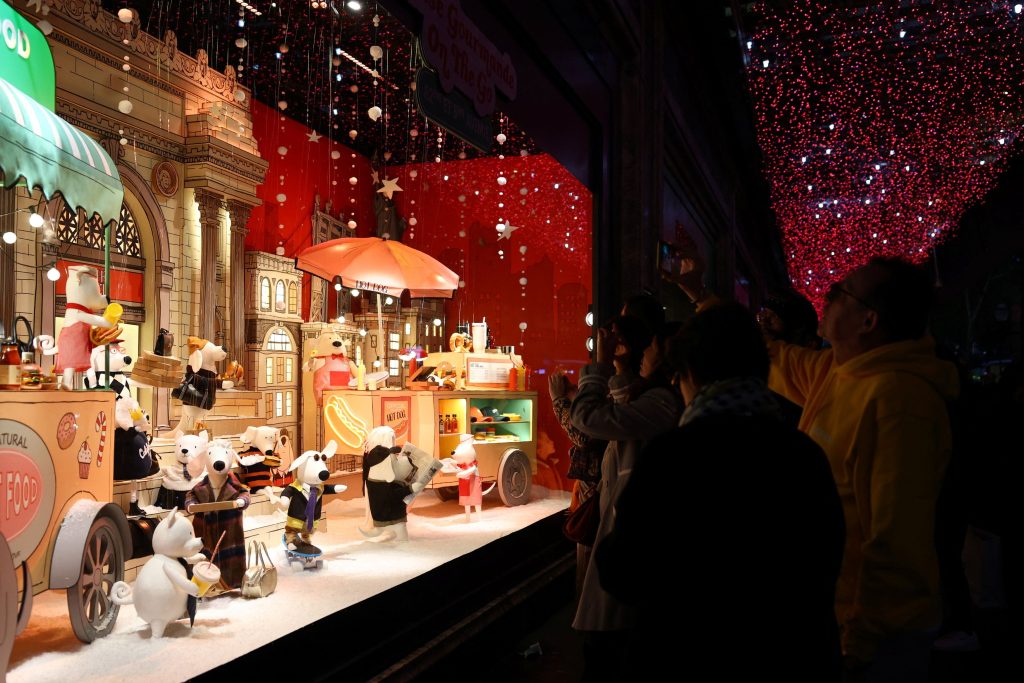
People take pictures of the festive window decorations for the Christmas season at Printemps Haussmann department store in Paris, France, November 6, 2025. REUTERS/Sarah Meyssonnier
Christmas Creep
At the same time, a recent analysis by the British Guardian shows that the widespread perception that “Christmas arrives earlier every year” is entirely justified. Data from major supermarkets, news bulletins, and the UK Top 40 charts confirm that Christmas Creep is real. Examining when a Christmas song first enters the UK Top 40 each year from 1980 to today reveals a steady upward trend in festive songs. In the late 1980s and early 2000s, it was far more common for a Christmas song to reach the Top 40 only in the final two weeks of the year, whereas after 2020, it happened as early as week 45. In 2023, two songs entered the charts in the week starting November 10—Wham’s Last Christmas and Mariah Carey’s All I Want for Christmas Is You—marking the second-earliest Christmas songs in the Top 40 at least since the 1960s.
We can do little to avoid the “frenzy” of early Christmas. It is everywhere—from paper fast-food packaging to the Christmas menus of major coffee and beverage chains.
In a world that is constantly accelerating and accumulating pressures—from the rising cost of living and worsening working conditions to the alienation of people—“early Christmas,” according to experts, creates additional pressure as many cannot meet the season’s demands. On the other hand, many prefer Christmas to arrive earlier because it provides a comforting and anxiety-relieving effect in their daily lives. But it is certainly not a solution to their problems…