In the early 1970s, the tidy interior of John’s café at the corner of 66th Street and Broadway welcomed a familiar morning customer: a police officer known worldwide for his incorruptible character. Al Pacino had immersed himself so deeply in his role as Serpico that he would startle the café’s Greek owner, Evangelos Bourlotos, with the intensity of his gaze as he ordered his coffee. Bourlotos still recalls their many encounters—always compelling—during a time when New York, as he puts it, “smelled of Greece.”
Back then, Greek-owned restaurants, diners, grocery stores, and bakeries were everywhere. They carried with them not only enterprise but a distinct warmth and personality—captured vividly in the mid-1970s by photographer Kay Zakariassen as she documented the streets of Manhattan and Queens. Recently shared by the New York Public Library to mark Greek Heritage Month, her images offer a rare window into a thriving immigrant world.
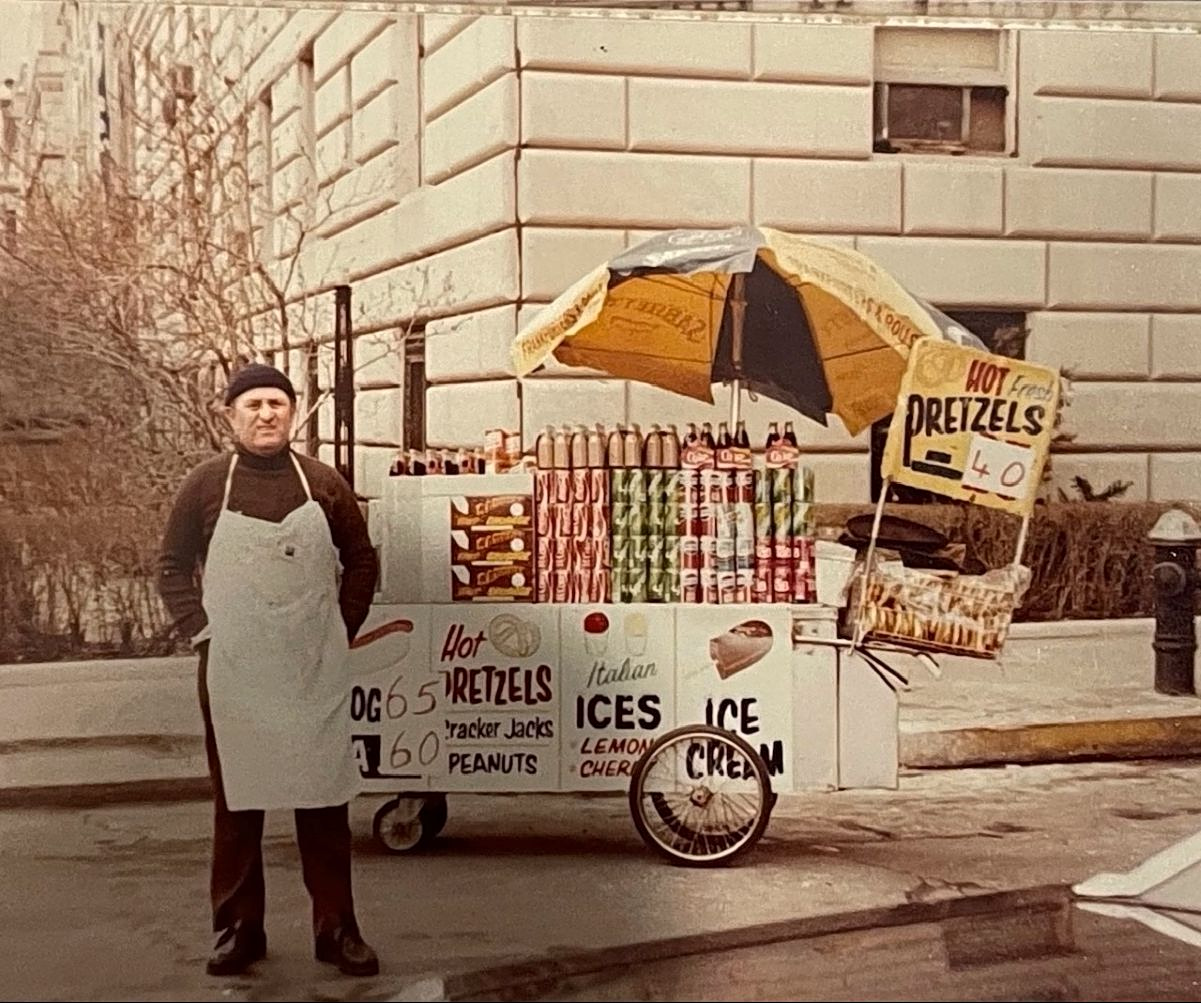
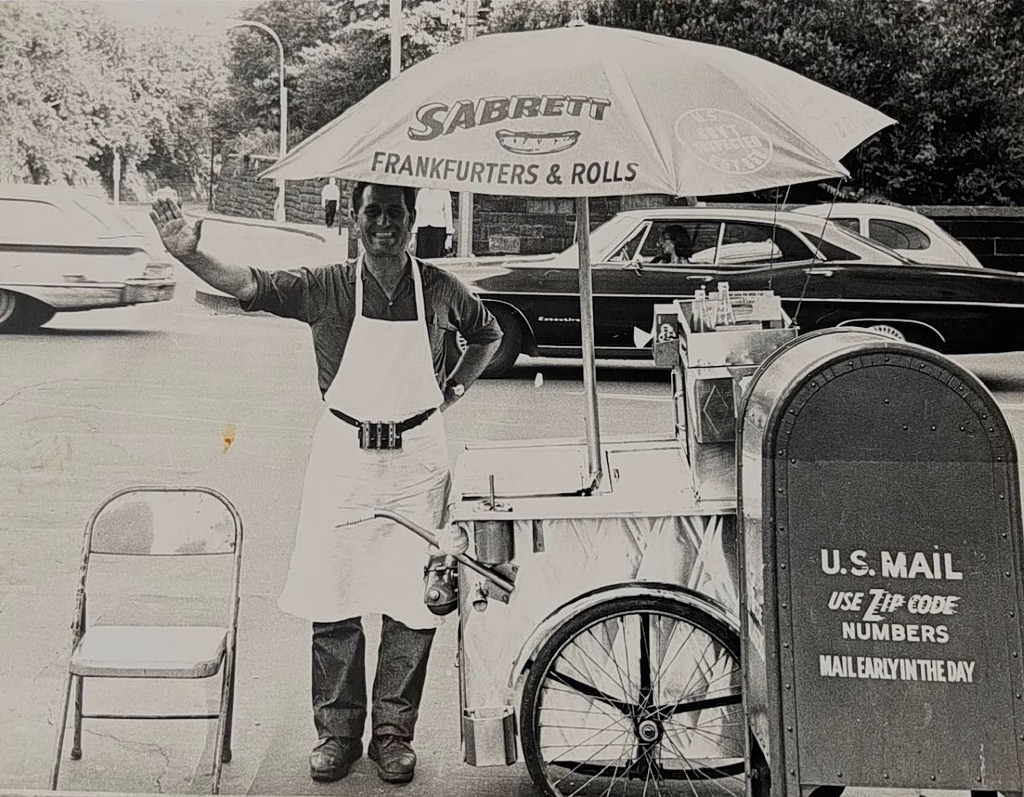
Anastasios Velis at his street cart in New York, circa the late 1970s (Anastasios Velis Photographic Archive)
“It’s wonderful to see my father in front of the Metropolitan Museum selling hot dogs—it brings back so many memories,” Fotis Velis says today. Alongside his daughter Francine, he recognized a familiar figure in one of Zakariassen’s photographs: a man in a dark blue ushanka and white apron, smiling beside a hot dog cart under the iconic yellow Sabrett umbrella. It was Anastassios Velis—father, grandfather, and immigrant—captured on a sunny day in 1976.
A Living Archive of the Greek Diaspora
That portrait forms part of a unique archive Zakariassen donated to the New York Public Library in 2022. The collection includes around 400 color slides, negatives, prints, interview transcripts, and research material from her 1976 photographic essay on New York’s Greek diaspora.
Within these files, the images are accompanied by the voices of their subjects: business owners and workers, identified by name, place of origin, and occupation. Though not yet digitized, these interviews preserve a textured oral history. Zakariassen, who later became a photo editor at Natural History magazine, had focused on immigrant communities since her student years.
Her husband, David Hanson, recalls how struck she was upon arriving in New York by the extent to which Greeks had embedded themselves in the city’s diners and small businesses. A 1972 survey by the Greek American Neighborhood Action Committee found that 92% of restaurants across New York’s boroughs and surrounding areas were owned or operated by Greek immigrants.
From Survival to Self-Made Enterprise
For Anastassios Velis, the journey began in a Greek restaurant, working punishing hours—six days a week, from six in the morning until midnight—for just $60. “He struggled to pay the rent,” his son remembers. A turning point came through a small ad in a Greek-language newspaper: “Be your own boss,” it read, beside an image of a hot dog cart.
Velis took the leap. He built his own cart and gradually established a modest business. The work remained hard, but it was now his own—his risk, his responsibility. In time, he employed others. For his family, that step marked the beginning of a more stable life, forged through persistence.
“My grandfather left behind the home he loved to step into the unknown,” Francine says. “He carried courage and determination to build something for his family.” His legacy, she adds, extends beyond his own success: it enabled future generations to pursue different paths. “My career as a lawyer in New York and New Jersey rests on the foundation he created.”
Yet America never replaced Greece in his heart. “He missed it from the moment he boarded the ship,” Francine reflects. The nostalgia may sound familiar, but it runs deep. “There’s a beauty in Nafpaktos that stays with you—the people, the sea, the landscape. Everything feels calmer, as if it’s exactly how life should be.”
After three decades of labor on New York’s streets, Velis returned to Greece. This November, he will celebrate his 97th birthday—the same smiling man once photographed beside his cart, now a living link between two worlds.
The Other Manhattan
Evangelos Bourlotos’ story illuminates another facet of Greek New York: the relentless rhythm of diners and coffee shops. Arriving from Piraeus at just 15, he describes migration as both adventure and rupture. “I was devastated,” he recalls. Settling in Brooklyn, he began school and soon entered the restaurant world with limited English but firm resolve.
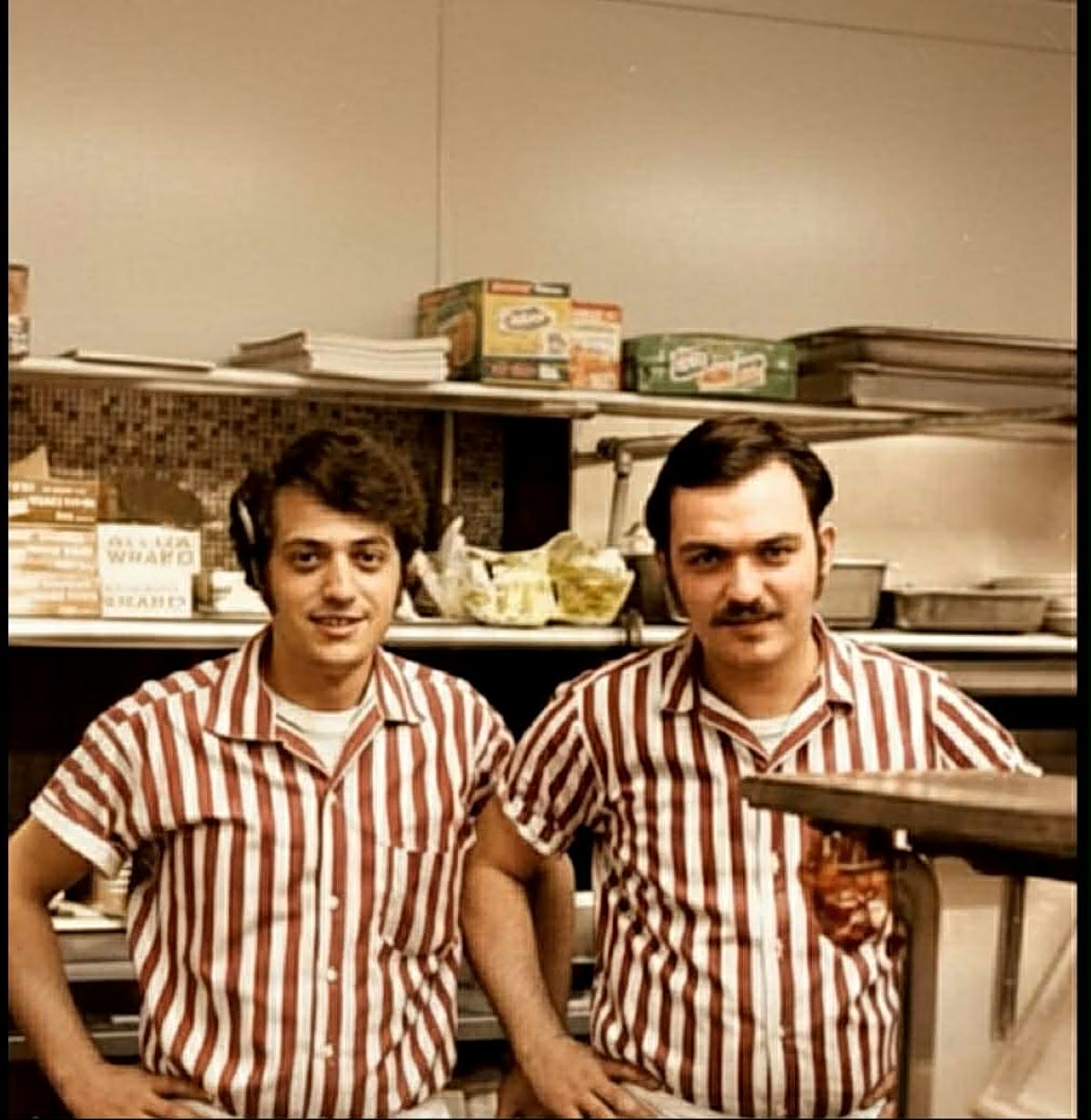
Evangelos Bourlotos (right) with his business partner Sotiris Fragias in the kitchen of John’s coffee shop, around 1977 (Evangelos Bourlotos Photographic Archive)
His workplace, John’s, sat at the cultural heart of Manhattan—near Lincoln Center, the Metropolitan Opera, and Juilliard. Without fully realizing it, he found himself amid a rarefied artistic scene. Knowing the neighborhood well, he often slipped into performances without paying. “I saw Pavarotti, Domingo, Carreras—live, without a ticket,” he says. He also remembers composer Mikis Theodorakis and the excitement he stirred within the Greek community.
Eventually, Bourlotos and his friend Sotiris Fragias bought John’s. “My life changed forever,” he says. Open 24 hours a day, the café became a crossroads of the city: artists, journalists, laborers, and celebrities passed through its doors. During the filming of Serpico, Al Pacino was a regular. Others—Anjelica Huston, John Huston, Carroll O’Connor—appeared like fleeting shadows of a city constantly reinventing itself.
Yet Bourlotos resists romanticizing that world. His memories return to the grind: long hours, pressure, and exploitation. He recalls a young journalist, Geraldo Rivera, who worked alongside him—apron on, flipping burgers—to document poor labor conditions among Greek workers in diners.
He also remembers the July 1977 blackout. “People came into the café because they couldn’t leave the area. We sold everything within hours—eggs with donuts instead of bread.” Outside, the city burned, marked by looting and fires—a stark portrait of desperation and inequality in 1970s New York.
Through it all, one constant endured: the pull of home. “A Greek who never left will never fully understand the nostalgia,” Bourlotos says. He remembers concerts where Greek immigrants wept openly—not only for what they had lost, but for what they could never fully reclaim.
Bourlotos returned to Greece in 2016 and now lives in Volos with his American wife. “Life here wasn’t as smooth as I expected,” he admits, “but I overcame the difficulties. I can now say I made the right decision.”
Reframing the Ordinary
Today, Zakariassen’s work resonates beyond its archival value. It preserves an often-overlooked chapter of Greek immigrant life in 1970s New York, inviting reflection on the quiet virtues—dignity, perseverance, responsibility—that shaped a generation.
These are not grand narratives, but they endure. They speak of people who lived with hardship, nostalgia, and risk without fanfare—who built lives in the margins and, in doing so, transformed them.
Interest in Zakariassen’s work continues to grow. An Athens gallery is preparing an exhibition alongside a publication drawing heavily from her interviews. Nearly half a century later, these images return not only as documents of a vanished world, but as prompts for deeper reflection on identity, displacement, and memory—on what it means to belong, and to carry more than one home within you.