In 2025, Greek police forensic laboratories examined 136 homemade incendiary devices and 43 explosive devices, a striking number that reflects the seemingly endless wave of firebomb attacks on homes, offices, police stations, and government agencies. Some of these devices were related to forest arson, but many were tied to what anti-establishment groups call “fire festivals” and arson barrages, often used as initiation tests for aspiring urban guerrillas before they escalate to armed attacks with bombs and firearms.
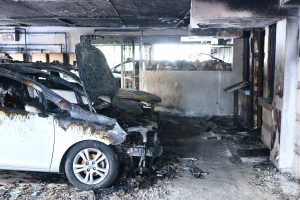
In several cases, far-right groups have also carried out attacks targeting anti-establishment activists, foreign nationals, and others. These firebomb attacks pose serious risks to public safety, as shown dramatically by the death of a 72-year-old woman, mother of New Democracy politician Afroditi Nestora, in Thessaloniki early Wednesday.
Authorities note that in at least 15 similar attacks in recent years, using Molotov cocktails, gas canisters, and flammable liquids, no one was killed only by luck, since fires from such devices can spread quickly and trap toxic gases, especially in enclosed spaces, building entryways, and garages.
A notable precedent was the Marfin Bank arson on May 5, 2010, when a Molotov cocktail thrown during a protest in central Athens killed three bank employees.
To solve the deadly Thessaloniki arson on Kimonos Voga Street, the counterterrorism service is analyzing footage from dozens of cameras across a five-kilometer radius covering the movements of three masked attackers, who had earlier hit two other New Democracy officials’ homes in Toumba and Pylaia with gas canisters and flammable liquid without causing major damage.
Investigators are focused on identifying any preparatory movements or communications among the suspects before the attack, and are also searching for the motorcycles believed used by at least three perpetrators, one of whom served as lookout, while not ruling out the possibility that personally owned vehicles or those of associates were used.
Police are also factoring in data from roughly 40 firebomb attacks recorded in Thessaloniki in recent years, some also targeting New Democracy figures, including members of parliament Stratos Simopoulos and Anna Efthymiou. Targets of such attacks have ranged from senior judges to NATO military personnel, and from police officers to far-right group members, along with government offices, company offices, and private or state vehicles.
180 to 200 active anti-establishment activists
Police estimate that 180 to 200 active anti-establishment activists operate in Thessaloniki, with bases in four or five squats, some inside Aristotle University, that have since been cleared in successive police operations. Investigators have also found evidence of cooperation with anti-establishment groups and urban guerrillas in Athens.
Police are focusing on at least three active anarchist movement organizers in the city, believed to have recruited three to four young people to form the strike team behind the latest wave of firebomb attacks, one that this time had a tragic outcome. Investigators believe the attacks were meant as a message, largely tied to interventions at the Alexandras Avenue refugee housing complex and the arrest of anti-establishment bank robbers in Tithorea.