Greece continues to experience intense heat as the latest heatwave refuses to subside. Meteorologist Thodoris Kolydas explains the reasons behind the prolonged high temperatures and outlines the forecast for the coming days.
A Temporary Meltemi and Trapped Heat
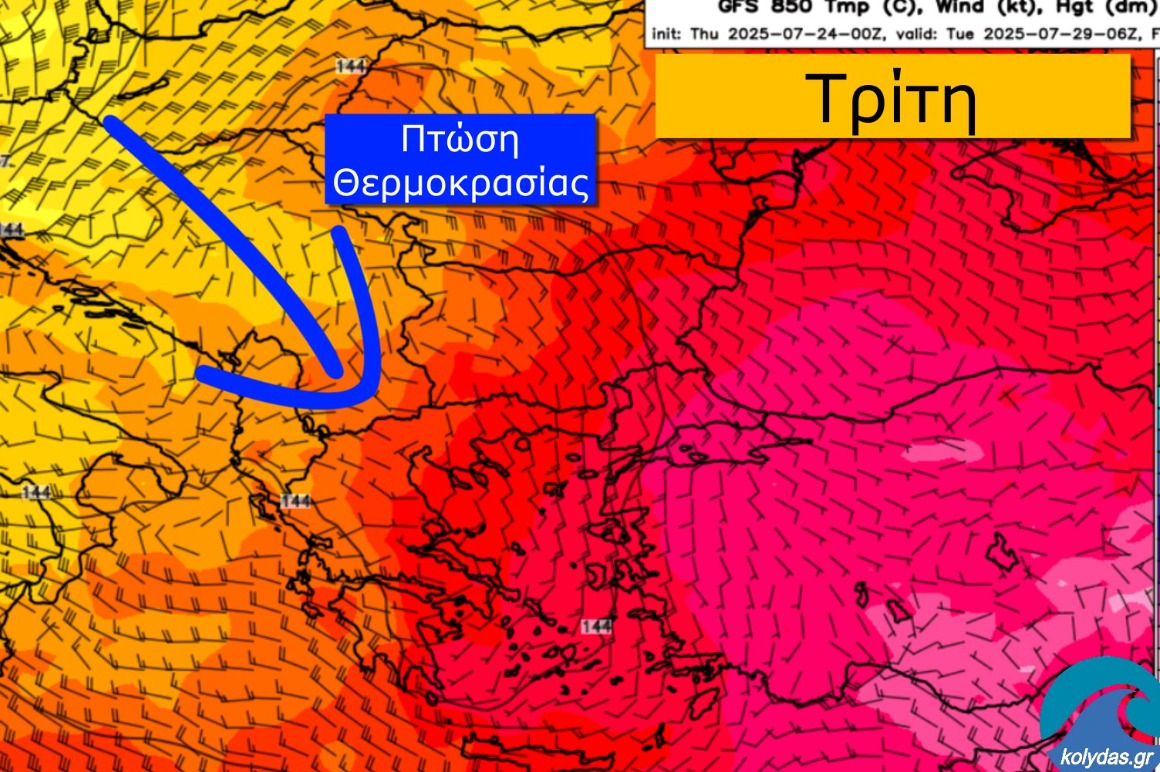
On Friday, July 25, and Saturday, July 26, temperatures at 850 hPa — a standard atmospheric pressure level used in meteorology — are expected to remain between 26–28°C across much of the country. Despite the presence of a northeast wind known locally as the “meltemi” over the Aegean Sea, its cooling effects are limited to some eastern and island regions, such as the Cyclades, Euboea, and parts of eastern Attica. Meanwhile, inland continental areas remain exposed to extreme heat.
Kolydas points out that this is not the typical meltemi wind associated with July and August, which is usually generated by a strong high-pressure system over the Balkans and a low-pressure system in the Middle East. Instead, it is a temporary northeastern airflow resulting from a thermal low over the Eastern Mediterranean. As a result, it is weaker and shorter in duration.
Sunday Brings Little Change
On Sunday, July 27, the meltemi weakens significantly or disappears entirely over central and southern mainland Greece. The hot air mass remains in place, with temperatures at 850 hPa still hovering around 26–28°C, allowing the heat to persist across the region.
No Immediate Relief on Monday
Monday, July 28, offers little relief as the meltemi does not return. The hot air mass stays trapped over the country’s interior, keeping temperatures near 26°C at 850 hPa. This translates to surface temperatures surpassing 39–40°C in many mainland areas.
Cooler Air Expected from Tuesday
Improvement is expected starting Tuesday, July 29, when cooler air masses begin arriving from the northwest, specifically from the Adriatic and Serbia. While the meltemi still doesn’t fully return, this new airflow will help reduce temperatures, especially in northern and western parts of Greece.
However, in eastern regions — including Central Greece, Attica, and the Peloponnese — the heatwave will persist for another 6 to 12 hours before temperatures begin to drop.