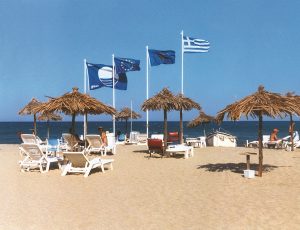
As summer draws to a close, swimmers in Greece still enjoy the country’s famed beaches, especially those awarded the Blue Flag for cleanliness. But the question remains: will they be just as clean next year?
Beach water quality is monitored by the General Secretariat for the Natural Environment and Water of the Ministry of Environment and Energy. Accredited laboratories take samples every 30 days from May through the swimming season. Results are published online and reported annually to the European Commission. Based on these checks, the Ministry of Health issues bans on swimming in polluted areas.
In Attica, swimming is prohibited in all harbors, shipyards, and industrial zones stretching from Piraeus to Aspropyrgos, as well as in parts of Rafina, Lavrio, and along rivers and wastewater outlets. Similar restrictions apply in other regions when water samples show high pollution levels.
The Panhellenic Center for Ecological Research (PAKOE), an independent organization, has been conducting its own tests since 1979. “This year we visited 572 beaches across Greece,” says its president, Panagiotis Christodoulakis. “If samples show unsafe water, we recheck in June and send the results to municipalities and regional authorities.”
Christodoulakis notes that municipalities, often with support from the coast guard, are responsible for beach maintenance. “Today, most local authorities trust our sampling. We see improvements thanks to wastewater treatment plants and stricter controls,” he says, citing Piraeus’ Votsalakia beach as an example of a once-polluted site now declared safe.
Still, risks remain. “Many beaches between Piraeus and Cape Sounio are contaminated, especially in summer. High levels of enterococci and other microbes can cause infections, particularly in women and children,” Christodoulakis warns.
The Blue Flag program, managed in Greece by the Hellenic Society for the Protection of Nature, rewards beaches that meet strict criteria, starting with excellent water quality. Municipalities and private operators apply each November, and inspections continue throughout summer.
“This year, 623 Greek beaches received the Blue Flag,” says program manager Stamatina Syrigou. “But 12 lost the award for failing to maintain standards.”
For now, many of Greece’s beaches remain among the cleanest in Europe—but keeping them that way will require vigilance, investment, and local responsibility well into next summer.