
 Μake us preferred on Google
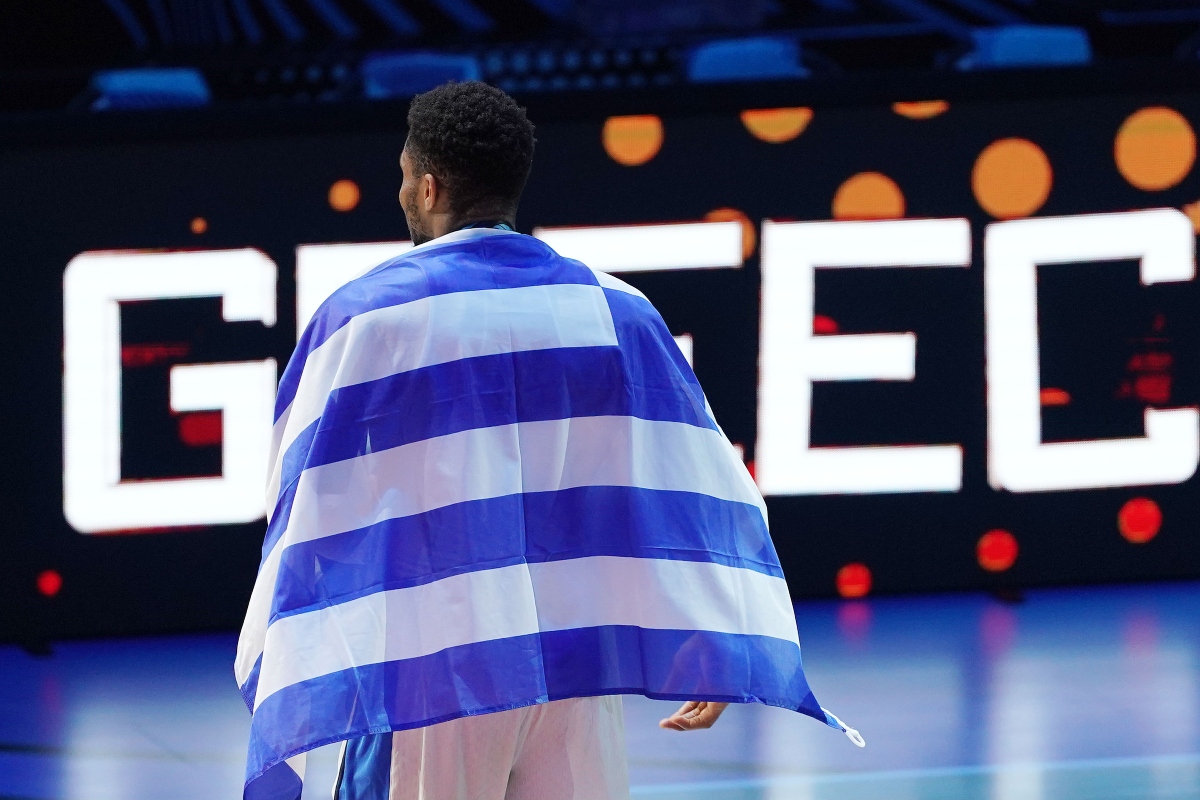
 On September 14, 2025, the world watched as Giannis Antetokounmpo, the NBA champion and three-time MVP, broke down in tears. Draped in the blue-and-white flag of Greece, he declared that winning the bronze medal at EuroBasket 2025 was “the greatest achievement of his life.”
For a man who has lifted the Larry O’Brien Trophy and dominated the NBA Finals, the moment was not about personal glory. It was about belonging. About being Greek. And it was a reminder that, for nearly two decades of his life, the state he now represents did not officially recognize him as one of its own.
Stateless in His Own Country
Giannis was born in 1994 in Sepolia, a working-class neighborhood of Athens, to Nigerian immigrants who had entered Greece without papers. Despite growing up Greek in every sense—attending Greek schools, speaking the language, even being given Greek names—he and his brothers were legally invisible.
Until the age of 18, Giannis existed without an identity card, without citizenship, without rights. He was, as Greek law defined him, “stateless.” For the Greek state, he simply did not exist.
He recalls those years not through basketball highlights, but through memories of selling sunglasses and CDs alongside his mother, Veronica, at street markets in Athens and nearby Thiva. “There wasn’t much time for dreams,” he once admitted. Basketball nearly slipped away—until his team, Filathlitikos, arranged steady jobs for his parents so that Giannis could fully commit to the sport.
A Race Against Time
By 2013, the towering 18-year-old was attracting international attention. Spanish club Zaragoza had already secured his rights, and the NBA Draft loomed. But there was a problem: without a passport, Giannis could not leave Greece.
Nigeria, recognizing his talent, offered citizenship. But Giannis and his brother Thanasis refused. “We were born here, raised here, went to school here,” they told officials at the time. “Greece is our home. We want to be Greek.”
It took a government intervention to cut through the bureaucracy. The then-General Secretary of the Ministry of the Interior, Angelos Syrigos (now an MP), recalls:
“The Antetokounmpo brothers were registered as stateless at birth. The law allowed them to apply for citizenship at 18, but they didn’t know it. We expedited the process so Giannis could travel for the NBA Draft. It was a completely legal act—we simply accelerated what they were already entitled to.”
On May 9, 2013, Giannis and Thanasis finally received Greek citizenship. Just two months later, Giannis was drafted 15th overall by the Milwaukee Bucks.
From Athens Streets to NBA Glory
The rest is history: two NBA MVPs, a Finals MVP, and a championship ring. Yet despite his success in America, Giannis never stopped identifying as Greek. He has described himself repeatedly as “just a kid from Sepolia,” and every summer he returns to wear the Greek jersey with pride.
His emotional display in Riga this year, as Greece claimed its first EuroBasket medal in 16 years, underscored how much the national team means to him. For Giannis, it is not about fame or money. It is about recognition—something he lacked for the first 18 years of his life.
Citizenship in Greece Today
But Giannis’ story is also a mirror to Greece’s ongoing citizenship struggles. In 2025, thousands of children of immigrants born and raised in Greece still wait years—sometimes more than four—to have their applications processed.
According to Generation 2.0 RED, an NGO advocating for equal rights, “a huge backlog” remains, especially for applicants from non-EU countries. Income requirements, bureaucratic delays, and staff shortages mean that for many, Greek citizenship remains out of reach.
Official government data tells the story: between 2015 and 2019, an average of 27,700 people received citizenship each year. Since 2019, that number has fallen by half, to under 14,000 annually.
The contrast is stark. In 2017, more than 34,000 applicants were approved. By 2021, approvals had dropped to just over 10,000. Rejections have also risen—13,617 applications denied in the past six years alone.
A Larger Debate
Critics argue that citizenship in Greece is still granted on an ad hoc basis—expedited for exceptional athletes like Giannis, but painfully slow for thousands of others. As Nikos Odubitan, co-founder of Generation 2.0 RED, notes:
“The real issue is how the state treats all children of immigrants. Not case by case, but across the board. Giannis’ success shouldn’t obscure the struggles of so many others who feel Greek but remain foreigners on paper.”
For Giannis Antetokounmpo, the tears in Riga symbolized both a personal triumph and a national contradiction. The boy who once sold trinkets on the streets of Athens is now Greece’s greatest basketball icon. Yet his journey is also a reminder that, in modern Greece, you are not born Greek—you become Greek.