 Μake us preferred on Google
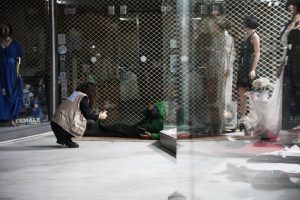
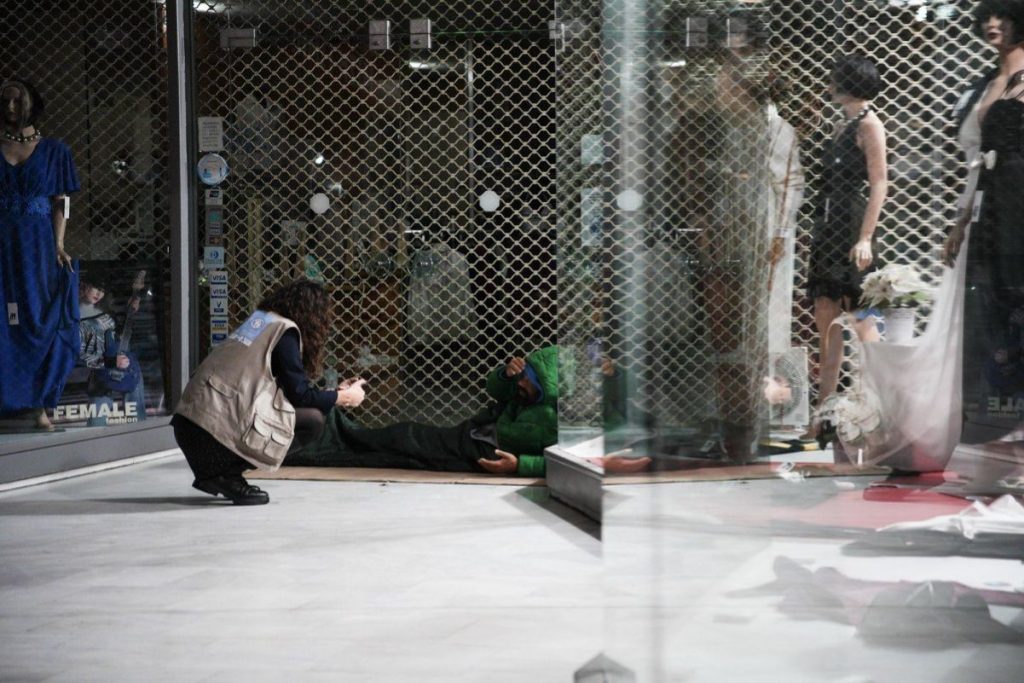
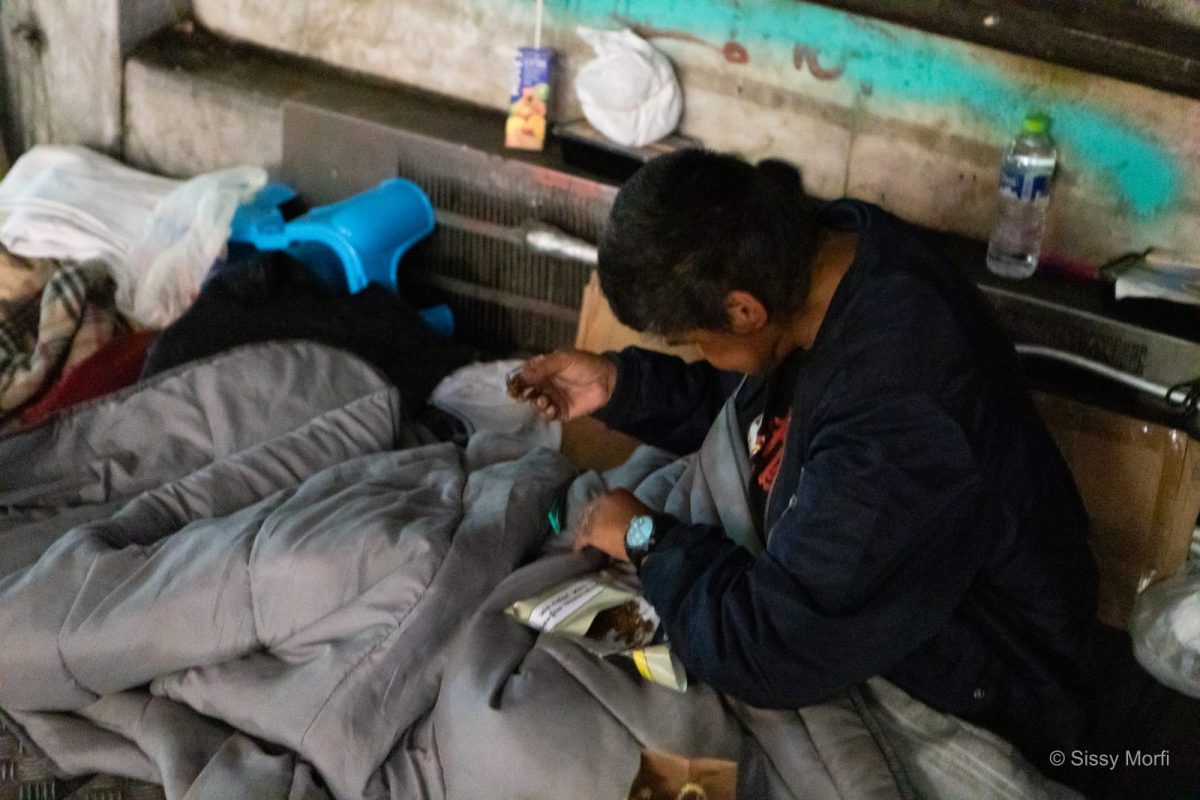
 It’s late afternoon in downtown Athens. Rain has made its presence felt. Near Omonia Square — one of the city’s busiest intersections — a woman crouches under a cracked awning, shielding her face with a worn blanket to avoid the water dripping through the roof.
The spot seems ideal for keeping dry, even as passersby quicken their pace, umbrellas tilted forward, eyes fixed on the ground. Her face is invisible to them, but she is used to that kind of indifference. Carefully, she rearranges the cardboard pieces that make up her improvised bed, trying to protect them from the rain. In front of her sits a paper cup; beside it, a few essential items — a bottle of water, a plastic bag, a small flashlight.
She has been here for more than five years, she tells reporters from To Vima. Wrapped tightly in a gray blanket, her voice is soft, almost a whisper.
“Could you maybe bring me a pair of shoes? And a duvet, because I only have one blanket left. I need to go to the police — I was robbed,” she says.
Her name is A.M., originally from Bulgaria – another person who found herself homeless on the streets of the Greek capital, with no money and no one to turn to.
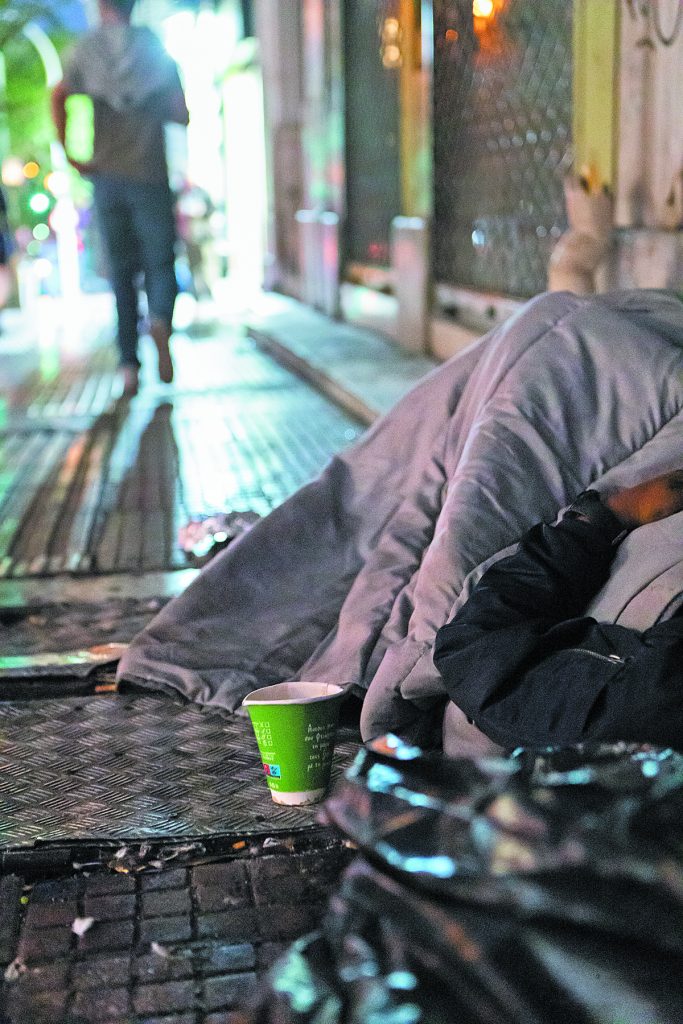
With government aid for the homeless scarce — and often absent — passersby remain their only source of relief. For many, a single blanket is all that separates them from the cold and rain. Credit: Sissy Morfi
The Mosaic of Homelessness
According to data from the Municipality of Athens, around 1,000 people are currently living without shelter within the city’s limits — a “city within a city,” with its own roles, hierarchies, and unwritten rules.
Greece is often described as a country of strong social ties, where family and community are seen as safety nets against misfortune. Yet, the numbers tell another story. A thousand people, in a European capital like Athens, sleep in the open — under bridges, on park benches, in abandoned buildings.
Even so, officials say the number is only an estimate.
“We don’t really know exactly how many homeless people there are in the city,” explains attorney Katerina Manousou-Alexiou, a member of the municipality’s Street Walking Team. “We’ll have a clearer picture when the next count is conducted — but even that won’t be exact. Counting once, on a single night, doesn’t give you the real number. It’s just an attempt at an estimate. What we do know is how many people we’ve served over the past six months. That’s a kind of measurement — but it only tells us how many we’ve reached, not the total number of people living on the streets.”
The Street Walking Team includes 25 professionals — social workers, psychologists, and nurses — who walk through Athens every day, seeking out people living rough, offering food, medical support, and a chance to reconnect with services.
Behind every statistic, however, there’s a human story. These stories form the mosaic of homelessness in the Greek capital — people who lost everything overnight, migrants stranded without work, those struggling with untreated mental illness, and others consumed by addiction.
A ‘Home’ on a Bench
For 58-year-old Efi K., childhood was already marked by instability. Frequent arguments with her parents pushed her to spend her time in parks and public squares with friends. Eventually, the tension led to her being thrown out of the house.
Since then, little has changed. A bench in the port city of Piraeus, a bus stop in the Ampelokipi district, and now a narrow street near Syntagma Square — Athens’ central plaza.
“Until a few years ago, I didn’t even have an ID card,” she tells To Vima. “I’ve been diagnosed with bipolar disorder and have been hospitalized several times. This year, I’m waiting for a spot to open in a facility for people with mental illness so I can move in. But the conditions in these places are hard — especially for someone like me who can’t fully take care of herself. Don’t be fooled by how I look now — I used to be worse.”
Rain or heat, Efi sets up her “household” every day — rearranging her few belongings, searching for a spot that feels safe enough to sleep. She has no family or friends left, except for an old acquaintance who lives in a care home and visits her occasionally.
“I can’t handle the cold anymore,” she says. “I just want a place indoors, a bed, some warmth.”
The municipality of Athens, however, operates only one main shelter, and space is extremely limited.
The Rise of Addiction
Maria Stratigaki, Athens’ Deputy Mayor for Social Solidarity and Equality, explains that in recent years, the number of people on the streets struggling with addiction has sharply increased.
“The city’s homeless center hosts around 200 people in total,” she says. “But its goal is transitional accommodation — a temporary refuge, not a permanent solution. The idea is that within six months, residents can stabilize, find work, and start over.
“If all 200 residents fit that profile, we’d have no problem,” she continues. “But since the shelter opened in 2021, it’s been full — and now, there are no available spots.”
The obvious solution would be to create more facilities, but as the numbers grow, so does the complexity of the problem. Many homeless people, municipal workers note, refuse to enter shelters at all — either because they fear losing their “territory” or because life on the street follows its own peculiar order, one they have learned to navigate.
“The shelters have essentially turned into informal nursing homes,” says Manousou-Alexiou.
“They’re filled with elderly residents — people in their 60s, 70s, even 80s — who can’t be evicted but also can’t live independently.
“That means there are fewer places available for younger homeless people — those who just lost their homes, who are jobless but still capable of getting back on their feet. The real tragedy is that for older homeless people, reintegration is no longer realistic.
“A twenty-year-old might find a day job, a friend’s couch, a way to restart. But how does a seventy-year-old man with varicose veins and bad knees find work? How does he start over?” she asks.
‘We Want to Stand on Our Own Feet’
On a narrow street in the Exarchia neighborhood — a district long associated with activism and alternative culture — 48-year-olds Dimitris P. and Panagiota L. have been living on the sidewalk for months. The couple has been together for eighteen years. She used to teach English; he worked in a restaurant. Economic hardship and drug addiction eventually drove them onto the streets.
“We don’t use anymore,” Dimitris says. “We want to stand on our own feet, rent a place, and rebuild our lives. We don’t want to go to a shelter — they’d separate us. We want to make it together.”
They have two children, currently in state care, with whom they have no contact.
“Dimitris was in prison for a while,” Panagiota adds. “Now we’re trying to rebuild everything.”
Unlike other neighborhoods, Exarchia shows them compassion. Local residents bring them food and water, check on them, even share blankets in the winter. Both are now enrolled in a rehabilitation program, determined to stay clean.
A few miles away, in the Ambelokipi area, another story unfolds. Ioanna, 50, is applying for a homelessness certificate so she can receive a small state allowance. Clean, calm, but visibly exhausted, she recounts five years without a home.
“I have one child,” she says softly. “I don’t know if they’re alive. My husband took the baby and left for Sudan. I have a mental illness — I can’t work or walk long distances.”
Stratigaki says Ioanna represents the hardest cases.
“There are homeless people who can’t take care of themselves,” she explains. “For them, we need specialized facilities — and unfortunately, there are very few. But if we truly want to reduce homelessness, they are essential.”
From Kolonaki to the Streets
Until 2007, 69-year-old Periklis Vousolinos lived with his mother in their family apartment in the upscale Kolonaki district of Athens. He had studied veterinary medicine at the Aristotle University of Thessaloniki and later pursued a medical degree in Montpellier, France.
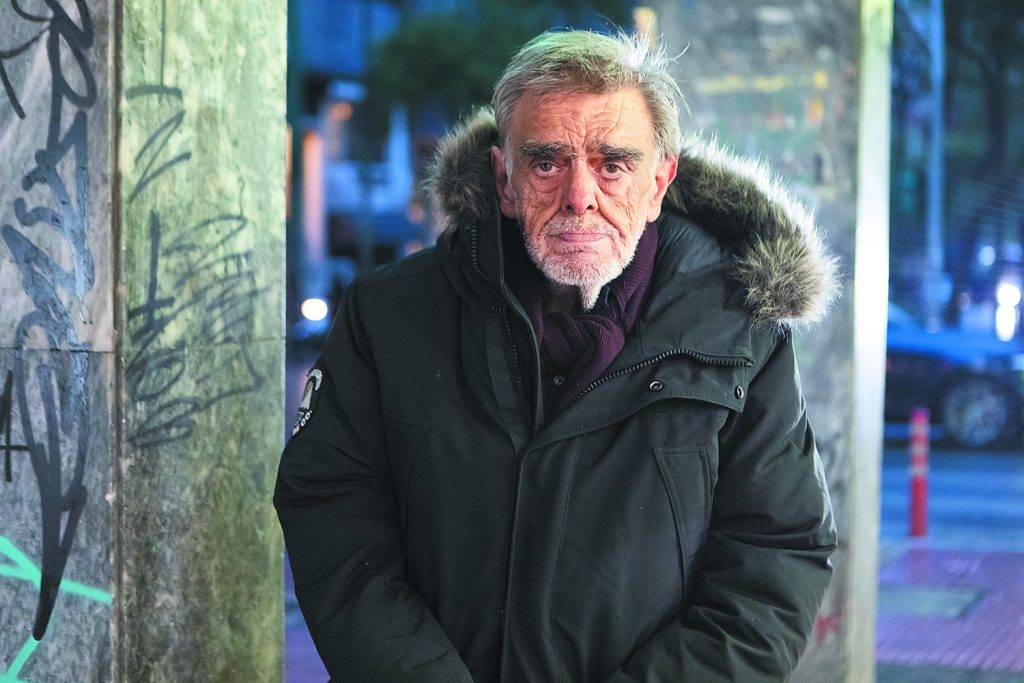
‘I just want a chance to stand on my own again.’ Periklis Vousolinos lives with the hope of finding a place he can afford — and finally leaving the streets behind. Credit: Sissy Morfi.
“I had a large collection of paintings and icons,” he recalls. “It was the home of my life.”
Then, in June, a fire destroyed everything. “It wasn’t arson — the court confirmed that. I was acquitted. But nothing survived: books, furniture, paintings — everything turned to ash.”
He tried to return, to salvage what he could, to rebuild. “I wanted to bring it back to life,” he says. “But it was completely destroyed.”
Today, Vousolinos lives on the street, near Harilaou Trikoupi Street, not far from central Athens.
“I live on my disability pension — 565 euros a month,” he says. “I have psychiatric problems and see doctors occasionally, but not regularly. That money isn’t enough for rent or medication. I take antidepressants to sleep, but sleep rarely comes. I don’t feel safe.”
He’s searching for a small studio apartment, something affordable — “around 200 euros a month, just to start again.” Despite everything, he hasn’t lost his faith. His neighbors are trying to help him find a home.
“I’m a man of God,” he says softly. “I hold no grudges. People are like bees — each carries the weight of another. I just want a chance to stand again. A place to sleep. A glass of water. A little light.”
A City’s Hidden Citizens
Homelessness in Athens is not just a matter of poverty; it is a reflection of the city’s invisible wounds — economic crises, migration waves, mental health gaps, and the quiet erosion of family structures once thought unbreakable.
In the rain-soaked corners of Omonia Square, the alleys of Exarchia, the marble walkways near Syntagma, and the shaded parks of Piraeus, a parallel city survives — a city without addresses, yet filled with lives, stories, and dreams of shelter.
For most Athenians, these people remain unseen, shadows at the edge of the crowd. But for A.M., Efi, Dimitris, Panagiota, Ioanna, and Periklis, Athens is not just a city. It’s their entire world — a world still searching for light and air.