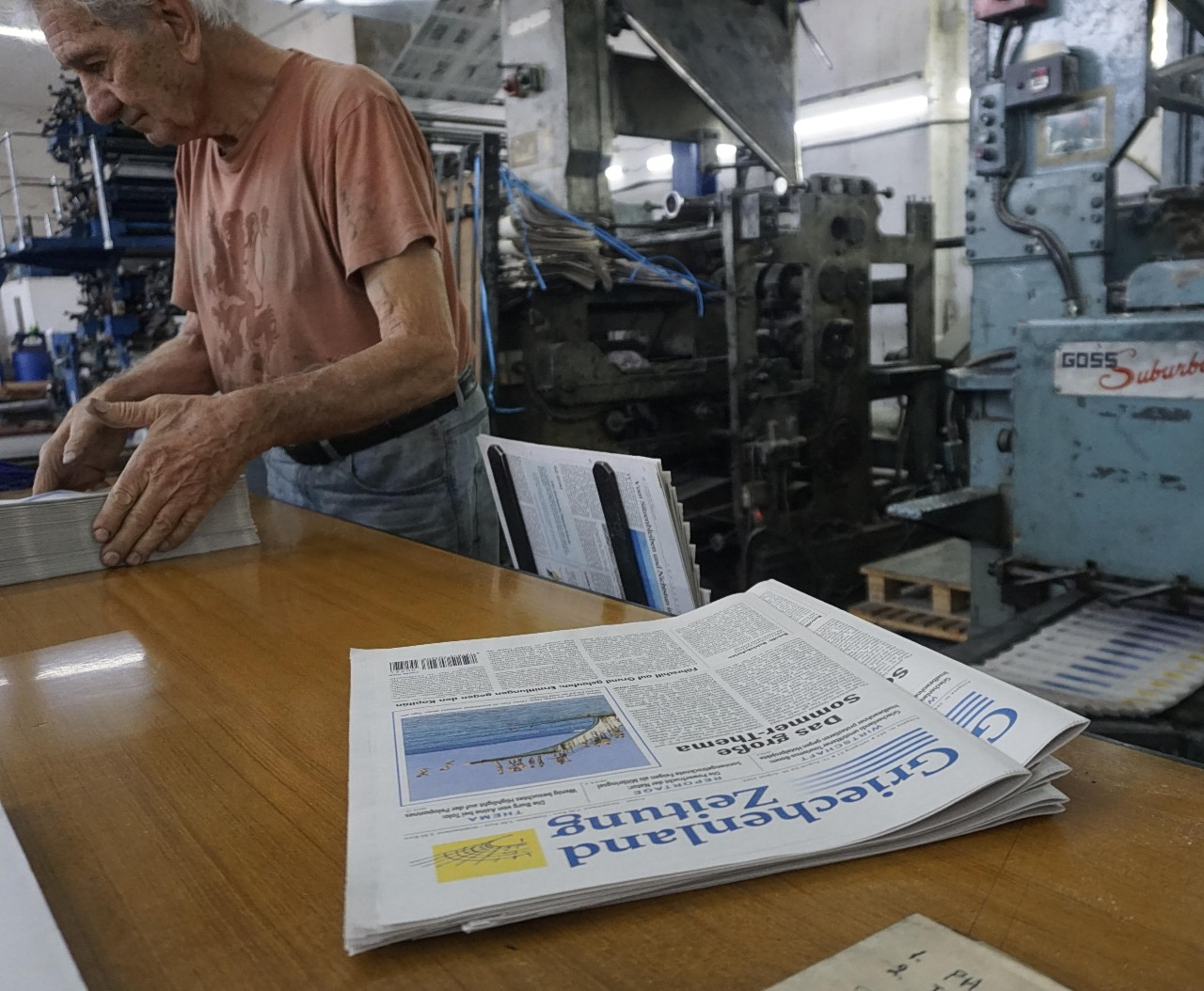
When the two journalists began their work twenty years ago, the world of German-Greek relations still seemed intact. But dark storm clouds soon gathered. A period began that Germany’s friends of Greece – especially the Germans living there – recall only with reluctance. Greece’s sovereign debt crisis and the German interventions that accompanied it soon came to dominate the country’s political life, and before long its social life as well. In Greece, Germany became a collective scapegoat.
When Jan Hübel and Robert Stadler, two seasoned journalists – one from Germany, the other from Austria – look back today on the occasion of the 20th anniversary of their Griechenland Zeitung and the paper’s 1,000th issue, the conversation quickly turns to those crisis years and the extraordinary entrepreneurial and editorial challenges they posed. “Every week we struggled to find at least one positive story – even if it was only a single one – that we could publish about Greece,” says Jan Hübel, one of the two publishers.
With their weekly newspaper, Hübel – who has found a second home in Greece – and Stadler, who had previously worked as a correspondent for a Vienna daily in Athens, fulfilled a long-cherished professional dream.
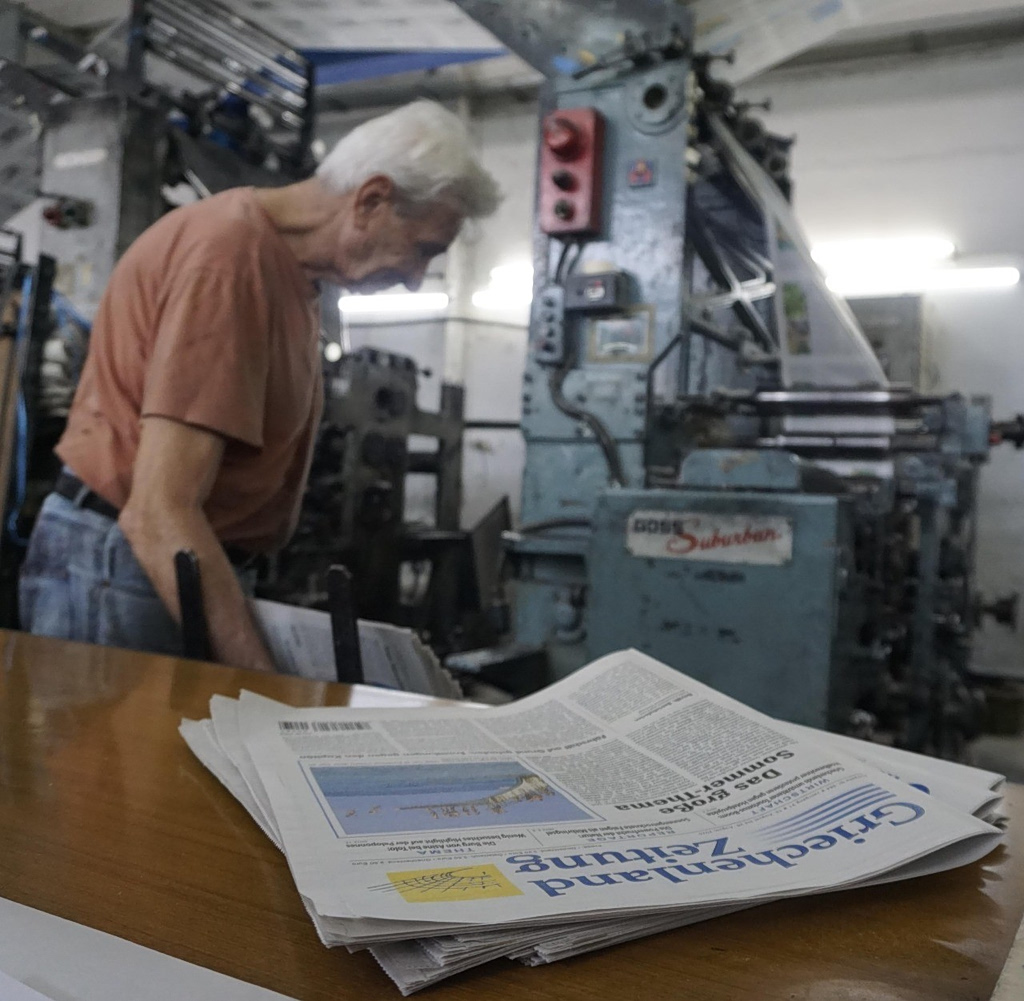
The guiding idea of the project was clear from the outset: the newspaper was to provide an audience interested in Greece with a comprehensive weekly picture of political, economic and social developments – and, crucially, in German. “Greece in German,” Stadler sums up the editorial concept succinctly.
Numerous congratulatory messages have reached the publishers of the Griechenland Zeitung on the occasion of the company’s 20th anniversary. Among those offering their congratulations is the Greek writer Petros Markaris, well known in Germany, who recalls his youth in Turkey in his tribute. “I was born and raised as a Greek in Istanbul. I know from personal experience how important the Greek newspapers published there were for the Greek minority.” What had once applied to Greeks in Turkey, he said, now applied – under entirely different circumstances – to Germans in Greece. Since news about Greece appeared in the international media “only exceptionally, and only when it also affects other countries,” the Griechenland Zeitung, with its systematic coverage, was “particularly important,” said the author, who is popular in Germany for his crime novels featuring Inspector Kostas Charitos.
Applause also came from Germany. The Association of German-Greek Societies (VDGG), the umbrella organization of more than 30 philhellenic associations, awarded the newspaper its honorary prize. A high-ranking delegation traveled to Athens for the occasion, underscoring the paper’s special significance for Greece enthusiasts in Germany.
Over the years, the Griechenland Zeitung has become the most important communication platform for philhellenes in the German-speaking world and for Germans living in Greece – and this under especially difficult conditions. The financial crisis not only shook German-Greek relations; it also hit the country’s print media hard. More than one long-established newspaper did not survive the collapse. “We work every day not to become rich,” Robert Stadler says, capturing the economic reality in a single sentence.
Compared with many other papers, however, Greece’s German-language weekly stands on solid ground. According to its own media data, it is printed in an edition of 10,000 copies, with a weekly readership that at its peak reaches up to 30,000. Over the years, the publishing house has also established itself as a publisher of German-language books related to Greece. Hübel and Stadler point with some pride to more than 50 titles they have released – predominantly translations of major Greek authors, supplemented by contemporary German-language works that appear only with them. What unites all publications is their connection to Greece. This also applies to everyday consumer products that the publishing house has added to its range: olive oil, mountain tea and spices from Hellas enjoy great popularity among Germans as well and, in a side business, contribute to financing the newspaper.
Few industries have been hit harder by digitalization than print media. Accordingly, the internet plays an increasingly important role for the Griechenland Zeitung as well. “The internet didn’t destroy our business; it gave us room to breathe,” Stadler says. While it has become ever more difficult to find the paper at newsstands in Greece and Germany, more and more subscribers now read it online.
Ensuring that the weekly edition is available online every Wednesday or delivered by mail around the world is the responsibility of a small, highly motivated team working out of a side street near Athens’ Omonia Square. Interns are an indispensable part of the newsroom’s daily life. The two desks reserved for trainees are always occupied. Since “learning by doing” is regarded as the key to journalistic training, the young reporters – who usually come from Germany for three-month stints – get their full share of hands-on experience.
Editorially, the small team covers the full spectrum of Greek current affairs, complemented by regular pieces with a German-Greek focus that appear in this density only here. All contributions are original. No other German-language publication reports as comprehensively on Greece as this newspaper.
The information and commentary also serve a purpose that extends beyond the daily news cycle. “With our newspaper, we want to strengthen mutual understanding between Germans and Greeks,” says Hübel, who is married to a Greek woman. The couple, their daughter and co-publisher Robert Stadler form the human backbone of the newspaper. Asked about the most important factor behind their success in what has at times been an extremely difficult environment, the two publishers give a clear answer: “We have no financial backers whose interests we must consider. We are accountable only to ourselves and to our readers.”
Dr. Ronald Meinardus is Senior Research Fellow and Coordinator of Research Projects on Greek-German Relations at the Hellenic Foundation for European and Foreign Policy (ELIAMEP).