Immediately after the 12-day Israel-Iran war, with immense US strikes on Iranian nuclear facilities, the former Crown Prince of Iran, Reza Pahlavi, gave a long news conference in which he described the confluence of events as the ideal opportunity for regime change. Events belied him.
In the decades since the 1979 revolution, Pahlavi has propagated the tenuous claim that he is the leader of the opposition to the Islamic Republic, both inside Iran and in the diaspora.
In the last few years, however, he has forged a relationship with Israel in a bid to accomplish their shared goal – regime change.
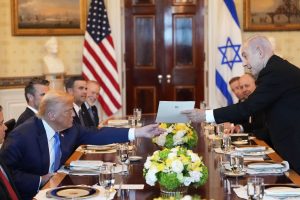
In April, 2023, he held talks with Israeli PM Benjamin Netanyahu, who last August released a video calling on the Iranians to rise up and topple the regime.
Pahlavi hastily called for a referendum, implying the question would be “Constitutional Monarchy or Republic?”
Washington for now does not seem to view him as a viable and credible alternative to the current regime.
What’s in a name? With the Pahlavi brand, a lot
Pahlavi’s name is what has made him the most recognisable opposition figure, but it is a double-edged sword, as the royal background that he carries includes the sins of his father.
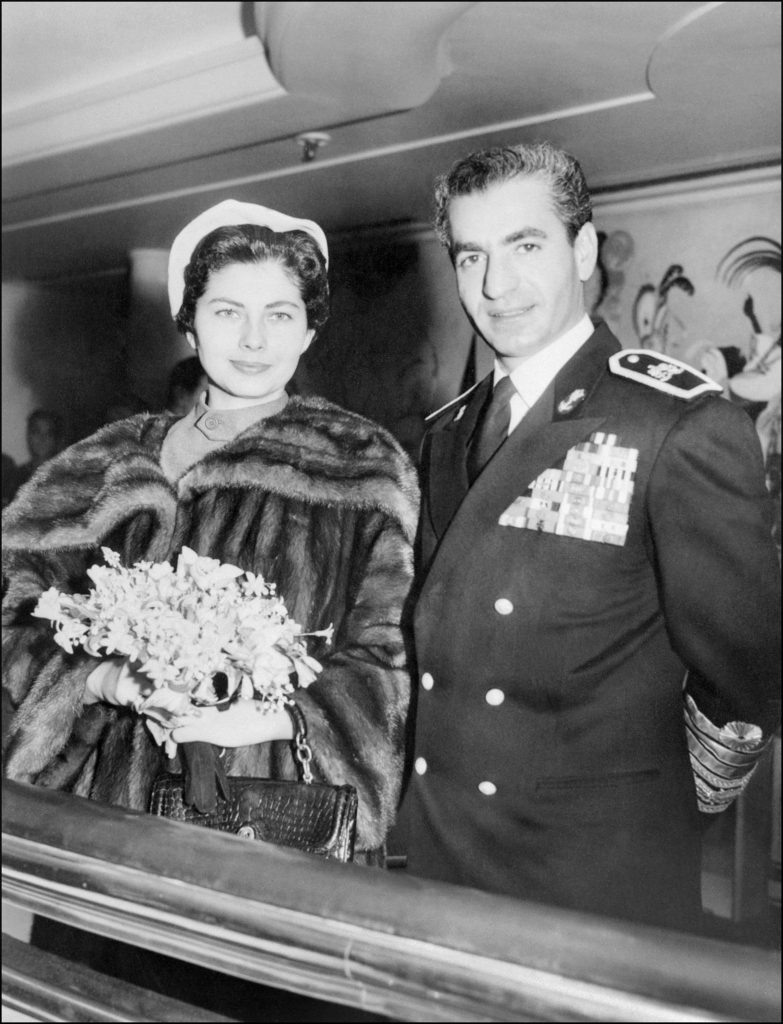
A picture dated March 1953 shows late Shah of Iran Mohammed Reza Pahlavi and his second wife, Soraya Esfandiary in Tehran. /EPA PHOTO-AFP-FILES
The Shah’s was a highly autocratic regime and though many may yearn for the secular society and outward-looking, Western orientation of his era, he exercised absolute rule and dissidents were incarcerated, brutally tortured and executed, as dissidents in the Islamic Republic are today.
SAVAK (“Intelligence and Security Organisation), with its enormous domestic spy network and internationally notorious methods, was widely despised by Iranians and, the acronym has ever since become shorthand for savage oppression.
In 1953, the Shah supported a CIA-backed coup against Prime Minister Mohammad Mosaddegh, who had sought to enormously strengthen parliament and his own powers, and severely curtail the Shah’s political powers (including, crucially, over the military and national resources) and had previously stirred British and international ire when he nationalised the Anglo-Iranian Oil Company, a move that gained him enormous popularity at home.
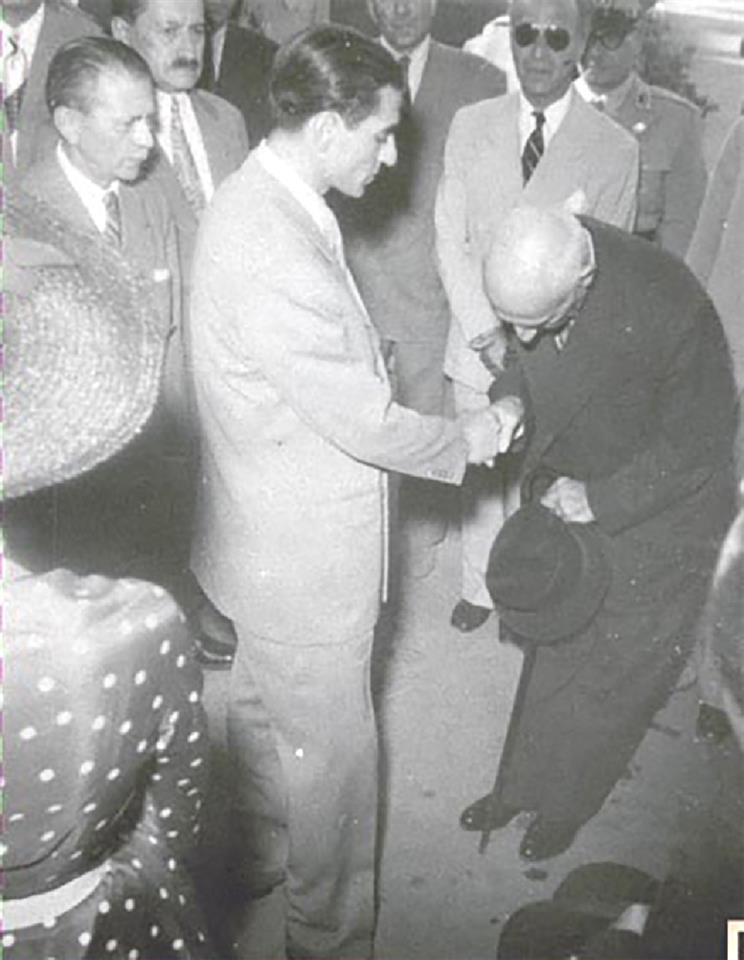
Prime minister Mossadegh shaking hands with Mohammad Reza Shah Pahlavi in their first meeting after Mosaddegh’s election as Prime Minister. /Public domain, via Wikimedia Commons
Amid huge rioting, the Shah fled the country for Rome, only to be reinstated by the CIA within a few days. He claimed that he returned by popular demand
Today, presumably, as the Iranian population seeks freedom and independence, it would not look kindly at the prospect of a rex ex machina, ushered in by the Israelis and the Americans.
Effectively, Reza Pahlavi cannot completely shake the burden of his family history, and does not seem to want to, as he has adopted the symbols of the monarchy, and has repeatedly made clear his desire to become Shah presumably in the framework of a constitutional monarchy. He has appeared to view the leadership of the opposition as a birthright, thus contributing to its fragmentation.
The squandered opportunity of the big 2023 uprising
The huge, unprecedented “Woman, Life, Freedom” uprising triggered by the murder of the Iranian woman Mahsa Amini in September 2022 (because she wore her head scarf the wrong way), became a lost golden opportunity for the fractured diaspora opposition, and Pahlavi’s reluctance to cooperate on an equal footing was reportedly a key factor.

A woman cuts her hair during a protest against the Islamic regime of Iran and the death of Mahsa Amini in New York City, New York, U.S., September 27, 2022. REUTERS/Stephanie Keith

A police motorcycle burns during a protest over the death of Mahsa Amini, a woman who died after being arrested by the Islamic republic’s “morality police”, in Tehran, Iran September 19, 2022. WANA (West Asia News Agency) via REUTERS
Persepolis and Persia’s 2,500 years: A huge financial price tag and political cost
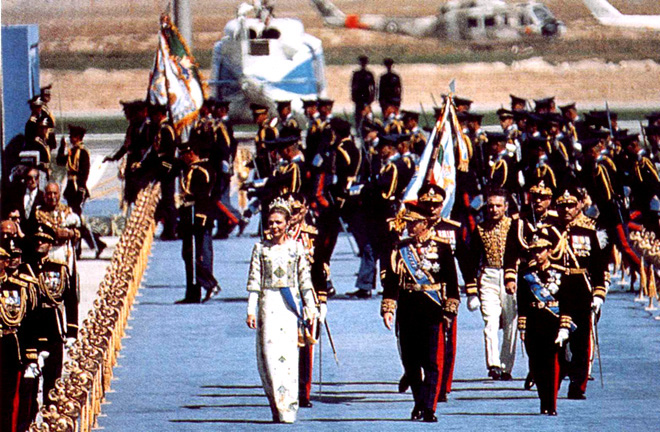
A key turning point in the public’s perception of the Shah was a lavish, hugely expensive celebration of the 2,500th Anniversary of Persia near the tomb of Cyrus the Great in Persepolis, perhaps the most opulent ever – attended by kings and queens, heads of state and government, and other global potentates and notables.
The Price tag, in a country where, in 1971, more than 60% of the population lived below the poverty line (the figure is similar today), was officially declared at $22mn, but Time Magazine, reported it to be $100mn, which today, with adjusted inflation would equal $516-$635mn.
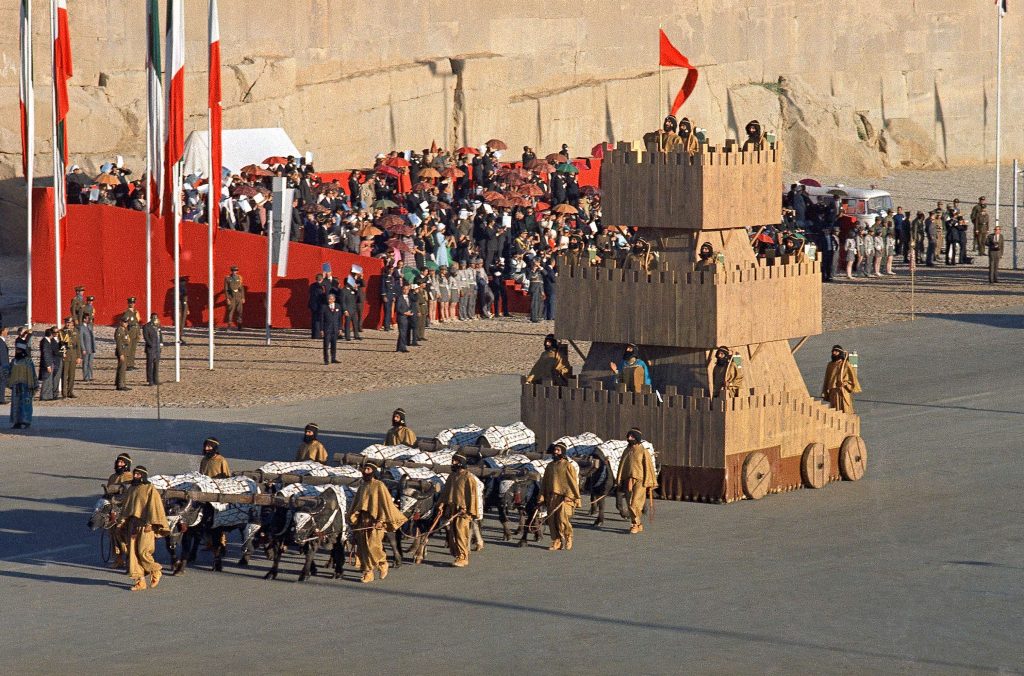
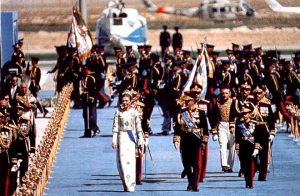
Army troops dressed as Persian warriors of the past, parade before a large gathering of the world’s royalty and heads of state, at Persepolis, Iran, October 13, 1971 to mark the 2,500 anniversary of the founding of the Persian Empire. A huge assault tower is pulled by buffaloes. (AP Photo/Horst Faas)
The Iranian people immediately understood that their monarch was completely oblivious and indifferent to their social needs, but also beset by grandiose ideas about his role, as demonstrated when before the tomb he said, “Rest in peace, Cyrus, for we are awake”.
Clumsy Israeli support
Israel is different. On 3 October, the Israeli daily Haaretz published an exposé revealing that there was indirect Israeli funding of a massive Persian-language deepfake video campaign calling for Pahlavi to be installed as Shah.
The vantage point of Pahlavi’s former ‘chef–de–cabinet’
Few know Pahlavi better than Mehrdad Marty Youssefiani. For nearly two decades, he served as his personal confidant and top strategic counsellor, and he does not mince words in evaluating the efficacy of certain tactics, past and present.
In a rare and exclusive interview with To Vima International Edition, Youssefiani addresses key questions and offers an inside look at the man who would be Shah.
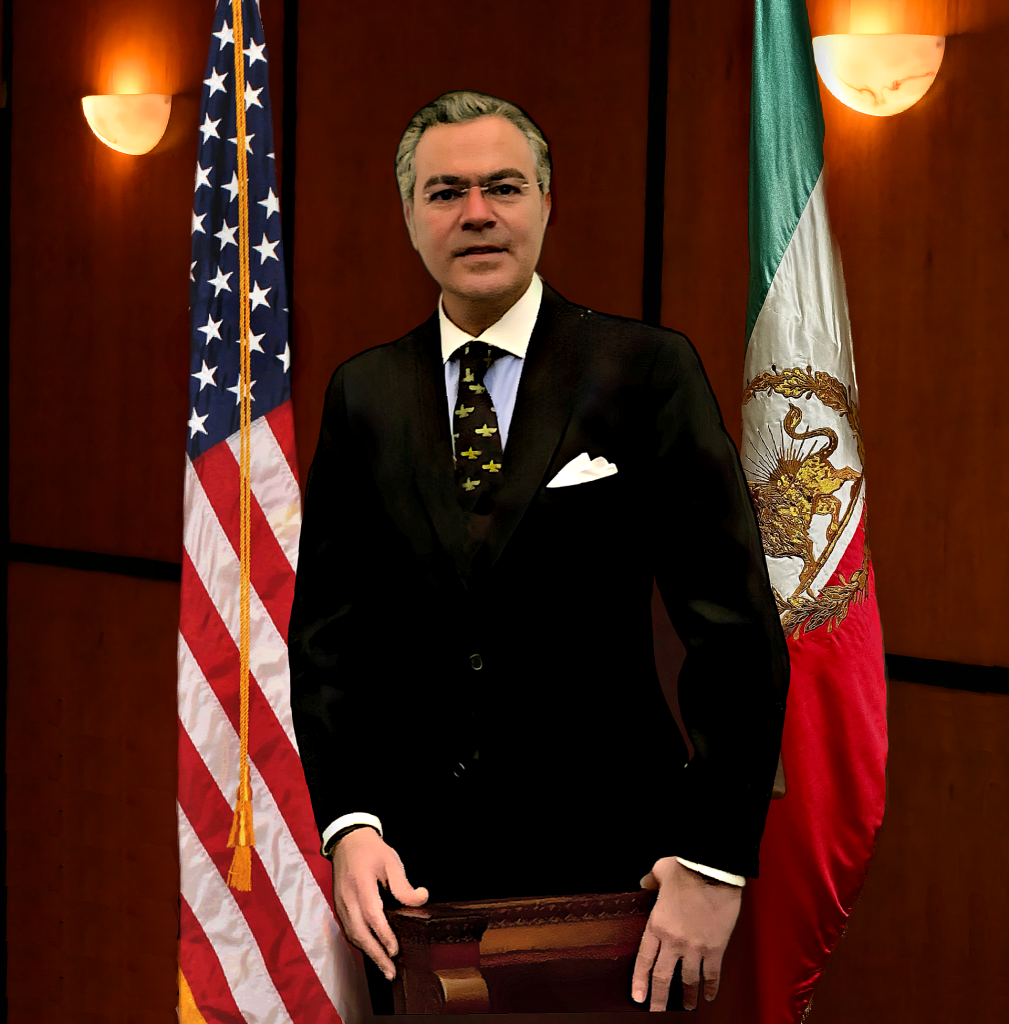
Mehrdad Marty Youssefiani is an international strategic communications professional. A veteran of US and international political and corporate campaigns, he previously served as senior counselor to Iran’s Crown Prince.
Immediately after the Israeli-US bombings of Iran, Crown Prince Reza Pahlavi declared that the world was witnessing Iran’s Berlin Wall moment. He declared the regime was teetering under crushing problems and called on the Iranian people to take the streets. Months later, the regime stands and not a single Iranian took to the streets. Why?
History offers plenty examples of regimes collapsing following military defeat or, as with Iran, a decisive military humiliation and incapacity. But those results, rarely happen during the actual war.
They take time and follow a gradual process of internal unravelling. Despite Tehran’s grand-standing, claims of military capacity, and regional hegemony, within hours of the Israeli attack, the entire Iranian airspace fell (remaining so today).
Within the first hours, Iran’s entire top-tier of military and intelligence command was decapitated with precision and lightning speed, without the loss of a single asset by Israel.
Such devastation rarely cracks open popular uprisings in real time. Instead, it sows seeds of latent instability, inviting the regime to claim the mantle of embattled fatherland and, for a time, to knit patriotic unity from shared humiliation
Patriotism, territorial integrity, and standing up for the motherland are deeply rooted and ingrained in the Iranian DNA. So, in that respect, declaring the war as Iran’s Berlin Wall moment, and issuing commands for Iranians to take the streets to topple the regime — under falling bombs — was counterintuitive, perhaps rushed, ill-advised counsel.
Reza Pahlavi in an unofficial 2023 trip to Israel, held talks with PM Netanyahu and then Minister of Intelligence Gila Gamliel. This suggests a calculated pursuit of an alliance with Israel, and Netanyahu in August, called upon Iranians to rise up. Does Pahlavi expect Israel to topple the Iran regime for him?
The optics of Prince Reza Pahlavi’s visit as a supplicant seeking regime change by foreign hand is misplaced: The trip succeeded in breaking a taboo, for Iranians of all political persuasions, on Israel. It reminded the world and our two peoples that the Perso-Judaic relations are civilizational, deeply rooted, dating back to biblical times. Pahlavi’s message was clear: the animosity of the Islamic Republic is a historical parenthesis, not destiny.
In an October 3 report, the Israeli daily Haaretz exposed a major fake digital (astroturfing) campaign indirectly funded by Israel during the 12 -day war calling for the restoration of monarchy in Iran. Might this indicate Israel’s desire to install Pahlavi as its puppet Shah?
I have no means of verifying that data, but the history of politics and war is written through the dark ink of deception. Iranians have zero tolerance for foreign interference of any sort, and a campaign to push an inorganic solution, not reflecting the deep pluralism and intense debate currently taking shape within Iran, will hurt both the ‘campaigner’ and whoever is being pushed. Israel knows this, as does Reza Pahlavi. So, I would be stunned to discover official governmental backing, or even formal cooperation with Team Pahlavi. Could it have been an isolated initiative by well-motivated sophomores? Most likely.

Reza Pahlavi, the exiled son of the last Shah of Iran, attends a press conference about the situation in Iran and the need to support Iranians, in Paris, France, June 23, 2025. REUTERS/Abdul Saboor
What evidence is there of Pahlavi’s claim of support by an overwhelming majority of Iranians?
There is no dispute that Reza Pahlavi has support in Iran. What exact level his support stands is impossible to gauge. Public opinion is neither stable nor measurable in environments where strong, independent journalism, vibrant political party systems, or civil society activism are systematically suppressed.
Two surveys, in 2022 and 2024, offer glimpses into domestic Iranian opinion. Both conducted by GAMAAN out of the Netherlands and broadly reported on, place Reza Pahlavi’s favourability in Iran at around 31% -39%, a ‘plurality‘ in data jargon, but well short of the ‘overwhelming majority’ mark.
Reza Pahlavi has called for a referendum after the regime collapses, presumably to offer Iranians a choice between a constitutional monarchy and a republic. What arguments are there for them to prefer the former?
History. It is the best arbitrator. There is no question, the Pahlavi era is today viewed with warm nostalgia for its direction towards modernity, economic development, social vibrancy, pride, and rapid advancement. Despite its imperfections, the Pahlavi era today has a net favourability. Especially, when compared to the incompetent, corrupt plutocracy which has squandered our national wealth and embraced terrorism as a state tool to control the region and 90 million Iranians. So, the Pahlavi brand stands on a tall record.
Which specifically are the opposition groups within Iran? Do they represent a coordinated force, and what has been their interaction with Reza Pahlavi?
The Iranian opposition is a mosaic, not an edifice — a multitude of groups ranging from reformists, former reformists turned regime changers, old-guard republicans, ethnic and regional activists, secular and religious moderates, labour and women’s rights advocates. Coordination was elusive, as tactical and ideological chasms persisted. However, today, real contact between these groups is taking place inside Iran, with varying degrees of openness about Reza Pahlavi. Today, in Iran, rivalries, distrust, and ideological roadblocks are methodically being overcome by a very real sense of urgency for a national coalescence rooted in pluralism.
Donald Trump has wavered on regime change, at first not ruling it out, then dismissing it. Do you think the US is backing Pahlavi, with financial support for regime change or otherwise? Can he count on America?
I believe President Trump’s own words, repeating that he “is not looking for regime-change in Iran.” Adding, “I am happy to help make Iran great again,” provided the regime abandons its nuclear program. His alternative is continued pain: maximum sanctions and, if necessary, military action — as he recently exercised.
Remember, also, Trump personally stopped Israel’s targeting of Ali Khamenei, which many believe would’ve triggered regime collapse. Moreover, the Sharm al-Sheikh Accord’s aim to promote regional stability will disfavour “regime change” as an Iran policy option, so long as no serious political alternative to the regime emerges.